 Logout

Editor’s note: As news of the Sept. 11 terrorist attacks spread, The Lutheran staff gathered at the Lutheran Center in Chicago to watch the events unfold. Plans for the November 2001 issue were quickly scrapped to make room for 15 pages of stories about New York Lutherans. As we observe the 25th anniversary of Sept. 11, we look back at that coverage through the lead story by then-editor David L. Miller and selected quotes from the issue.
A city not forsaken
Sorrow and grace weave together in stories of New York’s Lutherans
A kind of “new scripture” is emerging among Lutherans in New York City since the World Trade Center attack, a patchwork quilt of stories revealing how the suffering are connected to God and each other.
As stories are reverently passed from mourners to the merciful, the quilt grows more colorful and complex, but no less troubling.
Each story elicits another just as tragic as the last: the empty chair of a family member who didn’t come home Sept. 11, a coach whose baritone will never again be heard teaching kids, a friend whose smile is now only a photograph gently held, the little girl whose mother didn’t pick her up from school.
As stories are passed, each expands the fabric that now binds formerly disconnected lives into one cloth.
Pastors have become the “story-bearers,” says Stephen Bouman, bishop of the Metropolitan New York Synod. And if their shoulders sag beneath the tonnage of sorrow, they are also lifted by the grace subtly sown into each story.
For whatever else New York is today, it is not a city forsaken. Just ask Bouman.
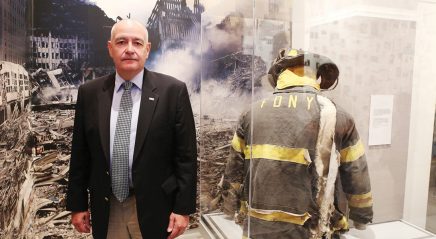
“Even while it was going on, I didn’t feel this horrendous dread. I’d like to think that was because of my faith.” —Daniel Nigro, then chief of the New York City Fire Department and member of Good Shepherd Lutheran Church, Bayside, Queens
Seeing faces
“You see faces as you look into that blasted pile,” Bouman says, having just returned from the smoldering stench at “ground zero.”
But the faces are visible only in his mind. Still, one stands out: Lars Qualben, president of Trinity Lutheran Church, Brooklyn. Lars had assisted his father, Paul, who presided at liturgy the previous Sunday. But now he is gone, one of about 100 slain church members or parents and relatives of Lutheran schoolchildren.
Walking among the ashes at ground zero, Bouman recited the committal service for the dead. “I saw Lars’ face,” he says. “I saw all of them in Lars’ face.
“You see their faces in there, and you want to say, ‘Unbind them! Unbind them all!’ You want to say, ‘Lord, if only you had been here!’ You want to sit in sackcloth in the middle of Broadway and scream.”
“We break one bread and are one body. Let us together seek the healing of the nations. Evil does not overcome evil; it augments it. Christ taught us that.” —Riad Jarjour, then general secretary of the Middle East Council of Churches
As he left the site, Bouman pronounced a benediction over this “holy ground,” calling on God’s mercy for the dead, for the shell-shocked firefighters laboring there and for all whose grief and fear mingle like a dense cloud quieting the city.
Across the East River in Brooklyn, Richard Miller, pastor of St. John-St. Matthew-Emmanuel Lutheran Church, also tries to redeem the day. He scoops up a layer of ash coating his deck. “Sacred ash,” he calls the mixture of cremated concrete, steel and flesh.
He used it to sign the cross on the foreheads of worshipers. The mother of a woman who died on the 98th floor of tower one was among those who came forward to be “marked” with a sign of sorrow and hope.
Ultimate questions
Throughout the synod, such liturgies and prayer services have been filled with people hungry for words that will make meaning of tragedy.
“No one is willing to accept meaninglessness,” says Bill Hurst, pastor of Trinity Lutheran Church, White Plaines, N.Y. “There’s a hunger to know how to relate to God from people who are only now able to take baby steps in that direction.
There’s also “skin hunger,” a tremendous desire to be touched.
Members of Generation X, who make up a large portion of those killed in the towers, also show up in churches and at makeshift memorials citywide. Many with little or no religious background are dealing with ultimate questions of death, evil and God for the first time, their secular value systems shaken.
Bouman’s 23-year-old daughter, Rachel, a Sunday school leader, phoned him from in front of the church before she could go in. “I’m afraid to go in,” she told him. “What am I going to say? Please pray with me.”
Carla McKenzie, a member of Advent Lutheran Church, Elmont, N.Y., was on the 16th or 17th floor of tower one when the plane hit. She will never be able to forget the faces of rescue squads going up as she was coming down, Bouman says.
But he can’t forget her faith. As bodies fell from the sky and people fled, screaming, a woman kept asking, “Where is God?” McKenzie, stopping to care for the woman, quoted Romans 8: Nothing can ever separate us from God’s love. “She had the faith to say God was with them even as they fell,” Bouman says.
Then McKenzie tried to get to her congregation’s school to support teachers as they ministered to children who would soon receive horrible news. About 40 Lutheran schoolchildren lost a parent or grandparent, said Marlene Lund, executive director of the Lutheran Schools Association in New York City.
Grace in the pain
That theme, that God will be found in the pain—not by avoiding or minimizing it—echoes through the stories and sermons of the city’s Lutherans. Easy assurances and glib talk about closure and healing are rejected as falsehoods—or as an unwillingness to be faithful to what the times require.
“I’ve had groups of people ask me to pray for them right there while they’re working [with the remains at the Pentagon]. And I’ve had people ask me ‘why?’ questions. As chaplains, we can’t give answers, but we can help folks grow in their faith.” —Gregory Hager, then a chaplain at Dover Air Force base
Kathy Carpenter, the city’s deputy director for WIC, a government program serving needy women and children, watched with colleagues as the towers collapsed a few blocks from their office window. “The wail came up from the street,” says the member of Advent Lutheran Church, Manhattan. “We were all sobbing and screaming. We knew people were dying in the most horrible way as we watched.
“It was a beautiful fall morning, and here we were holding onto each other knowing people were being vaporized before our eyes. But now what echoes in our heads is the sound of our own screams.
“We’re not ready to hear words of comfort. The most wonderful thing about our pastors is that they didn’t try to make it all better. They didn’t say we’ll all heal. They respected the situation. I don’t know if it will ever come back to normal. I don’t think we’ll ever be the proud, carefree city we were.
“We need time. We don’t need people telling us it will be OK in the morning. Clergy need to listen and provide a framework where people feel safe to breathe and feel what they feel.”
“Help us pray for our enemies, because if we cannot do that, we will never be able to love them. If we are pregnant with hate and revenge, we will surely birth hate and revenge.” —Arlyn Tolzmann, Holy Cross Lutheran Church, Wheat Ridge, Colo.
Carpenter worries about the children, especially those she sees at Advent’s Sunday school.
Advent’s children made a quilt for hope and healing, and they visited a nearby firehouse with flowers. Carpenter said she couldn’t tell who got the most out of the visit and the hugs—the children or the firefighters.
Bearing the weight of these stories takes a toll. “I phone our pastors,” Bouman says. “And the crying starts almost as soon as they hear my voice. But these people are magnificent, so present to what they must attend to, so trustworthy with the stories.
“What they are receiving is a psalm, a lamentation, a kyrie or a gloria—whatever is being experienced. And they add the name of Jesus to it and lift it up as holy story.”
Not wasted
They “share the heat of the day,” he adds, being faithful to what this time is, not what they might want it to be.
But what this quilt of sorrow and grace will be remains well beyond the horizon. This unfinished story will be shaped in part by millions of prayers, by the faithfulness and ingenuity of New York’s Lutherans—and by the depth of commitment of Lutherans far beyond the city.
“The last thing we are is abandoned,” Bouman says. “It astounds us, the level of care we are receiving from around the church.
“The city at its best can be a sign of shalom [God’s peace]. So we will keep pestering God. … God is not the destroyer, but we know that God wastes nothing—and God won’t waste this.”