 Logout
When families crossed a bridge and paid tolls every Sunday to worship in Arabic, Charbel Zgheib noticed.
As pastor of Salam Arabic Church in Brooklyn, N.Y., Zgheib met families who had relocated to Staten Island, N.Y., but continued returning for Sunday worship. Three or four families regularly made the trip, he said, while Arab businesses and grocery stores were opening on Staten Island and more families were finding the borough an affordable alternative to Brooklyn.
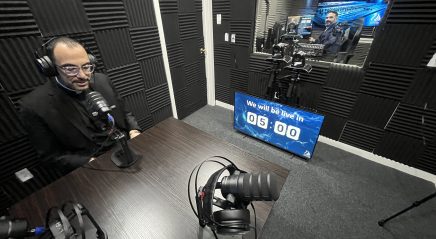
Zgheib was hearing from another group too: listeners to Salam Radio Station, the Arabic-language Christian radio ministry he launched earlier this year from Christ Lutheran Church on Staten Island.
“Why don’t you hold worship services on Staten Island?” he recalled listeners asking. “It’s closer to us.”
Khader Khalilia, program director for ELCA Arab and Middle Eastern Ministries, had been seeing the need too.
“For several years, I have prayed that there would be an Arabic-speaking worshiping community on Staten Island,” said Khalilia, a member of the ELCA Ministries of Diverse Cultures and Communities team. “As Arab families moved from Brooklyn, Queens and other parts of New York City, and as new immigrants made Staten Island their home, the need became increasingly clear.”
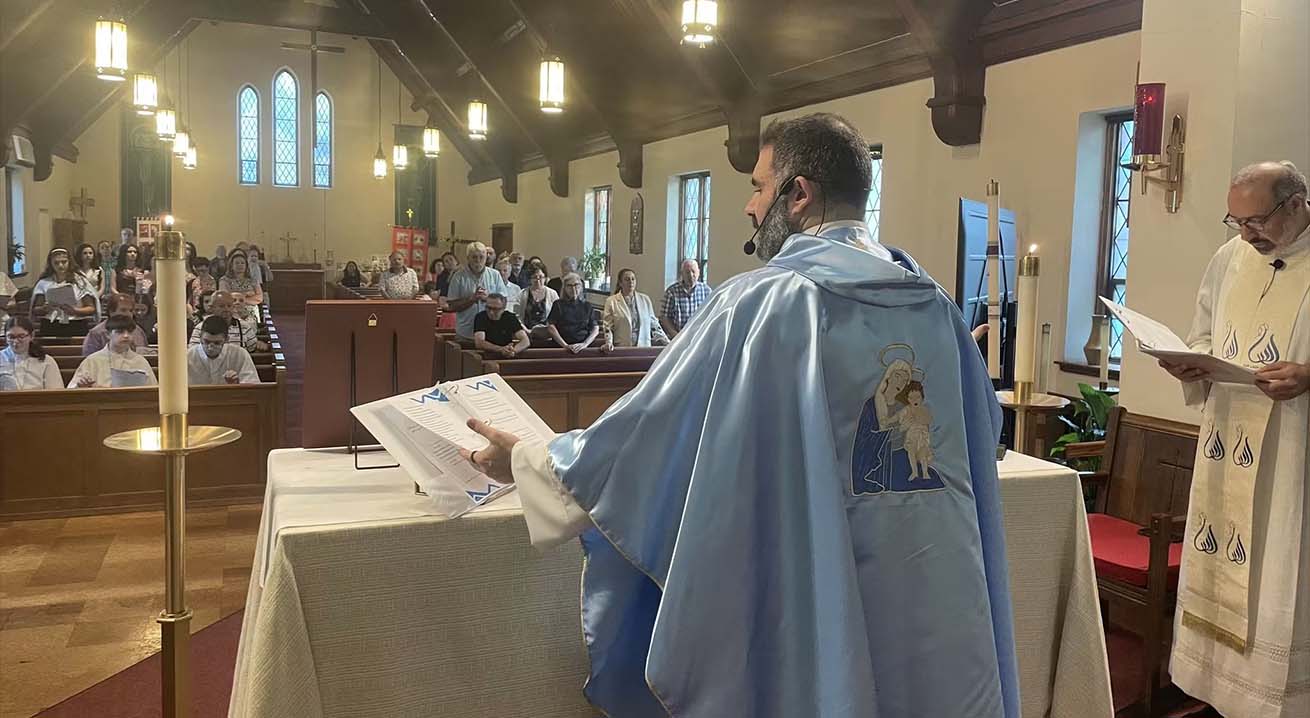
Zgheib’s response was launching Our Lady of Salam, an Arabic-language worshiping community sharing space with Christ Lutheran. That relationship is intended to be more than shared space: the two communities are exploring what it means to share ministry, prayer and Christian witness while maintaining their distinct cultural identities.
After two preliminary services drew about 60 to 70 people, the community officially celebrated its beginning Aug. 15, on the feast of Mary, Mother of God. More than 100 people attended, Zgheib said, bringing traditional dishes from their countries of origin to share.
Worship was primarily in Arabic, with a bilingual Arabic-English program allowing non-Arabic speakers to follow along and helping younger people who may speak the language but not read it fluently.
Khalilia called Our Lady of Salam “a beautiful expression of the church meeting people where they are,” offering a place to worship, belong and pass on faith to the next generation.
“It feels like a new Pentecost”
Those attending Our Lady of Salam come from Catholic, Orthodox, Protestant and other Christian traditions. “The thing that gathers them here is the Arabic language, because they want to worship in Arabic,” Zgheib said.
That ecumenical character extends into the surrounding community. Wolfgang Laudert, pastor of Christ Lutheran, said neighboring Roman Catholic and Coptic Orthodox Christians have welcomed the launch of Our Lady of Salam.
“In so many ways, we are embodying and witnessing to the whole church what it means and looks like to be church together,” he said. “It feels like a new Pentecost!”
Christ Lutheran, he added, receives the worshiping community and Zgheib “as a gift, as Christ in our midst.”
Though Our Lady of Salam is an ELCA community, its worship incorporates practices familiar across Middle Eastern Christian traditions, while maintaining its Lutheran theology and liturgy.
There are icons and incense. Zgheib bakes bread for communion rather than using wafers. Hymns honoring Mary draw from Catholic and Orthodox traditions and helped inspire Our Lady of Salam’s name.
He describes liturgy as something people can “feel, can touch, can smell, can see,” connecting worshipers with cultural and spiritual memories while exposing others to traditions they may not know.
“This is how we evolve with people,” Zgheib said, adding that worship should be “culturally sensitive to people” while preserving essential theological and liturgical elements.
For many immigrants, belonging to a church can extend beyond Sunday worship to rebuilding community after leaving behind family, familiar churches and social networks. Our Lady of Salam seeks to provide a spiritual home where cultural identity and faith can coexist.
“In so many ways, we are embodying and witnessing to the whole church what it means and looks like to be church together.”
Zgheib is developing a Sunday school, youth group and women’s group. Five committees provide opportunities to participate in spiritual life, outreach and digital ministry, stewardship, operations, and coordination with Christ Lutheran.
The structure is intentional. Zgheib doesn’t want the community to depend entirely on its pastor. “I’m creating a system that if I leave, it’s not for me,” he said. “I’m creating leaders.”
For Zgheib, that process begins with a question: Do you belong?
He isn’t referring to denomination. He wants those who call Our Lady of Salam home to see themselves not simply as attendees but as participants in sustaining the community.
“We belong to this community,” he said. “We pray together and worship together as one Christian family, rooted in the Lutheran tradition and enriched by the diverse traditions our people bring with them with a deeply ecumenical spirit.”
That sense of belonging is particularly important as the new community faces one of its most complicated challenges: sustainability.
“What is the church able to provide for its people?”
Zgheib has come to recognize a cultural difference that can be mistaken for an unwillingness to support the church.
Many American Christian congregations operate on a familiar model: members pledge, tithe and donate, and those contributions sustain the congregation’s staff, worship, buildings and ministries. Giving can create a sense of shared ownership.
“[Members feel that] ‘This is my church—I’m putting part of my money’” into it, Zgheib said, describing the model.
But many Middle Eastern immigrants grew up with a different relationship to the institutional church. “Back home in the Middle East, churches have power, and they have money, and people were poor,” Zgheib said.
Churches may operate large institutions and social ministries that assist people who need food, housing or other support. The flow of resources is often understood as moving from the church to the people. That understanding doesn’t necessarily disappear after immigration.
Our Lady of Salam is building a congregation while introducing some members to an unfamiliar model of congregational stewardship.
For some worshipers, Zgheib said, the question isn’t “What should I give my church?” but “What is the church able to provide for its people?”
Visible signs of the wider church’s resources—buildings, institutions, synods and other structures—can further complicate efforts to explain why a small local ministry needs support from its members. Our Lady of Salam is therefore building a congregation while introducing some members to an unfamiliar model of congregational stewardship.
Zgheib is careful not to make that relationship transactional. He doesn’t charge parishioners for marriages or funerals. Instead, he strives to connect stewardship with transparency, trust and belonging.
Giving doesn’t always mean money. Members can teach Sunday school, volunteer or help develop ministries. “I want them to take ownership of this ministry,” Zgheib said, “so that they feel that, ‘Oh, this is our ministry. We decide what we need.’”
More than one way
Our Lady of Salam joins Salam Arabic Church in Brooklyn and Salam Radio Station as interconnected parts of Zgheib’s ministry. The three ministries, which make up make up Salam Ministries, represent different expressions of the same mission: a historic congregation in Brooklyn, an emerging worshiping community on Staten Island and a digital ministry capable of reaching Arabic-speaking Christians far beyond either location.
Together, they offer several points of entry into a community centered on Arabic language and worship.
But this model requires resources. Our Lady of Salam is simultaneously providing worship, developing leaders, establishing programs, building trust and cultivating a model of stewardship among people who may have arrived with a different understanding of how churches are sustained.
For the wider church, understanding ministries such as Our Lady of Salam may require looking beyond familiar measures of participation and giving. An immigrant congregation can be doing the work of evangelism, cultural preservation, leadership development and community building while still developing the financial practices established congregations may take for granted.
Zgheib knows the question of sustainability can’t be avoided. “We need to speak the truth as well,” he said. “Church is not always about money, yet we have a huge challenge for sustainability.”
For now, he seeks to build that sustainability through belonging—one volunteer, leader, family and act of stewardship at a time.
And the invitation remains simple: “Ahlan wa sahlan (أهلاً وسهلاً).”
Welcome.