 Logout


The ELCA set sail into the 2020s on the winds of a fresh priority announced by then-presiding bishop Elizabeth Eaton: to become an “innovation denomination.”
Two months into the first year of the decade, the value of innovation became even greater as congregations developed strategies and tactics for conducting their ministries amid COVID-19.
Throughout the pandemic and as it subsided, innovation—which comes from the Latin word innovāre, meaning “to renew”—became woven into the fabric of the church, say staff of the ELCA Innovation Lab, which launched in January 2020.
“As we move forward, we’re more of an infrastructure piece, kind of like IT, that’s infused throughout everything we do as a church, throughout the whole church culture,” said Maddie Fairfax, innovation services coordinator. “We equip leaders with a culture of collaboration—we don’t innovate in isolation, it’s always in collaboration with another team, a congregation, a synod. We have tools to match with their ideas, and it’s fun to see things come together.”
Fairfax and seven others comprise the lab’s staff, known as the Innovation team. The staff has a rich diversity of both expertise and geography, with at least one person based in each of the four continental U.S. time zones.
“If you need someone from the Innovation team in your area, we can get someone to you.”
“Where we are located, we’re so well positioned to serve the needs of the church,” said Rahel Mwitula Williams, interim executive director of Innovation and the director of the team’s Innovation + Ideas group. “If you need someone from the Innovation team in your area, we can get someone to you.”
In addition to Fairfax and Williams, the Innovation team includes Phillip LaDeur, director for organizational innovation; Rebecca Payne, program director for the Congregations Lead Initiative; Tyra Dennis, program manager for Innovation + Ideas; and ELCA innovation partners Aditi Shukla, Emilie Moravec and Sarah Weaver.
“Our entire unit, we are very big on listening,” LaDeur said. “We have a design-thinking tool kit that enables church leaders to listen to the people they serve in new ways—that’s a throughline for all of our work.”
“Design thinking” refers to tackling challenges with a human-centered approach that stresses empathy, creativity and iterative testing—and empathy begins with getting to know those you’re serving. For example, Williams, Dennis and Payne recently visited nine synods to build relationships and learn about innovative work already underway.
“We wanted to get a better perspective and share what the Innovation team is all about,” Payne said. “Part of what we want to do is serve as connectors. If congregations in multiple states are doing different, innovative things that the other probably doesn’t know about, we can connect them and help form churchwide networks.”
A wide reach
The Innovation team’s reach is far, wide and deep. Among the groups it has partnered with are the Northern Texas-Northern Louisiana Synod on a metaverse project involving a faith-based virtual reality platform; the North Carolina Synod on an outreach campaign to invite congregations to consider “green burial” ministries that explore the intersection of end-of-life care and environmental stewardship; a Colorado congregation on a preaching festival that provides opportunities for feedback and leader training; an Indiana congregation that co-hosted a multicultural Christmas cantata; and ELCA AMMPARO on a Conversations on Immigration pilot project centered on what congregations need to support their migrant ministry programs.
“The AMMPARO team could have put together a resource and it would have been good, but they took the time to talk to ministry leaders to find out what works and make the resource more impactful,” Moravec said.
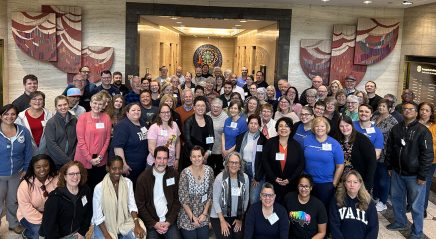
Last fall, Innovation worked with ELCA Young Adult Ministries to host the first-ever Innovation Leadership Academy in Chicago, under the theme “Design for Belonging.” The goal was to bring together lay leaders to learn, dream and design ministries that move people from the margins to the center.
“We invited folks from all 65 synods into a space at [Lutheran Center] where they could learn to be innovators, to learn what it looks like to innovate for people who don’t look like you, to combine forces to innovate together to go outward to bring others closer to Christ,” Dennis said.
In addition, when the team learned that better facilitation skills were an organizational need within the ELCA, staff members took a course in facilitation fundamentals—focused on how to get from a problem identified by user needs to a solution designed by the users. The team now offers its own facilitation course and has trained more than 100 people from across the church.
“We get to innovate with them, dream with them, collaborate with them.”
Another resource brokered by the Innovation team is a research recruitment tool in the form of a large, diverse database of people who have consented to being surveyed. The database can be filtered in a range of ways—for example, by geography or lived experiences—that make it easier for congregations and synods to gather information about the communities they seek to serve.
“We want to make it easy to listen to new people, and integrated technology helps us to do that,” LaDeur said. “We’ve also learned that 1 in 7 users of the ELCA website are people new to the ELCA and looking for information, and that’s really helped shape the work of the website redesign,” which recently launched.
In cyberspace and on the ground, the fuel that runs the Innovation team’s engine is a desire and ability to help people turn insights into actionable ideas that can be tested and implemented. Each project adds to the layer of trust that continues to build among the team and the groups it works with.
“People come with an idea, they pitch a proposal, they need funding and they also need resources, help in getting from A to B,” Dennis said. “If it fits with the criteria of ‘new and useful’ and aligns with the mission and values of the ELCA, we can potentially fund them and work with them and move them forward.”
There have been short-term, one-and-done projects, Dennis said, and some that last up to three years. Sometimes the team will work on a synodwide project, sometimes it’s five people in a congregation.
“We get to innovate with them, dream with them, collaborate with them,” she said. “They want to come to us because they know these are folks who will get their hands and feet dirty and walk through the project with them to the other side.”