 Logout
Editor’s note: This reflection is part of a series by chaplains in the Network of ELCA Colleges and Universities (NECU) about the ways in which God is at work on NECU campuses.
Benedict Owusu and I met at the Ole the Viking statue on Augustana University’s campus during move-in day last year. We were both brand new to Augustana, excited and nervous about what it all meant and how the year would go. We had both moved from familiarity to new surroundings. I hold dear to my heart how God brings people together through human connection to build God’s kingdom.
The Holy Spirit is always up to something transformative. Moving to a new place transforms us spiritually because of the reliance it takes to embrace the unknown. Owusu bravely boarded a 23-hour flight from Kumasi, Ghana, to Augustana’s campus in Sioux Falls, S.D., uncertain how a Midwestern state would react to a young man from Ghana.
The reality of leaving home sank in while he was trying American pasta on the flight. He still remembers it as an unpleasant meal, realizing that U.S. cuisine uses a lot of cheese and very little spice. The weather, even in August, was cold compared to home, and nothing would prepare him for the winter wind of the Great Plains. However, if you meet Owusu, you’ll quickly learn he is a resilient spirit. He rides his bicycle year-round to a grocery store where he can buy ingredients to make dishes from home that provide some comfort in an unfamiliar place.
Another reality that set in for him was how different everyday life would be. “Back home, you live in communities where you never go without someone stopping in to visit or borrow something they need, and privacy was not a thing—you often didn’t lock your door,” Owusu said. “With five siblings, [I was] always in the presence of a family member or friends. Campus life took getting used to; it was quiet, and the culture was one of American individualism. I was used to seeing children playing outside all day after school and people in conversation with neighbors outside. It was lonely the first few months.”
Out of curiosity, I asked Owusu what made him choose Augustana from the 10 U.S. universities to which he had applied. (He got into all of them on the strength of his academic achievements.) He laughed and said, “Mount Rushmore.” Growing up, he was inspired in school when he learned about the history of U.S. monuments. Unfortunately, when he visited Mount Rushmore in person, he found it didn’t live up to his expectations. We both laughed over the disappointment, but he found the beauty of the Black Hills and the Badlands to be majestic.
“Don’t give up”
Owusu’s greatest hardship came when he was working in Sioux Falls. He was serving food for a public event, and a man from the area yelled at him loudly enough for everyone to hear, refusing to stand in Owusu’s line. The experience hurt him profoundly. “Other than the color of my skin, what could this man hate about me?” he asked.
After the incident, he isolated himself and stopped leaving his room after class. He wondered if everyone felt this way and if it would happen again. He worked through the experience by drawing on his faith, through prayer and conversations with God, and confiding in his mother, to whom he is close. He also spoke with Augustana’s Office of Faith and Spiritual Life for pastoral care to process what had happened and learn how to work through it. Because Owusu’s faith is so important to him, he felt most comfortable sharing what had happened with spiritual care staff on campus.
“Talking to others helped me come out of my room and not give up,” he said. “While there are people in the world who will use hurtful words, there are many people who are kind and truly care.”
He found God in the people who cared—friends, family, the ones who show up during hardship and help you through a hard time. The experience has deepened his faith, he said, and he still takes time daily to talk to God. He shared something his mother had told him: “God’s love knows no bounds.” This expression from Ghana helped him remember that God’s love will get us through, that it is unavoidable, empowering and for all people; there are no boundaries to God’s love.
He found God in the people who cared.
From this experience, Owusu has gained wisdom to share with his international peers on campus. “First, don’t give up—you will miss out on the good that can happen,” he said. “I almost went home in the first month, and now, looking back, I feel at home at Augustana. It got better, and I met so many remarkable people I would have never met before. There are so many good people at Augustana and friends that I never thought would be so supportive. My friend Francisco calls me daily to check in and see how my day went.
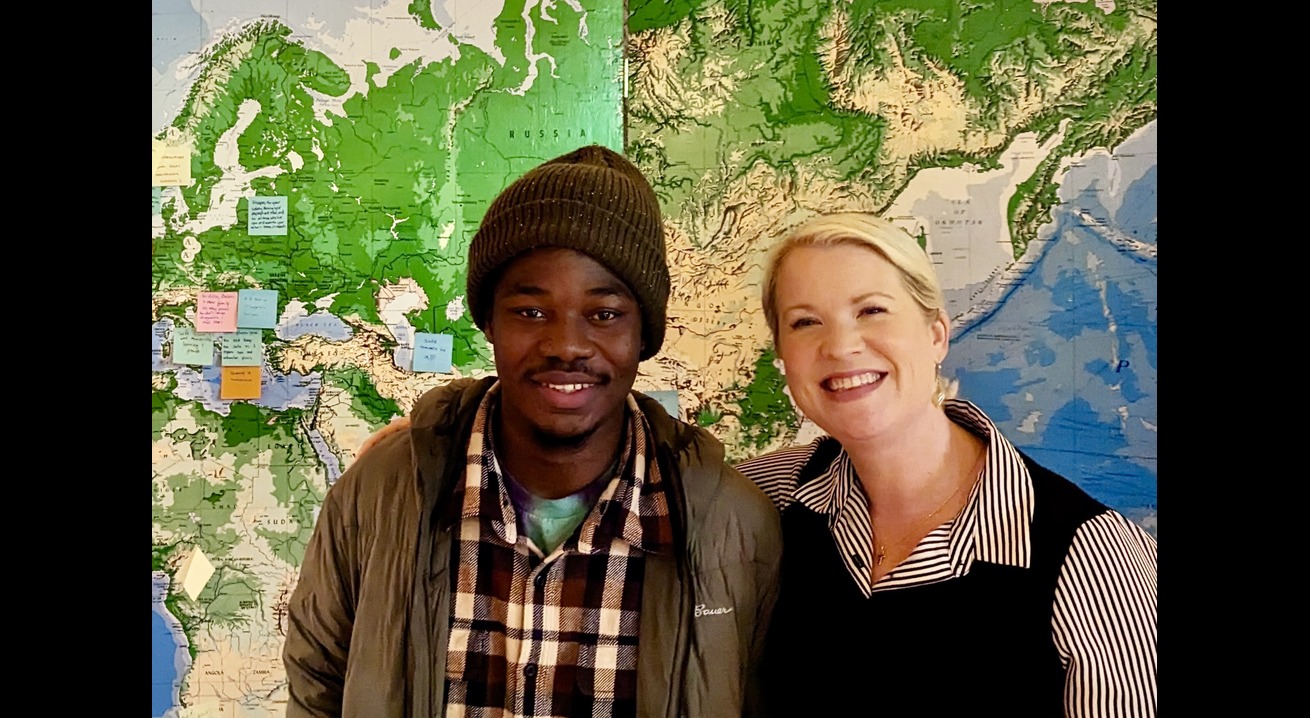
“Augustana grows on you, and I have no regrets. One of my favorite people is Suzanne [Miller], in the International Programs Office, who knows everything about everything, every currency from every country. She will sit with you and have coffee and talk. The world map in the office is a comfort to see and talk about. With people in and out of the office, laughter and talking, it feels like a home away from home.”
As a new campus pastor, I feel close to God in my conversations with Owusu, and I’ve learned through his eyes what it means to be an international student here. He has reminded me to not give up on my own journey. With his inner strength, strong faith, and kind and thoughtful personality, he is a gift to all lucky enough to call him a friend. I haven’t had the joy of meeting his mother, but I know she would be proud of him.
Not everyone will understand who you are, but we can get through our hardships with the Holy Spirit guiding us. When I reflect on my serendipitous meeting with Owusu at the Ole statue, I know the Spirit was at work.