 Logout

Editor’s note: ELCA Racial Justice Ministries offers a variety of free resources that are available for digital download on the ELCA website.
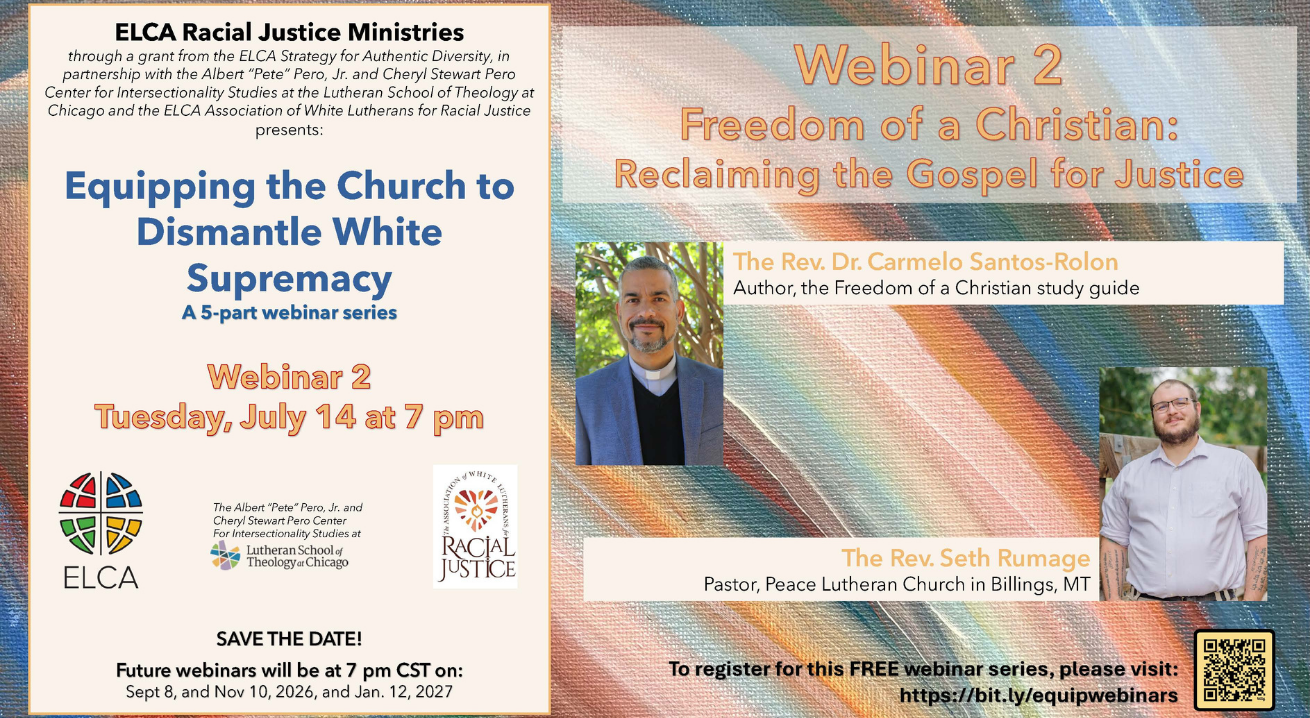
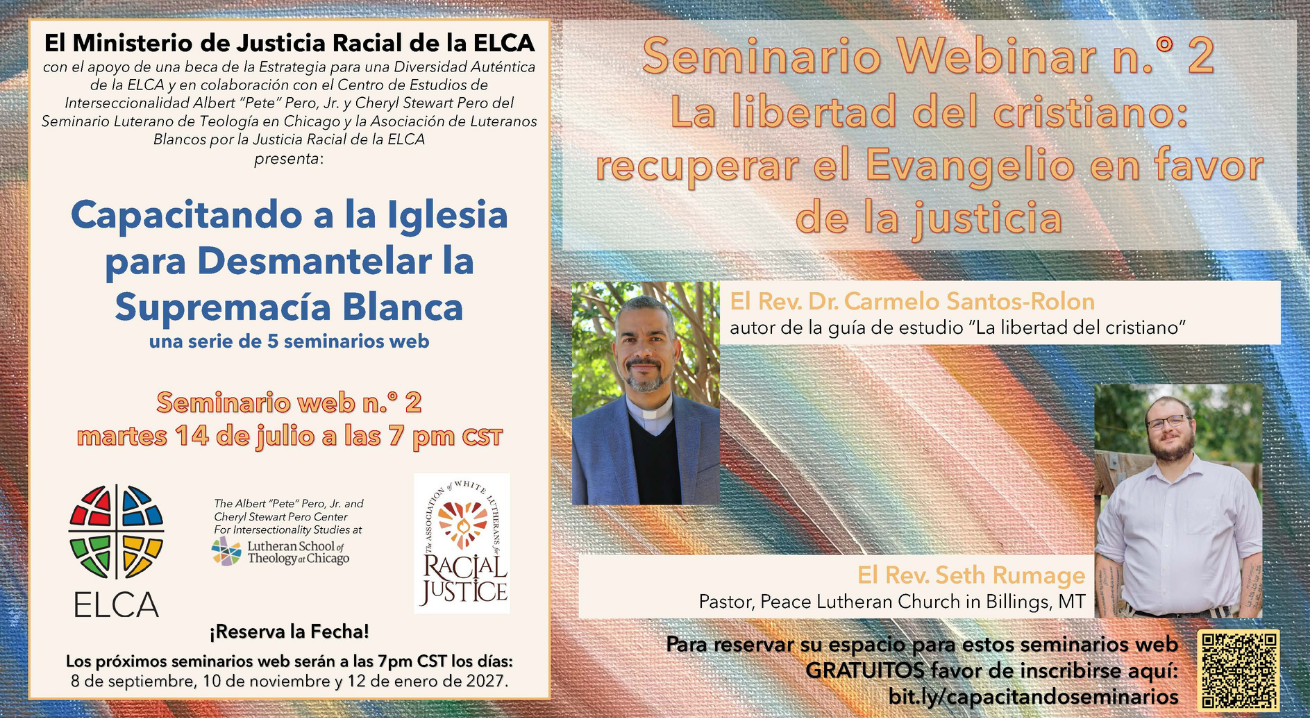
The next webinar in this series, “Freedom of a Christian: Reclaiming the Gospel for Justice,” is on Tuesday, July 14 at 7 p.m. Central time. For more information and to register, visit the event webpage.
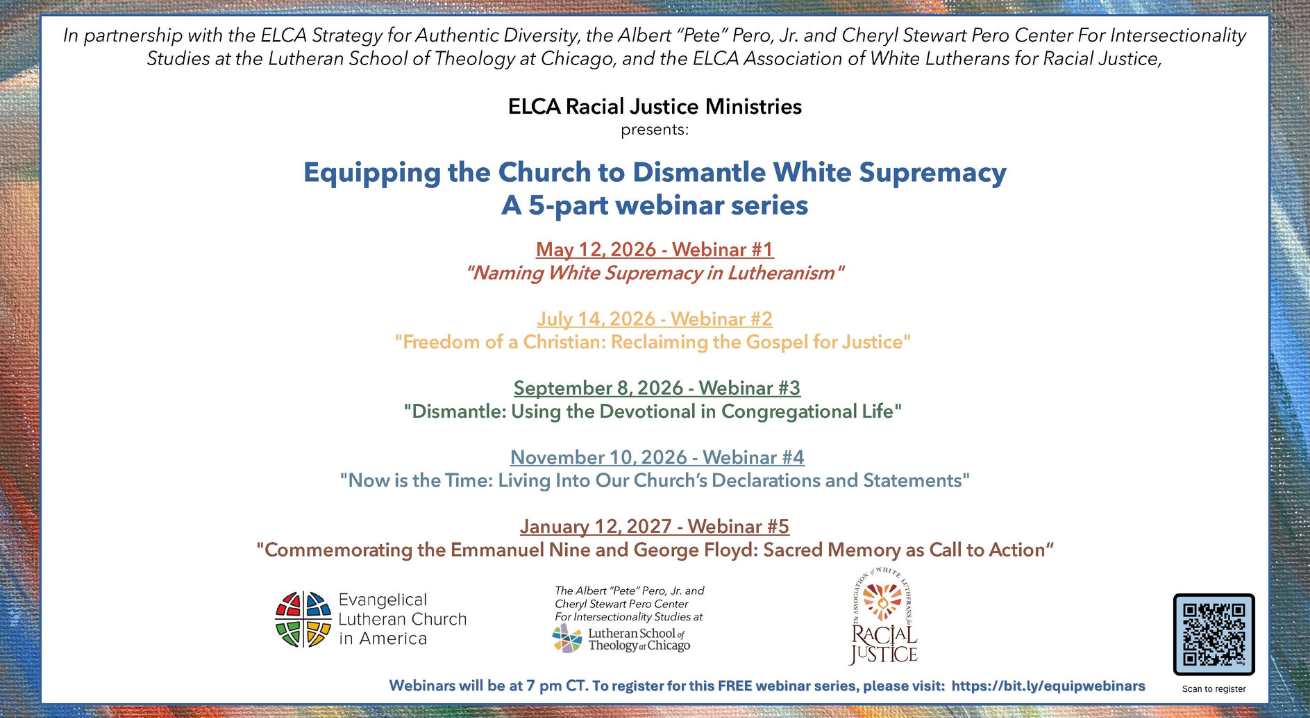
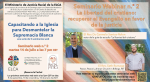
Through a grant from the ELCA Strategy for Authentic Diversity, ELCA Racial Justice Ministries, in partnership with the Albert “Pete” Pero, Jr. and Cheryl Stewart Pero Center for Intersectionality Studies at the Lutheran School of Theology at Chicago and the ELCA Association of White Lutherans for Racial Justice, is hosting a five-part webinar series, “Equipping the Church to Dismantle White Supremacy,” from May 2026 through January 2027.
The first webinar in the series, “Naming White Supremacy in Lutheranism,” focused on defining white supremacy and examining its presence in society and the church, both historically and in the present day. Keynote speakers were the Robert O. Smith, vice president and dean of academic affairs at the Lutheran School of Theology in Chicago, and James R. Thomas, retired associate professor of church and ministry at Lutheran Theological Southern Seminary of Lenoir-Rhyne University. A recording is available.
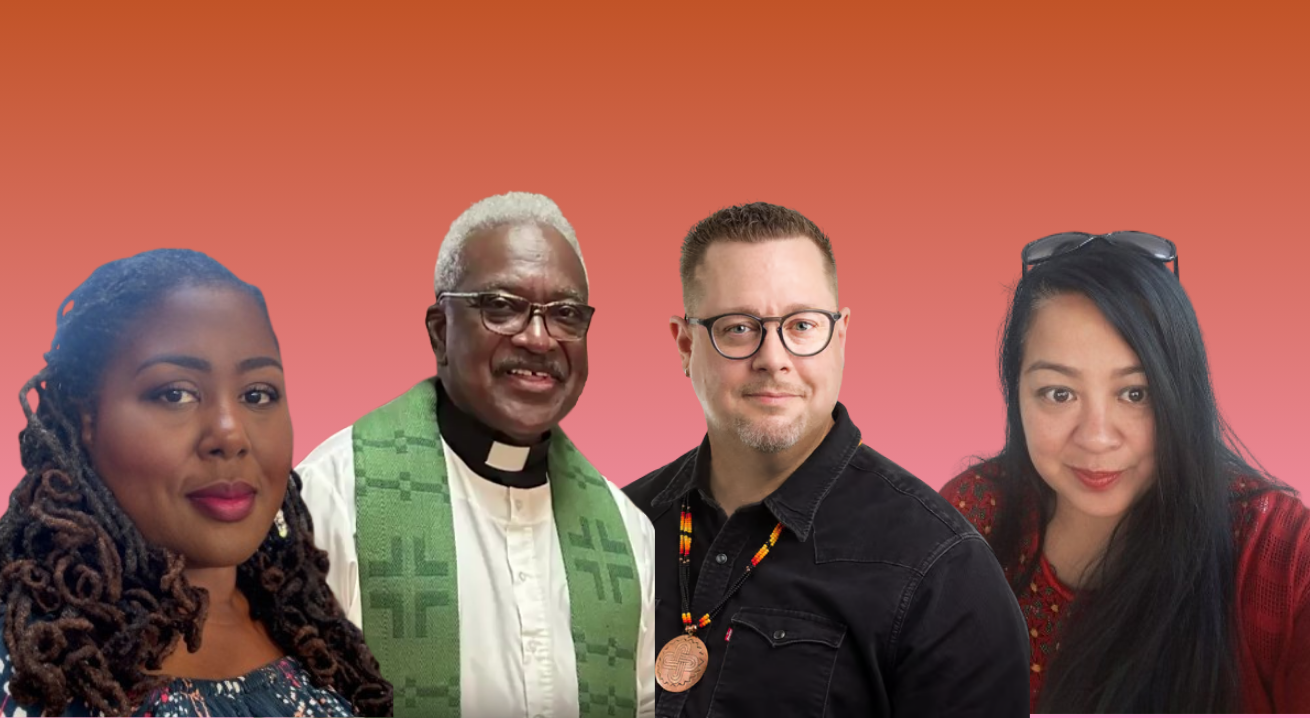
We spoke with Smith and Thomas, along with webinar series coordinators Jennifer De Leon, ELCA director for racial justice; and Christina Montgomery, ELCA racial justice manager, about the series and why this work matters.
Interview responses have been edited for length and clarity.
Why was it important to start the webinar series by laying the foundation for understanding white supremacy and how it has been, and continues to be, present in society and our church?
De Leon: We felt it was important from the beginning that people understand what we mean by white supremacy. Anytime we do workshops or education sessions, we start with common language, common understanding. We all speak English, but depending on where you come from and your lived experience, words can mean very different things. We wanted to make sure that, before people engage with any of the resources, they understand this is a system. It’s not about overt racism or the Klan or things that people can recognize as “in-your-face” racism. White supremacy is a system, it’s an institution, our norms and our cultural assumptions. It shapes our society and our church in ways we don’t even recognize. To make sure that we faithfully engage in dismantling it, we need to understand the language.
Thomas: White supremacy is a historical and systematic reality that has shaped Lutheran bodies in the United States. Lutheran theology places significant emphasis on confession and repentance. Before meaningful change occurs, there must be an honest acknowledgment of sin, both personal and institutional. Examining the presence of white supremacy is part of that process of truth-telling. The ELCA has acknowledged that Lutheran churches in the United States benefited from and participated in systems of racial segregation and exclusion. Understanding this history is necessary for honest reflection.
White supremacy is not merely a historical phenomenon. Patterns established in the past continue to shape who we are as Lutherans. We are asked to consider how these dynamics still operate within the church.
We hope people understand why anti-racism work is considered a matter of faith, discipleship and institutional accountability.
Smith: Until we understand the dynamic of white supremacy, we don’t fully understand the world in which we live, and therefore we have a limited understanding of God’s will within our context, what we are called to be and do.
Whiteness, as it functions in the United States, is a category that serves to drain people of their distinctive identities. To understand oneself as white, you have to forget all the aspects of your own past and your family’s lineage that make you distinct. Whiteness is a category of forgetting. It’s a category of homogenizing.
I obviously present as white, but I’m a citizen of the Chickasaw Nation, and I’m very proud of that heritage as well, and all the complications that come with it. It’s not a simple identity. Whiteness tells us not to have any curiosity about our neighbor. One of the very important steps of defeating white supremacy is complicating and defeating the concept of whiteness itself so it can’t be weaponized against other people.
How do you encourage potential webinar attendees to be open to learning about the influence of white supremacy and why it’s important to equip the church to dismantle it when their gut reaction might be, “Here’s another chance for us to apologize for being white”?
Montgomery: This is not about assigning personal guilt or shaming individuals for being white. Rather, this is about understanding the systems and histories we have all inherited and participate in, whether consciously or unconsciously.
The goal is not condemnation but liberation and healing for the whole church.
This work invites us to reflect on how our traditions, practices and structures may unintentionally or intentionally exclude or harm others and how we can more fully embody the inclusive love and justice of Christ, especially as Lutherans. Framing the conversation around discipleship, growth and faithfulness can help people move from defensiveness to curiosity and engagement.
Thomas: Some white people hear the term “white supremacy” and immediately assume they are being personally accused or shamed because they are white. Productive conversation usually begins by addressing that fear directly and reframing the purpose of the discussion. This is not about assigning guilt to people. It’s about self-work. It is about understanding systems and how they work in and through people. It’s about how the church is shaped by our racial assumptions and how we can be faithful disciples today.
We did not create the structure we inherited, but we inherited those structures and we benefit from them. Lutherans already practice confession without shame. Every Sunday we acknowledge that we have sinned by what we have done and by what we have left undone. The church’s examination of racism should be understood in the same spirit.
Smith: It’s really time for us to do what [Martin] Luther said: to tell the truth. The theologian of the cross calls a thing what it is. We need to have that level of frankness in our congregations and throughout our society. It’s never my intention to make somebody feel bad for who they are, who their parents were. What we need to do, however, is tell the truth about what our position has been in society. If we ignore those things, we’re not properly reading the signs of the times and not properly discerning God’s will for who we are and how we operate with our neighbors.
When we complicate the question of whiteness, we have an opportunity to say, “Is that all of who you are or is there more? Is there a more complicated story that just white?” That’s where we have an opportunity to connect with others in this society.
In what ways can we help open people’s perspectives to show and prove the power of more subtle white supremacy—not the overt Jim Crow laws but something hidden and harder to define?
De Leon: Having concrete examples and lived experiences helps, because we can reject overt racism, but we struggle to see how norms around leadership, worship styles, communication, beauty standards, theology and decision-making can privilege whiteness as the default.
We can invite people to ask questions: Whose voices are centered? Whose history is told? Who feels like they belong without needing to adapt?
Can I go to church and start clapping, or will everyone turn and look at me like, “Why is she clapping”? Well, because this song is from Latin America, and it’s rhythmic and I get into it. Why do I have to adapt? How can I just be myself and be accepted?
Subtle white supremacy often shows up through assuming what is normal, what is professional, what is appropriate. Storytelling, listening to marginalized and oppressed communities and reflecting on institutional practice can make it more visible.
Thomas: A challenge in discussing white supremacy is that many people associate it only with cross burnings, lynchings, segregation laws, separate but equal education, housing discrimination or racist language. If those are the only examples we use, people may conclude, “I don’t do those things, so this doesn’t concern me.” A more faithful approach is to help people understand that white supremacy functions as a cultural system of assumptions about whose experiences, perspectives, histories, leadership and norms are considered standard, normal or authoritative.
A church may say everyone is welcome, yet in its public worship, its images, traditions and assumptions reflect only one cultural experience.
Fish do not notice water because they have lived in it all their lives. Likewise, people often do not notice cultural assumptions that have surrounded them since birth. The goal is not to condemn people for breathing the air they inherited. The goal is to become aware of it
so that we may make faithful choices.
Smith: For us to exist in a racist society doesn’t rely on any one person’s attitudes about people who have a different skin tone than they do. We’re very conscious of visual forms of racism, but we face a level of structural racism that hides behind color blindness that says, “I don’t see color,” which is a way of ignoring the structural inequities in society. So even though we’ve often moved past that form of overt, person-to-person racism, structural racism is still very much with us.
We can get into the things that are hidden and harder to define when oppressions are overlapping. This is where concepts like intersectionality, coined by Kimberlé Crenshaw, can help. What is it like to live as a queer, Black, trans woman? What is that particularity of life? How do law and policy not serve that person in the same way it serves somebody like me?
That’s where, within the structures of the ELCA, we need to be very conscious that our norms have been shaped historically. Seminaries, for instance, are working to reshape [themselves] from models designed to serve usually young, single, white men. We are still struggling to overcome the structures of our policies to ensure that people of all types can enter into theological education. That’s when you really have to dig into your policies and structures to make sure that everyone is welcome and as likely to succeed as anybody else.
What does truth-telling look like? How do Lutherans tell the truth about themselves and the context in which they operate?
Montgomery: Truth-telling for us Lutherans, and I think also especially for us Lutherans of color, means honestly examining our history, our theology and institutions in light of the gospel. It means acknowledging both the ways the church has worked for justice and the ways it has participated in harm, exclusion, colonization, racism and silence. For us, truth-telling is not about self-condemnation. It is about accountability and integrity.
Truth-telling also means listening to the experiences of those who have been marginalized and, more importantly, believing those experiences, even when they challenge our assumptions and our understanding.
Thomas: For Lutherans, truth-telling begins with examining ourselves in the light of God’s word and God’s grace. Lutherans are positioned for this work because confession is already at the heart of our theology and worship. Truth-telling asks, “What have we done? What have we failed to do? What have we seen but not acknowledged? What have we benefited from without questioning?”
Truth-telling means listening carefully to the experiences of others. Black Lutherans, Indigenous Lutherans, LGBTQIA+ Lutherans, immigrant communities, other marginalized voices within the church.
Listening does not automatically mean agreeing with every interpretation. It does mean taking those experiences seriously enough to learn from them.
We’re going to hear some very hard things and the room may not feel safe at all, but we have to learn to listen to other voices.
A distinctly Lutheran contribution is the conviction that we can face uncomfortable truths, because our identity rests in God’s grace rather than our moral perfection. Because we are justified by grace, we do not need to deny mistakes. We do not need to defend every aspect of our history. We do not need to fear what truth may reveal. The gospel frees us to be honest. Truth-telling is one expression of that ongoing repentance, a willingness to stand before God, one another and history with honesty, trusting that God’s grace is sufficient for whatever truths we discover.
Smith: The entire Lutheran tradition is telling the truth about ourselves and telling the truth about God. We are both sinners and saints at the same time, and God has declared that God loves us and accepts us just as we are.
Here in the United States, I think it’s important for Lutherans to recognize that we have made extremely strong contributions to social welfare, especially in terms of educational opportunities and health and immigrant life. But we’ve also benefited from a society that is structured along the lines of white supremacy because most people in our denomination have been assimilated into whiteness. In some ways we’ve been made complacent. And we haven’t always then been on the front lines challenging the injustices and structural inequities we should be. I think there’s a double truth there. It’s a both-and.
As Lutherans, our goal is to serve our neighbor to the best possible extent that we can. We make sure that every effort is made to help the poor, the downtrodden and the harmed. In our society, racial analysis is a central tool that can help us identify who that is.
When we seek to be more diverse and representative in our congregations and worship services—using different worship styles, languages, music—how do we avoid the pitfalls of cultural appropriation or tokenism?
De Leon: Avoiding cultural appropriation or tokenism requires relationships—real relationships—humility and a willingness to share power.
Diversity shouldn’t be reduced to simply adding cultural elements into worship without meaningful engagement with the communities from which they come. If you’re playing a song that’s from the Caribbean that’s upbeat, it shouldn’t surprise you if someone wants to clap when they hear it played in your worship space. Are you interacting with someone from that community when you’re bringing in music, litany or cultural practice? Are you researching? Are you reading? Are you truly reaching out to these communities, even if they’re not in your church?
Congregations are invited to build authentic relationships, invite leadership and guidance from people within those communities, and approach multicultural ministry with respect and reciprocity.
It’s also important to recognize that authentic diversity is not about performance or optics. It’s about transformation.
We should ask if diverse voices are shaping decision-making, theology, leadership and community life, not just appearing occasionally, not just as window dressing, not just as decoration.
Thomas: Without relationships, diverse worship elements can feel decorative or performance. Who is present and who is leading? Are we including a culture? Are people from that culture helping shape the worship? Singing a Swahili hymn occasionally is different from building relationships with African Christians who help teach the congregation its meaning, context and spiritual significance.
Tokenism occurs when a congregation highlights a culture only on special occasions, like Black History Month, Latino Heritage Month or reading the lessons in other languages once a year. The message becomes: your culture is welcome as a guest appearance. A healthier approach is to weave diverse voices throughout the church year so that they become part of the congregation’s normal life.
The question is: How can our worship more faithfully witness to the reality that the body of Christ is larger than any one culture?
Smith: If our intention is to bring diversity in to fit within the structure already in place, if we’re unwilling to undo “the way we’ve always done it,” then we’re not truly welcoming. There is no “our” space. It’s God’s space.
That multiplicity of perspective and voice is the center of critical race theory. My belief, after studying that movement, is that the church needs to go headlong into that commitment, that other perspectives, voices and stories are not just welcome but essential. Without them, we are incomplete as God’s people.
Authentic diversity says, “We want you to bring your whole self.” That’s who God loves: our whole selves, not just this homogenized, sanitized version of identity.
If you could share one reason why it’s important for Lutherans across contexts to attend and promote this webinar series, what would it be?
Montgomery: It equips the church with practical tools, theological grounding, and a shared language for engaging with racial justice faithfully and effectively. Dismantling white supremacy is not peripheral to the church’s mission. It’s central to how we live out the gospel, especially in community. We believe this series helps our leaders and our members across the church to engage in this important calling together.
De Leon: It’s also about healing. The more we know, the more we can heal. Everyone suffers under white supremacy, not just those who are oppressed but white people as well. The more we learn about it, the more we unpack it, the more we can dismantle it, the more we can truly live in the shalom of God, creating that peace here.
Thomas: This webinar series equips leaders and communities for effective witness in a diverse world. The church’s mission is strengthened when it understands how race, culture, power and belonging affect its ministries and relationships. It can help leaders recognize barriers to inclusion and create communities where all people are welcomed, valued and empowered to serve.