 Logout
Editor’s note: This article is an excerpt from the e-newsletter “Stories from Your Nebraska Synod.” Used by permission from the synod, Tic Tac Toe Marketing and Erick Hill.
On a Monday morning not long after a small wooden structure appeared along the sidewalk at Messiah Lutheran Church in Ralston, Neb., Erick Hill stepped outside to see if anyone in the neighborhood had noticed. Inside the prayer box, the pastor found a handwritten card from an aunt, asking the congregation to pray for her niece who was struggling in a broken home. She carefully wrote out the situation, entrusted the card to the little box and walked away, trusting that someone would actually pray.
Members did what they promised. They lifted that child and her family in their intercessory prayers during worship the next Sunday.
A few days later, Hill checked the box again. Another card. This time, it was a thank you from the aunt: “You really did what you said you were going to do.” She had watched worship online, heard the prayer spoken aloud, and needed the congregation to know how much that faithfulness mattered.
“For me, that’s why we do what we do,” Hill said. “People are putting their trust, their faith in us to follow through. In a world where churches aren’t always as trustworthy as they should be, they need every little bit of evidence that they can be.”
The prayer box began with a conversation in the men’s group. “We take on Bible studies, book studies, all sorts of things,” said Neil Smith, a lay leader. “One Sunday we were talking about rituals of the church, especially confession.”
One group member, who had grown up Catholic, shared how much he missed the active, embodied practice of confession. That led to a bigger conversation about what it means to bring our burdens before God—not just silently but in community.
“In the middle of all that, Stan, who usually sits and listens, spoke up,” Smith recalled. “He said, ‘We should put that out in the parking lot where [community] members can participate.’”
The prayer box “invites us into a different kind of conversation with our neighbor.”
Smith heard that comment as more than just a nice idea. A home builder by trade, he began looking up designs and sketching out possibilities. Over the next several weeks and months, a handful of men gathered to build. Some showed up with tools and time; others contributed cash or materials.
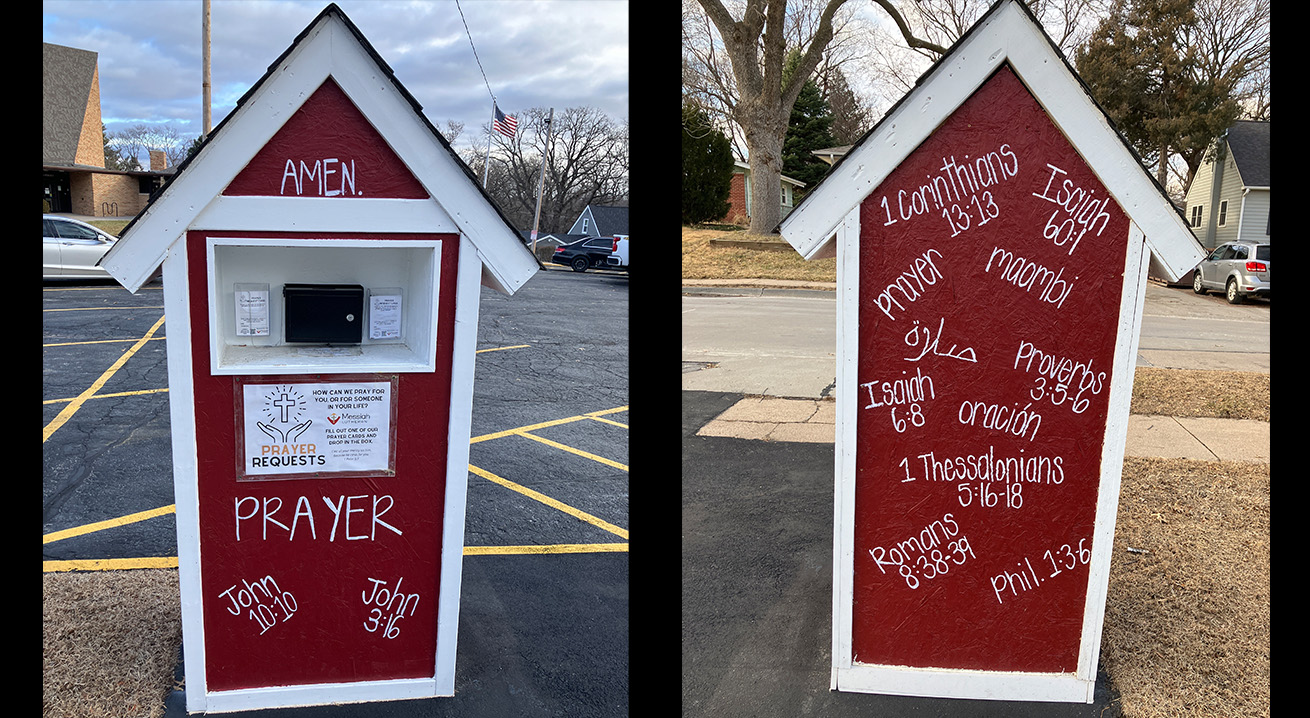
What emerged was more than a little wooden box. It’s a visible, physical invitation for the neighborhood to bring their prayers to God—and to know that the people of Messiah will carry those prayers together.
The box sits adjacent to the sidewalk at the edge of Messiah’s parking lot—close enough to the church to feel connected but clearly meant for the community.
“We wanted it to be more than just a slot in a wall,” Smith said. They made it big enough to feel like a small “outpost” of the church. They painted Scripture passages on the outside—verses that members said were important to their prayer life. They added the word “prayer” in multiple languages to reflect the neighborhood’s diversity.
The box also includes a clear invitation to leave prayer requests; a promise that these prayers will be lifted up every Sunday in worship; and a QR code linking to Messiah’s website.
“It’s us putting our footprint beyond just the walls of the church,” Hill said. “People may drive by and never walk inside. But the box says: we’re here, and we’re listening.”
“Prayer is foundational”
For Hill, the prayer box is not a one-off project. It’s part of a much larger reimagining of what it means to be church in this time.
“We’re getting ready to celebrate our 70th anniversary,” he said. “If we’re going to be around for the next 70 years, it’s going to depend on how well we integrate ourselves into the community—our neighbors, small businesses, nonprofits, schools.”
Like many congregations, Messiah has wrestled with declining numbers and the temptation to simply “keep the programs going” and hope people show up. “I keep telling the congregation: the people you want to minister to are here,” Hill said. “They’re just not necessarily in the Sunday school rooms. They’re in your neighborhood. They’re down the street. They’re in the schools.”
The prayer box, he added, “invites us into a different kind of conversation with our neighbor.”
It also keeps prayer at the center of everything else. “How can we expect our congregation to start a grocery store, launch a laundromat or create affordable housing if we don’t truly understand the magnitude of the God we worship?” Hill asked. “Prayer is foundational. It’s how we remember that all things are possible through Christ, and that we’re not doing this work alone.”
“I hope the box becomes a beacon not just for the community but for our congregation. A reminder that we can step out into the community in simple, faithful ways. It doesn’t always have to be some huge event.
For Smith, the prayer box is as much about obedience as it is about outreach. “I think that’s where I’m at in my faith journey right now—making sure that as God drops something in, we respond, not just by saying, ‘Oh, that was interesting,’ and then moving on,” he said.
The project wasn’t quick or smooth. There were moments when the partially built structure sat untouched. Weeks when the painting didn’t get done. Times when it could easily have been abandoned.
“That’s how I know it came from God,” Smith said. “Because as it hit those valleys, God kept putting it on our hearts, and we kept stepping forward. We don’t have to do everything. God does the heavy lifting. We just get to be his hands and feet at particular points in time.”
For now, the responses in the box have been “positive but slow.” A few cards. A few stories. A beginning. Hill planned to spend an afternoon outside by the box in the spring, inviting passersby into prayer and conversation. “Even if I just pray with one person, that counts,” he said.
And he is already thinking about a “phase two”—smaller versions families could take home and place in their neighborhoods, or even mobile prayer boxes that go to community events.
“I hope the box becomes a beacon not just for the community but for our congregation,” Smith said. “A reminder that we can step out into the community in simple, faithful ways. It doesn’t always have to be some huge event. Whatever God calls you to do, you listen, you respond, you take action. And then you let God multiply it.”