 Logout
St. James Lutheran Church, Portland, Ore.
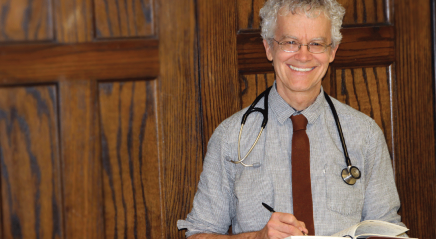
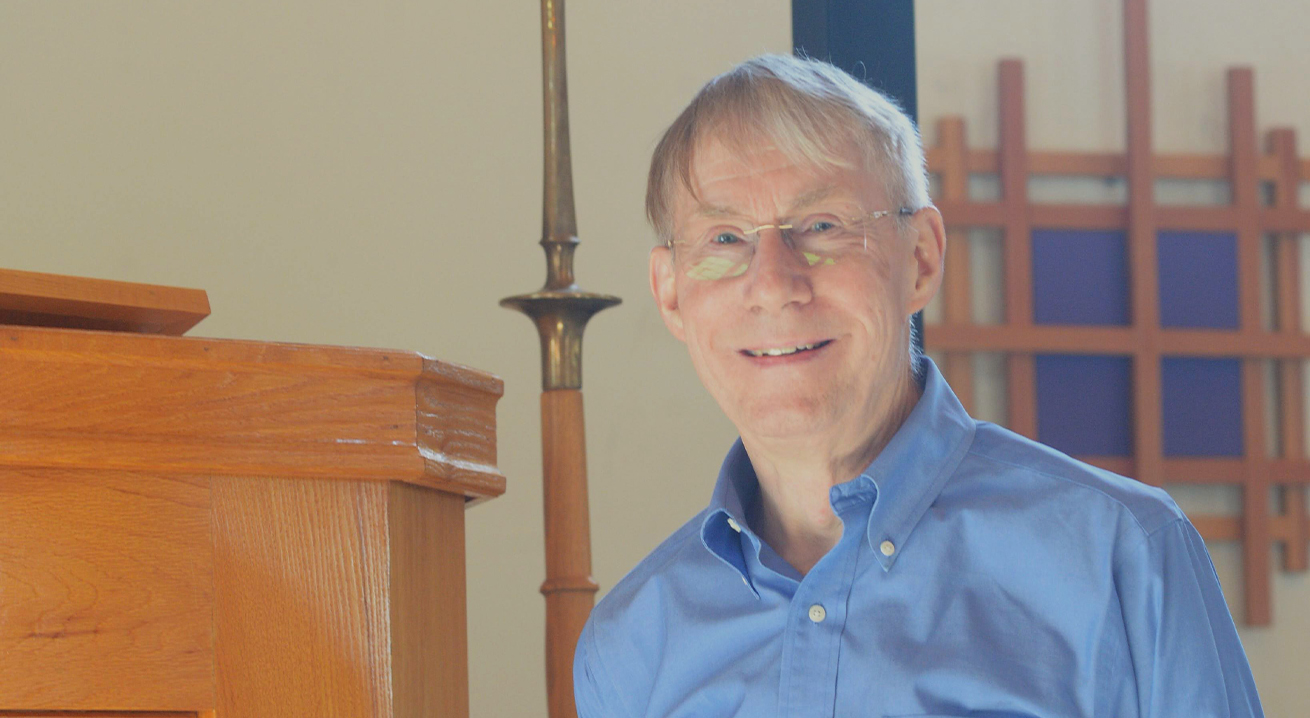
Professor emeritus of medicine and retired head of General Cardiology, Oregon Health and Science University; marathon runner
I’m named after my grandfather, David Ruotsalainen, who emigrated from Finland in the late 19th century. He was one of the first laypeople ordained in the Finnish Evangelical National Lutheran Church in America, and he served congregations in the Dakotas and northern Minnesota. Unfortunately, he passed away when my dad was 7. And then my mom died, by chance, when I was 7. My grandmother and my aunt stepped in, and my grandmother was very important in my faith formation.
I was confirmed at Westwood Lutheran in St. Louis Park [Minn.]. And then, when I was attending Dartmouth [College in Hanover, N.H.], I worshiped at Our Savior Lutheran Church in Hanover, and I directed the church choir there my last year. Eventually, I ended up at Trinity Lutheran in New Haven, Conn. I met my wife there, and the pastor married us and baptized all three of our kids. He and his wife are the godparents of our youngest child, and he took care of my father’s memorial service.
When my father passed away, my uncle said, “You know, your dad wanted to be a Lutheran pastor.” I had never known that. My pastor in New Haven went to Luther [Seminary, St. Paul, Minn.], so, I said, “Well, if we’re suggesting we do something to help someone become a Lutheran pastor in honor of my dad, we should look at Luther Seminary.” Within a couple of years, I got very involved at Luther.
I serve on the Luther Seminary board, where I’m finishing my 12th year. I also endowed the seminary’s annual Rutlen Lecture on Faith and Creation in memory of my parents, primarily to focus on the care of creation, environmental justice, and the recognition that God’s children that have the fewest resources are the most impacted if we don’t care for creation. And then I endowed a scholarship in honor of Agnes, my grandmother, because she was so important to me.
I decided to pursue medicine because I enjoy working with people. After I finished my training, I founded and led a [National Institute of Health]-funded cardiovascular physiology laboratory at Yale University School of Medicine [New Haven, Conn.]. Then I served as the chief of cardiology at the Medical College of Georgia [Augusta], the Medical College of Wisconsin [Milwaukee] and the University of Arkansas for Medical Sciences [Little Rock] and helped them rebuild their programs. In the last five years of my career, I was head of general cardiology at the Oregon Health and Science University (OHSU).
When I look over my career, the most important thing for me was being able to get to know people from all sorts of backgrounds. It was an honor and a privilege, and so important for me, to get to know people. It was people from all over the world that I was able to care for, and from all economic backgrounds, undocumented workers, the unhoused, corporate CEOs. I always took in patients’ social history and modeled that for our trainees.
In mentoring younger people, what I want to convey to them is how privileged we are to be able to take care of patients. And our patients will share the most detailed, complex, interesting stories with us that they wouldn’t share with anyone else. We are so lucky—this is such a privilege for us. You don’t have to have too many questions, and you can find out an awful lot about people.
I remain very active at OHSU, where I founded and lead its running program for seniors. I always wanted, when I retired, to do this as a public health measure. We’ve been doing well: the group is expanding, and we meet every Saturday morning. We have one member who’s 80 years old, and she’ll be running the Boston Marathon this year. That’s what I’m proud to do for the university at present.
I ran 10 Boston marathons in a row, from 2014 to 2023. My daughter got me into running when she asked me to run a half-marathon with her in 2012. Afterward, she said, “Dad, if you could run a marathon that fast, you’d qualify for Boston.” So I was off and running, so to speak. I qualified in 2013 and thought I’d do it once. But when I qualified again, I thought, “Well, I’ll keep doing this.” I also ran the 2019 New York City Marathon and the 2023 Chicago Marathon.
As a cradle Lutheran, I always took the Lutheran church for granted. I never thought too much about it, but just about all the time in my life I went to church. In the last two decades, though, the church has become more and more important to me. Part of the reason that I looked carefully at St. James was that when I walked by the church, flying from their belfry was “Let justice roll down like water,” a 40-foot-long banner. And I thought, “Wow.” I eventually joined the congregation.
In mentoring younger people, what I want to convey to them is how privileged we are to be able to take care of patients.
At St. James, our motto is “In the City for Good.” We do food-boxing, and we’ve supported families of immigrants from around the world, including a family of six from Afghanistan—they’re Muslim, and they came to our coffee hour. That just states so much about what the congregation does. One of my neighbors lives in an overnight shelter two blocks away from me. He worships with us, comes to our coffee hour. I’ve gotten to know him. And perhaps most importantly to me, after being divorced for 20 years, I met my partner at St. James three years ago. She’s more a Lutheran than I am—I never thought that would happen.
A couple of months ago, I found out that my son, Gus, has colorectal cancer. That was the worst thing that’s happened to me since my mom died. People at Luther have been praying for him, people at our congregation, any person of faith who’s a friend of mine has prayed for him. We then found out that he had a rare mutation, and going from what sounded like very desperate treatment plans, they’re now hopeful they can take care of everything with immunotherapy—no chemotherapy, radiation therapy or surgery. And I felt our prayers had been answered. I became even more of a believer.
The Lutheran doctrine “justified by grace through faith” has been a bedrock for me in all its manifestations. But what I’ve realized in the last five or 10 years about why I’m also so proud to be a Lutheran is because of all our organizations. Last summer, because of what’s going on in Palestine and Gaza, the congregation asked if I could invite a friend of mine who grew up on the West Bank to speak. It’s a very sad situation—on Oct. 11, 2023, his cousin, his cousin’s wife and their two children were killed in Gaza. He offered a moving story.
I found out afterward that his father has lymphoma and lives in Bethlehem. Of course, Augusta Victoria in Jerusalem, one of the great Lutheran hospitals, is serving Palestinians and has a great cancer program. He said, “It’s been impossible to try to get him there.” So, I talked to [Luther Seminary President] Robin Steinke because I knew she had been in leadership roles with the Lutheran World Federation. In less than 48 hours, I had a response from the hospital. They said, “This will be next to impossible for us to get him, 10 kilometers (6.2 miles) from Bethlehem. But we will do everything we can.” For one person, some guy communicating with them from Oregon, they’re pulling out all the stops. And then, of course, there’s Lutheran World Relief, Global Refuge, Lutheran social services [organizations].
I’m a Lutheran because I belong to a church that continues to reform itself over half a millennium; because we believe that we are justified by grace through faith; and because of what Lutheran organizations do in the world, particularly at this time.
If you’d like to nominate someone for “I’m a Lutheran,” email livinglutheran@elca.org.