 Logout
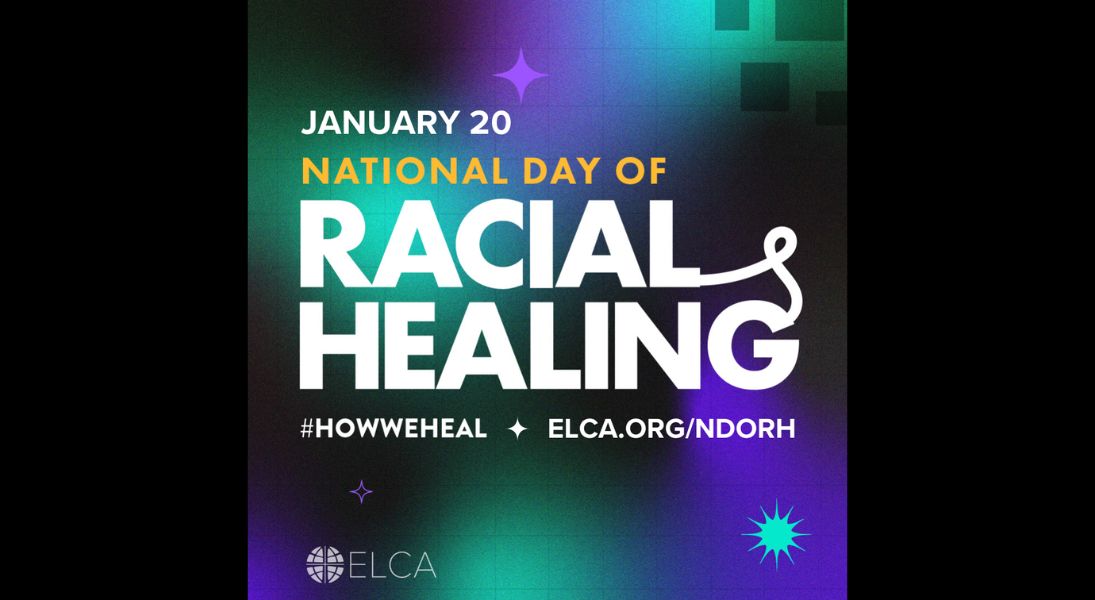
Editor’s note: Presented by the ELCA in partnership with Augsburg Fortress, the 2026 National Day of Racial Healing observance, “Just Us Narratives: A Night of Centering Multiracial Voices Across the ELCA,” is happening Tuesday, Jan. 20 from 6-8 p.m. Central time online and in person at Our Saviour’s Lutheran Church’s Celebration Campus in Naperville, Ill. Visit elca.org/NDORH for more information on how to attend this year’s free program.
Hot, dry air stirs over a large, restless crowd along a sandy shoreline. The sound of the sea is muffled by their murmuring, which rises in pitch as they glimpse the man they’ve come to see: Jesus. Dressed in robes spun out of the finest, most expensive cloth, Jairus—a leader in their community—runs to Jesus, begging him to heal his daughter.
On the crowd’s fringes, a woman also recognizes this as her chance. She’s been bleeding for 12 years, ostracized from her community. She just needs to get close enough to Jesus to touch him, even though the law explicitly forbids it. She slips through the bodies around her until her fingers brush Jesus’ cloak. Instantly, relief.
Jesus stops. He asks who touched him. The woman takes one trembling step forward, then another. The crowd parts to make space for her as she falls at Jesus’ feet and tells her whole truth.
In that holy moment—recounted in Mark 5:25-34—Jesus creates time and space for this marginalized woman, cut off from society, to demonstrate her faith and be acknowledged. It is important enough for him to stop everything, listen to the woman and heal her. Jairus also finds transformative healing when Jesus raises his daughter from the dead. Jesus made enough room to heal them both.
What happens when we make room for stories to be told and for healing to take place?
As the ELCA, in partnership with Augsburg Fortress Publishers, prepares to observe the 2026 National Day of Racial Healing on Jan. 20, its organizers are leaning into the power inherent in this year’s theme: storytelling.
The church’s Strategy for Authentic Diversity (STAD) advisory committee, which plans the event, “lifted up storytelling as a way of really listening deeply … [to] voices from very different lived experiences,” said Judith Roberts, ELCA senior director for diversity, equity and inclusion. The theme will provide time and space for participants to reflect, lean in and center the experiences of those who have been marginalized, she said. Sharing stories can empower those who have experienced racism and create learning opportunities for those who belong to the dominant culture.
“If our goal is racial healing, how can we make some sort of impact on that?” asked Felix Malpica, bishop of the La Crosse Area Synod and the Conference of Bishops liaison to the STAD advisory committee. He sees the importance of creating space for people to bear witness and for uplifting stories of allyship alongside painful accounts of racism. Such stories can help them to better understand those on the margins, share those burdens and provide “an opportunity for healing for those who get to tell their stories.”
Recalling Mark’s story of Jesus healing Jairus’ daughter and the woman who was bleeding, Malpica said, “It’s OK to spend that extra time to provide healing for those who are on the margins and to have enough faith that Jesus will still show up for you.”
Continuing the work
The National Day of Racial Healing (NDORH), an annual observance that follows Martin Luther King Jr. Day, is hosted by the W.K. Kellogg Foundation as part of its Truth, Racial Healing & Transformation efforts. The ELCA first observed the event in 2025, with a day of education designed to raise awareness of the need for racial healing and to encourage finding common ground for a more just and inclusive church and society.
The NDORH builds on a foundation years in the making. “It’s a movement, not a program,” explained Roberts. In 1993, the social statement “Freed in Christ: Race, Ethnicity, and Culture” aspired to make the ELCA’s membership 10% nonwhite, including people of African-descent, Asian, Hispanic and Native American heritage (since expanded to include Arab and Middle Eastern heritage). A resolution passed at the 2016 Churchwide Assembly called on all three of the church’s expressions to better reflect the demographic makeup of their communities.
Three years later, the church’s Strategy Toward Authentic Diversity solidified that commitment and recommended ways for the church to exhibit true diversity and inclusion.
Roberts sees the NDORH as part of the ELCA’s commitment to host a day against racial violence in the wake of such past tragedies as the 2015 murder of the Emanuel Nine in Charleston, S.C. “We join with other entities across this country for a day that focuses on truth-telling, relationship-building and transformation,” she said. “The goal is to provide the platform where we’ll hear many stories … to be reflective about how we hear stories, how stories may challenge us, how stories may connect us.”
Creating a sacred storytelling space provides people with the opportunity to do this hard, holy, healing work together. It also moves the ELCA’s event observance from learning about the “how” to the experience of the day itself. “Last year, we focused on how we give people education, inspiration, solidarity,” Malpica said. “This year … instead of doing that, can we just have people experience it?”
Redemption and reconciliation
For both Malpica and Roberts, the NDORH complements the gospel messages of redemption and reconciliation, being one in Christ, seeing the image of God in our fellow human beings and building relationships with the “other.”
“If we really want to be a church that walks alongside our neighbors … we have to do this work,” Malpica said.
Roberts agreed. “That’s where the transformation and the witness of the gospel message is activated, when people see and know and feel and hear that they’re wanted.”
Such work doesn’t stop at the head or heart. A portion of the 2024 ELCA Mission Development Fund grant that supported the NDORH program—$48,000—went to mini-grants that supported congregations, synods, leaders and nonprofit organizations in their efforts to enact racial healing in their communities. These included an ecumenical Christmas worship service that brought together ELCA and historically Black churches; a predominantly African-decent congregation producing outreach materials in Spanish to greet new neighbors; and a Spanish-speaking congregation creating healing and trauma-recovery resources for those in their community who fled LGBTQ-related violence and intimidation in their countries of origin.
For Malpica, this work embodies the Lutheran baptismal covenant. “We make baptismal promises to live in community and to work for justice and peace in all the world [that] necessitate us hearing the stories of our siblings,” he said. “You cannot work for justice if you don’t know [their] experience.”
Learn more
The National Day of Racial Healing educational event is free and open to all ELCA rostered ministers, lay leaders and members. Learn more and find resources at elca.org/NDORH.