 Logout

Lectionary for Aug. 2, 2026
10th Sunday after Pentecost
Isaiah 55:1-5; Psalm 145:8-9, 14-21;
Romans 9:1-5; Matthew 14:13-21
One of the proverbs we quote most in my house is: “An unplowed field produces food for the poor, but injustice sweeps it away” (Proverbs 13:23). During the Sabbath years and the Jubilee, landowners were to leave their fields fallow, and anything that grew there belonged to everyone, especially the poor. God’s kingdom requires that there’s enough for everyone. Sadly, people who have political or economic power to accumulate for themselves frequently take or hold what should be for others.
Chrysostom, archbishop of Constantinople, said:
“Since you have not given the accustomed offering [to the poor, God] says, you have stolen the goods of the poor. He says this to show the rich that they hold the goods of the poor even if they have inherited them from their fathers or no matter how they have gathered their wealth.”
God seeks to undermine the ongoing theft of the resources that are intended for the poor. This week’s lectionary readings make clear that God intends for everyone to have what they need to live.
Isaiah 55 begins with an attention-getting sound. We might translate it as “Yo!” or “Hey!” or, as the New American Standard Bible translates it, “You there!” This isn’t a message intended only for those already tuned in. Instead, this is a public service announcement that everyone should heed. If you have money, fine, use it to buy food. If you don’t have money, that’s OK too. There will be plenty of water, wine and milk to drink. If you’re spending your money, please don’t do it without eating bread first. God insists that the hearers of this message listen carefully and eat what is good.
Yet, some interpreters insist that we not listen to the physical reality of what God is saying and instead only spiritualize this message, stripping it from its real-world context. For people in exile, living on the edges of an empire and anticipating a return to the land God had given them, thirst wasn’t a metaphor. Starvation wasn’t just imagery. Certainly, humans do not live on bread alone (Deuteronomy 8:3 and Matthew 4:4). Also, humans do not live without food. Good news that is real good news always involves the sharing of food, freeing of prisoners, canceling debts and undoing injustice (Luke 4:16-19).
In Isaiah 55, God announces a leader of the peoples to make things right, not just spiritually but also materially. To guarantee a vision of equitable and just provision for all, God appoints humans to provide for God’s beloved humans. In other words, it’s our job to make sure that no one steals bread out of the mouths of people who need it!
Our job, as emissaries of God’s kingdom, is to make sure that greed and wealth accumulation do not steal bread or the Word of God from people.
The psalmist takes up the theme of God providing food and ensuring that injustice doesn’t derail fair distribution. We read that the Lord supports all who fall and lifts the ones who have been laid low (Psalm 145:14). Whether the difficult situation was the result of the actions of the person or through injustice, God exalts the lowly. Then God gives food in due time and satisfies the desire of every living thing (15-16). Again, this isn’t merely a metaphor.
Turning to the Gospel reading, I was struck by the situation after Jesus delayed mourning for his relative who had been murdered by Herod. For some time, Jesus had been healing and teaching the large crowds that had intercepted him. This time, the disciples urged Jesus to cut the lesson short and send the crowd away. I’ve been trying to work through the Greek text of Matthew. The disciples don’t just say the assembled people should buy food—they tell them to “go to the markets.” In other words, for the disciples, the choice here is not between the people starving or getting food but between continuing to listen to Jesus or finding a market-based solution.
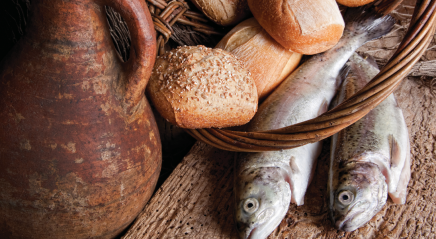
Jesus distributes the five loaves and two fishes specifically so the crowd can stay with him. Everyone can have food without having to buy it for themselves, and no one is forced to go without if they can’t afford it. Five thousand men, and an uncounted number of women and children, didn’t just have a bite. They all ate until they were filled (Matthew 14:20 ). How long does it take you to eat to be filled? How much more teaching time did Jesus buy with the miracle? Jesus multiplied loaves and fish so humans could live by both bread and the word of God. No one could take either bread or word away from the people.
God graciously provides for the people. Our job, as emissaries of God’s kingdom, is to make sure that greed and wealth accumulation do not steal bread or the Word of God from people.