 Logout
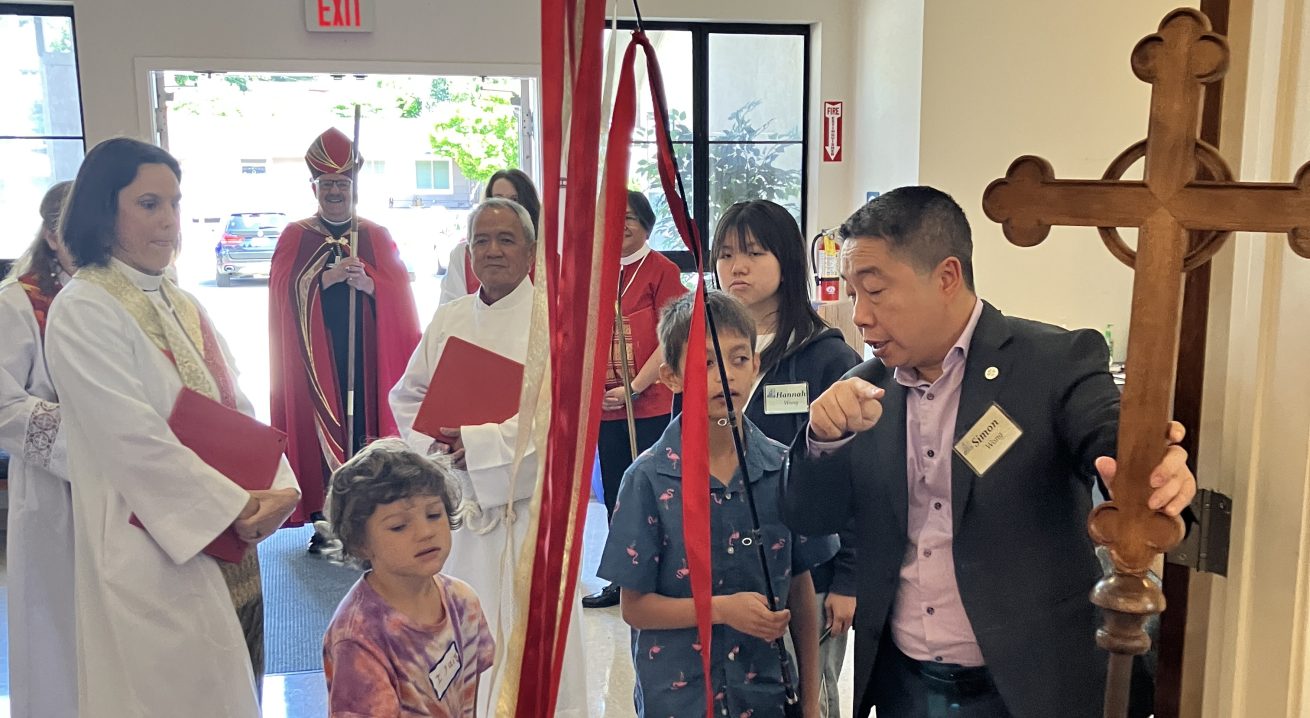
“ຍິນດີຕ້ອນຮັບ—welcome to this day,” proclaimed Sara Schultz in Lao and English. “Welcome to Grace Lao Lutheran Church, welcome to Hope Lutheran Church!” With these words, the pastor of Hope in El Sobrante, Calif., opened the worship service to rapturous applause.
In a joint Pentecost worship service filled with joyful music and rich, multilingual liturgy, Grace Lao and Hope celebrated their new ministry partnership in May.
Lao words and liturgy rang throughout the sanctuary, intermingling with English as the lectionary from Acts 2 took on new life. Two thousand years prior, a crowd proclaimed in astonishment: “In our own languages we hear them speaking about God’s deeds of power” (5:11). The members of Grace Lao and Hope experienced that same wonder as they heard God’s deeds proclaimed in their own languages. The hymns, smiles, hugs and festive vestments communicated God’s works as much as any words could.
“The miracle of Pentecost is not that every language disappears into one language,” preached Jeff Johnson, bishop of the Sierra Pacific Synod. “The miracle is that the Spirit makes understanding possible without erasing differences. Everyone is able to hear the promise of God in the language of their heart.”
The language was especially important to Simon Wong, former synod vice president and a leader of Hope, who created a complex presentation with Lao on one screen, English on another and captions for those with hearing loss.
“The technology has already helped create a meaningful and impactful worship experience,” he said. “It has given many a deeper sense of belonging and togetherness. Though we may be unique in many ways, we are one in the Spirit in worshiping, serving and growing together. When we worship in multiple languages, we honor the diversity God has given us while celebrating the unity of the Spirit that binds us.”
Conversations together
Worshipers who arrived early saw the bishop shaking hands outside, wearing a miter, chasuble and stole while carrying the shepherd’s staff—a clear tip-off that this would be a special Sunday. The sense of celebration and togetherness infused every part of the joint worship service held at Hope, where Grace Lao now worships at 9 a.m. before Hope’s new later service time at 11 a.m.
“This moment this morning that we are celebrating didn’t happen all at once,” Johnson said. “It came through long conversations together, deep prayer, meetings, patience, courage, even a little frustration and exhaustion. It has required each of you members and leaders from different communities to listen deeply and to imagine and to wonder what might be possible in the future.”
That future includes Vanphone Anlavan, who was commissioned during the joint service as a synod-authorized minister for Grace Lao.
As he confirmed his pledge, Teresita “Tita” Valeriano, program director for Asian and Pacific Islander Ministries, said: “You come among us as one invited to render a particular service, a gift from God to inspire us to love and good works. Synod-authorized ministry recognizes the need to be flexible and adapt to the changing ministry challenges and needs of congregations.”
Together we can provide the ministry, pastoral care and cultural expression that our neighborhoods need while still honoring the unique identity of each community.”
Anlavan’s role and the church partnership are both signs of the ELCA adapting to new ministry models. “Long term, I believe partnerships like this represent the future of the ELCA in multicultural areas,” Wong said. “By sharing space, resources, leadership and mission, we can create a stronger, more sustainable and more vibrant expression of the church, one that reflects the diversity of God’s people and the unity of the body of Christ.”
Wong said the traditional church model of a single congregation—with its own building, its own pastor and its own contracts for services—is increasingly difficult to maintain. “But beyond finances, this model also limits how we share the good news with the wider community,” he said.
“Collaborative ministry partnerships are not only practical, but they are faithful. A shared ministry model allows multiple worshiping communities to gather in one location, not just to reduce financial strain but to actively support one another. Together we can provide the ministry, pastoral care and cultural expression that our neighborhoods need while still honoring the unique identity of each community.”
At the same time, leaders of Hope and Grace Lao were quick to add that the change has been hard. “It hasn’t been easy to lay the groundwork for this partnership,” Schultz said. “Both communities have had to make sacrifices, and difficult conversations have been necessary.”
For now, the collaboration is a work in progress. “I don’t feel like we are some great example of anything just yet—we are just getting started,” Schultz said.
“Hope and Grace Lao have said ‘yes’ to exploring what it might mean to share space and resources and to partner in new ways. For example, both of our congregations have a desire to deepen and expand our children’s ministry. What could it look like to join our kids and families for something new?”
As for this story itself?
“There is no story of us yet—we are just beginning,” she said. “Hopefully Grace Lao and Hope get to write this story together.”