 Logout
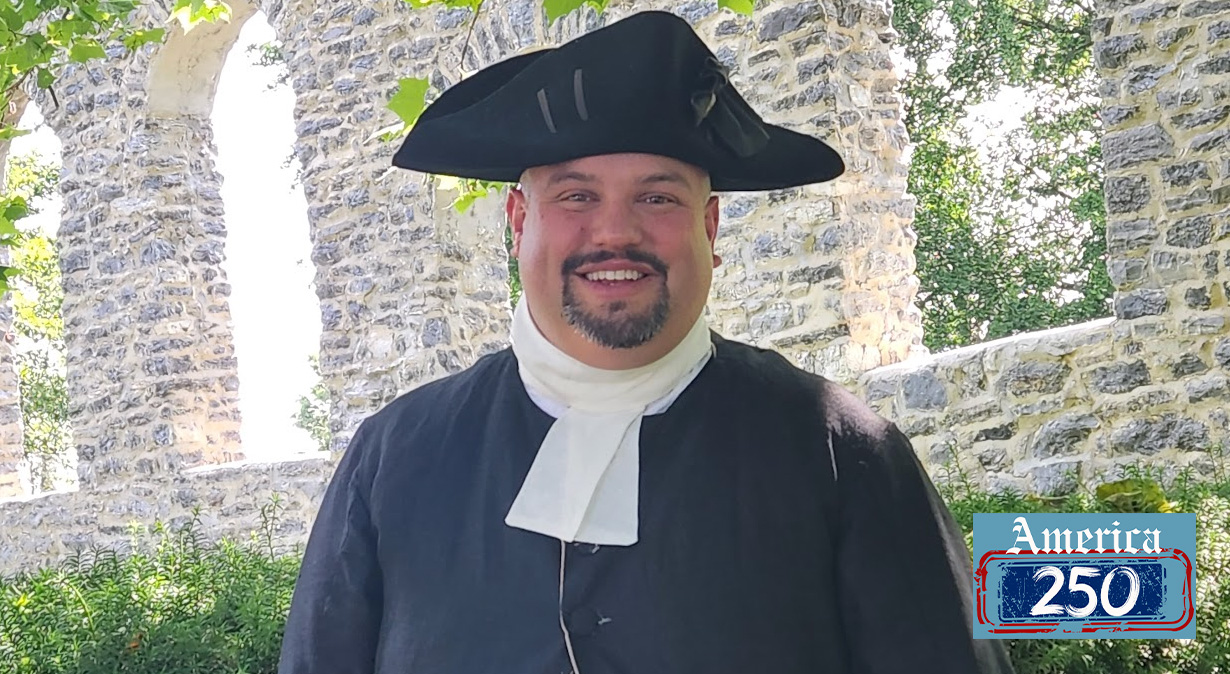
Editor’s note: Throughout the summer, Living Lutheran is commemorating the 250th anniversary of the adoption of the Declaration of Independence with articles reflecting on the church’s role in civic life and Lutheran contributions to the history of the United States. All articles carry our America 250 logo. In this article, Jonathan M. Boynton, pastor of Grace Evangelical Lutheran Church, Winchester, Va., reflects on Lutherans during the American Revolution. It originally appeared in “Wayfarers,” the newsletter of the Southwestern Pennsylvania Synod. Used by permission.
Lutheranism in Colonial America, while distinctive, may have been underappreciated leading up to the American Revolution. Rooted primarily in German-speaking immigrant communities, alongside the Reformed and Dunker traditions, Lutherans were not as politically dominant as the Anglicans or as unified as other Protestant groups. However, their influence, particularly through key figures like Henry Melchior Muhlenberg and other Lutheran leaders, extended across many of the colonies. This influence was meaningful in shaping both religious life and political identity in the 18th century.
The earliest Lutherans who arrived in North America did not come primarily as refugees fleeing religious persecution, as was the case with some other groups. Instead, they came for opportunity: land, economic stability and the freedom to practice their faith without excessive interference. Large groups settled in Pennsylvania and gradually migrated south down the Great Wagon Road into the Valley of Virginia, and into the backcountry of the Carolinas. There were other settlements along the Atlantic seaboard. In many cases these ethnic groups retained their language, customs and religious traditions within the wider English-speaking colonies.
As Lutheranism expanded, the settlements and adherents grew. This called for more ecclesiastical organization and leadership, which is where Muhlenberg emerges. Born in Hanover, Germany, and a subject of the British crown, he arrived in North America in 1742. His journey was not accidental; it was orchestrated through connections with the Lutheran church in Europe, particularly through the influence of Chaplain Friedrich Michael Ziegenhagen of London, who issued Muhlenberg’s call to Pennsylvania. Educated in a German university founded by King George II, Muhlenberg embodied the nature of Colonial Lutheranism.
Eighteenth-century Lutherans varied widely in their support for, opposition to and reluctance to participate in the war for American independence.
Often referred to as the “Father of Lutheranism in America,” Muhlenberg worked to organize congregations, establish standards for pastoral training, and bring a sense of unity to a geographically dispersed population. His work was not only administrative; it was pastoral, and by his love for the people he served, it became deeply personal. This pressure was felt strongly by his children, of which he writes in October 1763, “Unfortunately my boy Peter enjoyed very little care and supervision from me, owing to the distractions of my pastoral duties.”
He traveled extensively, visiting congregations up and down the colonies, mediating disputes and ensuring doctrinal consistency. In 1774, on the eve of revolution, he was called as far south as Ebenezer, Ga., where he worked alongside Christoph Friedrich Triebner to resolve tensions within the Salzburger Lutheran community there.
Muhlenberg’s influence extended to his own family. By early adulthood his sons Peter and Frederick were both Lutheran pastors and became prominent figures in the Revolution. Peter symbolizes the intersection of Lutheran faith and revolutionary fervor. Ordained as a Lutheran pastor, he is famously remembered for casting off his clerical robe to reveal a Continental Army uniform beneath, rallying his Woodstock, Va., congregation to join the fight for independence. Whether apocryphal or not, the story reminds us that Lutheran clergy and laity were not isolated from the political currents of their time, as Peter served as the chair of Dunmore County Virginia’s Committee of Safety, and represented the county in the Virginia House of Burgesses.
Henry Muhlenberg wrote in his journal on July 4, 1776: “Today the Continental Congress openly declared the united provinces of North America to be free and independent states. This has caused some thoughtful and far-seeing melancholici to be down in the mouth; on the other hand, it has caused some sanguine miopes (short-sighted persons) to exult and shout with joy. In fide videbitur cuius toni (it will appear in the end who has played the right tune).” Father Muhlenberg was not as enthusiastic about Revolution as his son Peter, nor later Frederick who went on to serve as the first speaker of the United States House.
Families were divided on the urgency and need for Revolution, some fought and others stood by, while other Lutherans such as Christian Streit and Christoph Friedreich Triebner served in roles of chaplain to the armies in North America.
Streit served as the chaplain to the 8th Virginia Continental Regiment, at endorsement of the Pennsylvania Ministerium, which was led by Col. Peter Muhlenberg (major general by the end of the Revolutionary War). Following the war Streit became the first settled pastor at the Lutheran church in Winchester, Va., nearby the soldiers with whom he served from the Shenandoah Valley, including the likes of Gen. Daniel Morgan who lived out his last days in the same community.
Christoph Friedreich Triebner was pastor with the Salzburger Lutherans in Georgia. In contrast to Streit, he ran at first look of the British and Hessian occupation of Savannah, and he sought refuge among the Hessians (German soldiers fighting for Britain). He served as a chaplain and a guide for the British and Hessian troops. Following the war, he was not welcomed back to his congregation and went to London to serve a congregation there.
The Lutheran understanding of “two kingdoms” tells us that both earthly and spiritual kingdoms exist. A person of faith is in the world, yet not of the world, therefore we may not be surprised at Henry Muhlenberg’s reluctance to the War for Independence. Eighteenth-century Lutherans varied widely in their support for, opposition to and reluctance to participate in the war for American independence.
Lutheranism has existed through good government, poor government and so-so government, yet we trust that God’s hand is working in, with and through God’s people by means of the Spirit. As we reflect on our nation’s 250th anniversary we are mindful of all those who have come before us, and we look with hope, for our nation, trusting in God’s presence with us, and for all those throughout the world.
Additional resources for study
- The Journals of Henry Melchior Muhlenberg (Muhlenberg Press, 1942-1958).
- A Basic History of Lutheranism in America (Fortress Press, 1964) by Abdel Ross Wentz.
- Lutheran Landmarks and Pioneers in America (1913) (Kessinger Publishing, 2010) by William J. Finck & Elmer F. Krauss. A collection of sketches detailing the lives of early colonial Lutheran pioneers.