 Logout
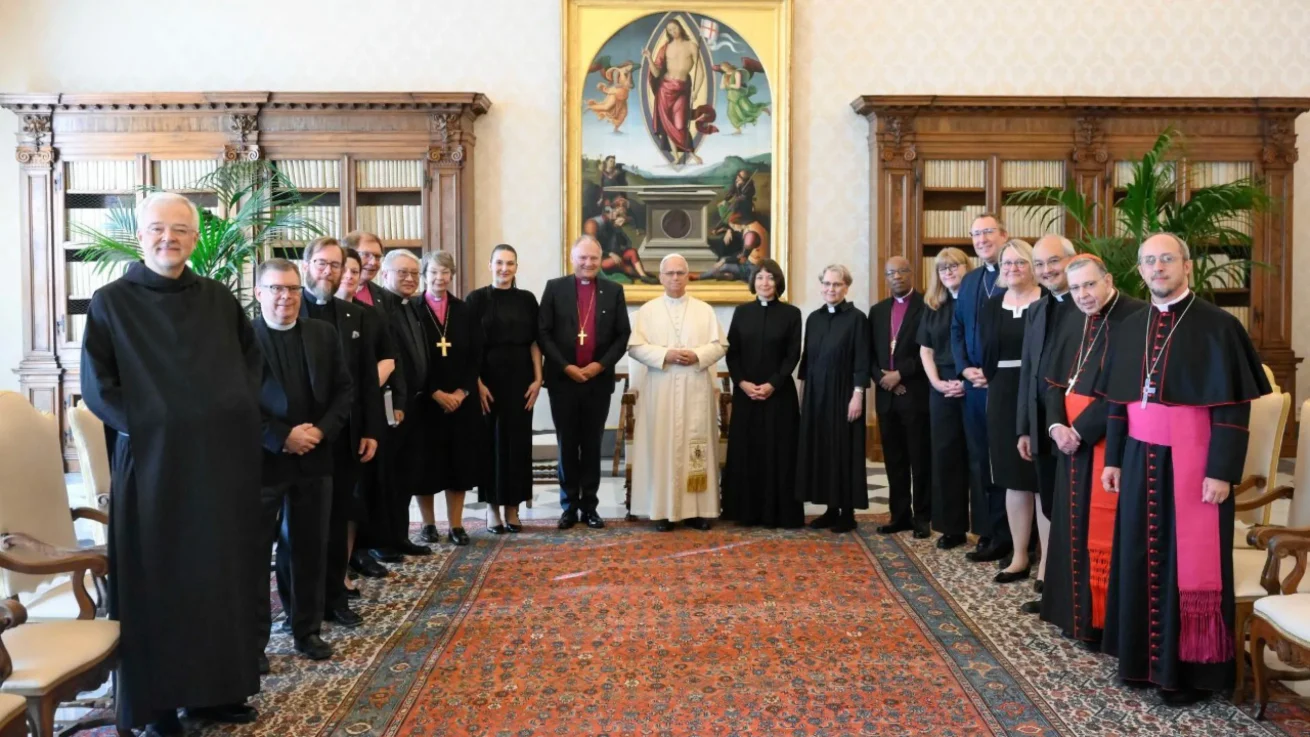
Leaders of the Lutheran World Federation (LWF) met with Pope Leo XIV in the Vatican on Oct. 1, looking forward to the ways in which Lutherans and Catholics can commemorate together the 500th anniversary of the Augsburg Confession in 2030.
Henrik Stubkjær, LWF president and bishop of Viborg in the Church of Denmark, led the delegation of Geneva Communion Office staff and LWF vice presidents representing member churches around the world. He gave thanks for the Roman Catholic leader’s repeated calls for “disarmament, the rejection of weapons and the need for dialogue,” as well as concerns outlined in his encyclical letter Magnifica Humanitas about the future of Artificial Intelligence.
“The LWF understands itself as a movement within the one ecumenical movement for the sake of the one church catholic,” Stubkjær said. He recalled the joint commemoration of the Reformation “exactly 10 years ago this month,” as Lutheran leaders came together with Leo’s predecessor, Pope Francis, in the Swedish cities of Lund and Malmö. “The ecclesial journey from conflict to communion between Catholics and Lutherans has borne significant fruit, not least in the Joint Declaration on the Doctrine of Justification, which continues to inspire wider ecumenical cooperation,” he said.
Reflecting on ways in which Lutherans and Catholics continue to deepen that dialogue today, Stubkjær spoke of the joint International Lutheran-Catholic Commission on Unity, which began 60 years ago and is now in its sixth phase, working on a joint statement to mark the 500th anniversary of the Augsburg Confession. That document, he said, “is part of that theological lineage stemming from St Augustine. In 1530, it was an ecumenical proposal to the church that highlighted the apostolic roots of the reforms and the desire for the church’s unity. It was never meant to divide but sought a dialogue for mutual discernment of gospel proclamation in its day.”
Although the proposal did not succeed in the 16th century and separation ensued, Stubkjær said, “today, however, we can start telling a different story” by lifting up the ecumenical dynamic in the current context. “It is our hope that Catholics and Lutherans will be able to commemorate this anniversary together on June 25, 2030, in Augsburg, where the Confession was first presented.”
“The ecclesial journey from conflict to communion between Catholics and Lutherans has borne significant fruit.”
In his words to the LWF delegation, Pope Leo also shared his hopes for the ecumenical potential of the Augsburg anniversary. “Renewed communion in the apostolic faith, in the sacraments and in the ministries, is the goal of our ecumenical journey of grace, which we walk together guided by the gospel,” he said. “On our journey from conflict to communion, he noted, “there are special moments. The year 2030 … can become one such shared moment: a profound ecumenical experience that can give new energy and joy to the steps we will take towards full visible unity.”
Noting with gratitude the ways in which Catholics and Lutherans are witnessing together “in proclamation and service to the world,” the LWF delegation presented Pope Leo with two gifts, a copy of the cross created for the 2016 joint ecumenical commemoration of the Reformation in Lund, Sweden, and a pomegranate-shaped bowl that was handcrafted by young Palestinians at the LWF Vocational Training Center in East Jerusalem.
The shape of the bowl, Stubkjær noted, symbolizes “life, abundance and hope in the Holy Land.” The exterior decoration, depicting grapevine and olive leaf motifs, “reflects the values of reconciliation, resilience and stewardship” that are central to LWF’s work at the training center, through the Evangelical Lutheran Church in Jordan and the Holy Land, and at the Augusta Victoria Hospital providing specialized cancer care to Palestinian patients.
“The Lund cross is a sign of our continued commitment to the journey towards full communion,” said Anne Burghardt, LWF general secretary. “We are grateful for the work of the joint international commission …. As Pope Leo has just reminded us, that document was intended to bear witness to the Reformers’ faith in the one, holy, catholic and apostolic church. Today, we continue to work towards that goal of reconciling and renewing our communion so that Lutherans and Catholic can share the sacraments together around the table of our Lord.”
The ELCA is a member of the LWF, with Yehiel Curry, presiding bishop of the ELCA, recently joining the federation council as a churchwide representative.
This story originally appeared at lutheranworld.org.