Logout
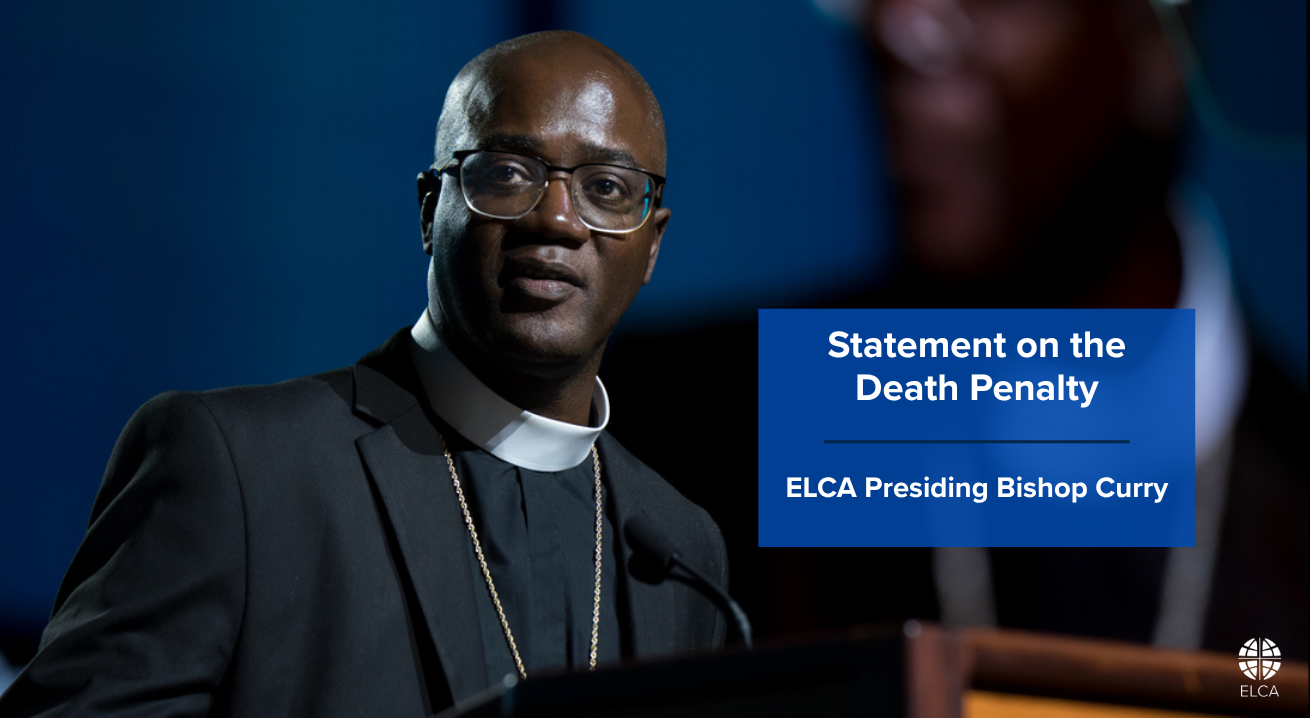
Yehiel Curry, presiding bishop of the ELCA, has issued a statement about recent incidents related to the death penalty in the United States.
“My heart was troubled by the recent proposal to livestream an execution in the United States,” the statement read, in part. “I am thankful that this plan has now been cancelled. The deliberate taking of a human life should never become a public spectacle. Such actions risk deepening the wounds of victims’ families, loved ones and communities while further desensitizing us to violence. Our society is diminished when violence is conflated with entertainment. Because of our ministry of reconciliation (2 Corinthians 5:16-21), this church opposes the death penalty and the recent plans for public display of the execution of Nidal Hasan.”
Curry continued: “As a church, we are not strangers to the mournful effects of violent crime. Our congregations minister to victims, to offenders and to communities that experience the ripple effects of its trauma. We recognize the need to protect people from violence, to call perpetrators to repentance, and to seek restoration for victims. United in our resistance to hate and in our joy over the good news of God’s grace, we minister to an often-vengeful society with words and actions of hope, justice and healing.
“The 1991 ELCA Churchwide Assembly adopted the social statement ‘The Death Penalty,’ demonstrating this church’s early opposition to capital punishment. That opposition is grounded in a long tradition of Christian theology and teaching. The social statement calls the church “to respond to violent crime in the restorative way taught by Jesus (Matthew 5:38-39) and shown by his actions (John 8:3-11).” It states that the death penalty’s continued use perpetuates cycles of violence, undermines the possibility of repentance and restoration, and binds our society more deeply to brutality rather than reconciliation. It fosters suffering rather than ends it, as we saw in the attempted execution of Christa Pike.
“The statement affirms that God ordains government to be a source and guarantor of safety and justice. Abundant research shows that the death penalty does not give us safety or justice. It does not provide healing to victims’ families or safety for the broader community. It does not deter future crimes. It does not serve the ends God calls government to serve, nor does it reflect the kind of society we are called to be.
“We hold in prayer all who are impacted by violent crime, including victims, families, workers in law enforcement and corrections, and those accused or convicted of violent crimes. We give thanks for prison chaplains and ministries that accompany people through suffering and that witness to the possibility of redemption.”
Curry concluded by inviting readers to talk with those in their communities about the death penalty. “Let our churches continue to be spaces for respectful, faithful dialogue about moral issues,” he said. “Study the ELCA’s social statements ‘The Death Penalty’ and ‘The Church and Criminal Justice: Hearing the Cries‘ together. Be part of the whole church’s witness in society to urge public officials to work toward abolishing the death penalty, including support for the Federal Death Penalty Prohibition Act. Together let us build a society that keeps us safe from violence, reflects God’s compassion, honors the dignity of every person and demonstrates that God is always working for and toward abundant life.”