Logout

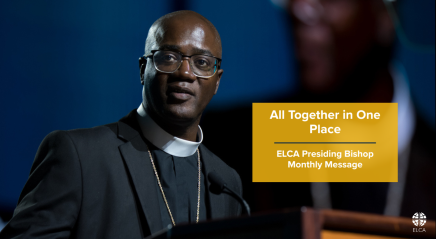
Editor’s note: Yehiel Curry, presiding bishop of the ELCA, has issued his seventh entry in “All together in one place,” a series of monthly messages. Each message shares a pastoral word, rooted in Scripture, that witnesses to God’s presence today, our rich theological tradition and the social teaching that connects us. Read the full message here.
During a recent visit to Upstate New York, I learned about the Haudenosaunee (HOH-din-oh-SHOH-nee) people, past and present. In the 12th century, long before the framing of the U.S. Constitution, the Haudenosaunee established the Great Law of Peace. The Great Law of Peace, crafted by the Great Peacemaker (Deganawidah) and Hiawatha, united five historically warring nations under the canopy of peace.
Centuries later, this Haudenosaunee Confederacy inspired leaders of the British colonies to work together as a unified federation. The result of the Great Law of Peace was a diverse body made stronger because its members were connected. Eventually the Great Law of Peace inspired and influenced the authors of the U.S. Constitution. These contributions were unacknowledged for years as the U.S. government continued to violently and systemically erode Indigenous life and community.
Finally, in 1988, the U.S. Congress formally recognized the contribution made by the Haudenosaunee Confederacy “and other Indian Nations to the formation and development of the United States” (H.Con.Res. 331, 1988). It is a contribution that shapes us today as a nation; we are stronger when we are connected.
It is essential to understand that the Great Law of Peace did not require people to ignore their differences. Generations of Haudenosaunee continue to hold this value of being connected as central to peace.
The peace of Christ, though different from national peace, does not require Christians to be the same or to ignore their differences. The Holy Spirit has already given peace through Christ.
Peace for the early Christian communities did not come from everyone being alike. Then, as now, we keep the peace of Christ by engaging our differences and making space for each other. The social statement For Peace in God’s World reminds us that “God’s steadfast resolve for peace encompasses our time as it does all times” and that “‘the Gospel of peace’ (Ephesians 6:15) heals our broken relationship with God, removing the ultimate root of violence and injustice” (p. 3). Our differences carry both promise and peril. People of differing identities, ideas and ways of living are made stronger when they are connected.
As Christians, we are connected through the waters of baptism and the unity of the Holy Spirit. This month, as some gather to celebrate Thanksgiving and others to commemorate the Day of Mourning, we remember both lessons learned from the history of the early church and those offered by peoples who lived on this land later called the United States.
Our shared history is both broken and woven, horrific and hopeful. The gospel of peace does not ask us not to ignore our complicated history but rather proclaims that “[Christ] is our peace; in his flesh he has … broken down the dividing wall, that is, the hostility between us” (Ephesians 2:14). In the gospel of peace, the hostility that often thrives on difference is removed as Christ, “our peace,” creates a connectedness that draws us more deeply into community with one another.
In the coming weeks, let us give thanks for the Great Law of Peace among nations, and let us praise God for the gospel of peace that unites us in Christ Jesus across difference as we pray for peace that is still to come and keep the peace the Holy Spirit already gives us today.