Logout

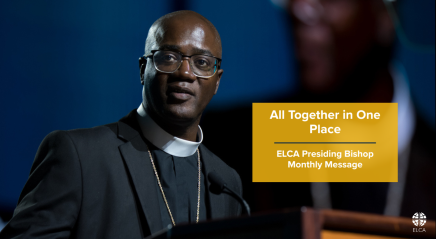
Editor’s note: Yehiel Curry, presiding bishop of the ELCA, has issued his sixth entry in “All together in one place,” a series of monthly messages. Each message shares a pastoral word, rooted in Scripture, that witnesses to God’s presence today, our rich theological tradition and the social teaching that connects us. Read the full message here.
Fannie Lou Hamer was a powerful Black woman who risked her life so that all people could exercise their right to vote. After attempting to register to vote in Mississippi in 1962, she faced violent retaliation, enduring threats, beatings and intimidation. Yet she continued to sing, testify, march and organize for equal voting rights for all people. She was not wealthy. She did not hold a high public office. Yet she exercised a profound public vocation, insisting she and her neighbors had the right to participate in civic life and to have the food, land and opportunity needed to flourish. She was a patriot who loved her country enough to challenge it to live up to its promise that every voice matters and every vote counts. By risking her own safety in the struggle for democracy, Hamer acted as a patriot, calling public leaders to serve everyone.
The airwaves are full of conflicting messages about patriotism, and many of you have written with your own questions and perspectives.
Together, this is what our church has decided to say:
“The ELCA understanding of civic life and faith affirms healthy forms of patriotism. Patriotism is to love one’s country, to pray for its well-being, to be committed to its success, to have a sense of pride in it, to criticize it, and to work for its reform when necessary. All of these can be elements of how Christians and their communities live out discipleship as individuals and in corporate bodies” (2025 social statement “Faith and Civic Life: Seeking the Well-being of All”).
Healthy patriotism celebrates what is good and beautiful in our common life while remaining committed to tending to what is wounded and broken. Healthy patriotism fosters a sense of shared belonging because the strength of our nation lies in our ability to live together as diverse people who share a common future.
As Lutherans, we can live out healthy patriotism. We understand the government is called to serve and protect the common good. We exercise patriotism in part by holding public leaders accountable to serve the common good.
As Lutherans, we continue to make a connection between trusting God and serving the common good.
How should public leaders act? After Martin Luther wrote a commentary about Mary’s Magnificat (Luke 1:46-55), he sent it to the local prince along with a cover letter, telling him to follow the example of Mary the mother of Jesus. It was not common for monks to address princes in this way. Yet Luther wanted the prince to know Mary was a true leader. She trusted God with an open heart and allowed the Holy Spirit to work through her for the sake of others. She did this, not for her own fame or renown, but with humility and grace. Luther’s emphasis on the marks of leadership rings true today.
As Lutherans, we continue to make this connection between trusting God and serving the common good.
Both Luther and Hamer remind us that positions of responsibility and public service are gifts to be used for the good of all, and that societies thrive when leaders and neighbors alike are guided by humility, gratitude and a concern for others.
As Election Day approaches, we can approach this responsibility with prayerful hearts and a commitment to the flourishing of all people. In all that we do, may we embody a patriotism rooted in gratitude, shaped by humility, strengthened by hope and guided by Christ’s command to love our neighbors, working so that every voice can be heard and every person can participate in shaping our future. May we care for one another and our country enough to serve faithfully, speak truthfully and seek our common good. Like Hamer, may we take up our vocations in public life. And may Mary’s song remind us that above all, our hope rests not in human strength, but in the steadfast love of God.