 Logout
Series editor’s note: The 2026 theme for “Deeper understandings” is faithful witness in challenging times. This year various authors will explore what it means for the ELCA, and each of us as Lutherans, to face the headwinds of societal fracture, loneliness and political contention, and to bear witness to the good news of Jesus Christ that forgives, frees and transforms not only us individually but the whole world. We hope you will be encouraged and empowered to plant your feet firmly on the rock of our faith and speak joyfully and hopefully about the power of the gospel to foster peace and justice in a world desperately in need of both.
—Kristin Johnston Largen, president of Wartburg Theological Seminary, Dubuque, Iowa, on behalf of the ELCA’s seminaries
One of the most powerful biblical narratives of the resurrected Christ is his appearance to his disciples on the road to Emmaus (Luke 24:13-35). They are confused, grieving and trying to make sense of events they do not understand and cannot explain. Jesus comes alongside them, and in his retelling and reframing of a familiar story, they come to appreciate more deeply who he is and all God has accomplished through him. They see anew. There is a lesson in this for us all.
You may have heard that Netflix has commissioned a new version of Little House on the Prairie, to premiere July 9. The previous TV series, popular in the 1970s, was loosely based on the books by Laura Ingalls Wilder. Co-starring Michael Landon—who also wrote and directed many of the episodes—as “Pa” Ingalls and Melissa Gilbert as the ever-in-trouble Laura Ingalls, the show caught my imagination about pioneer America long before I found out I was related to Laura.
As an adult, I learned through a cousin that my great grandma, Lottie Quiner, and Laura Ingalls were double cousins. Both were born in 1867 in Pepin, Wis., and Ingalls called the two “as close as siblings.” At first, this thrilled me. But later, when I read the Little House books to my children, I felt shocked by Ingalls’ disregard toward Native Americans. I had just moved to St. Paul, Minn., to teach at Luther Seminary, and during these years, Minnesota was reckoning with its treatment of Indigenous peoples. The 150th anniversary of the U.S.-Dakota War of 1862 offered new, critical stories about the past, stories I didn’t know, which reframed my sense of my own story and that of my pioneer ancestors.
Since then, I’ve taken on an in-depth reeducation, reading books, visiting sites and listening to Native voices such as Vine Deloria Jr. (Standing Rock Sioux), the historian and Lutheran School of Theology at Chicago alum. I’ve learned that my family told only part of our story and left out important truths. Truths that are hard to face.
Our pioneer story was written as a myth—an American myth of settlers who understood that it was only common sense and justice that the Indians move west so white people could claim the land for themselves. The ELCA’s “Repudiation of the Doctrine of Discovery” (2016) was an important step in “[acknowledging] and [repenting] from this church’s complicity in the evils of colonialism in the Americas, which continue to harm tribal governments and individual tribal members.”
Seeing from the cross
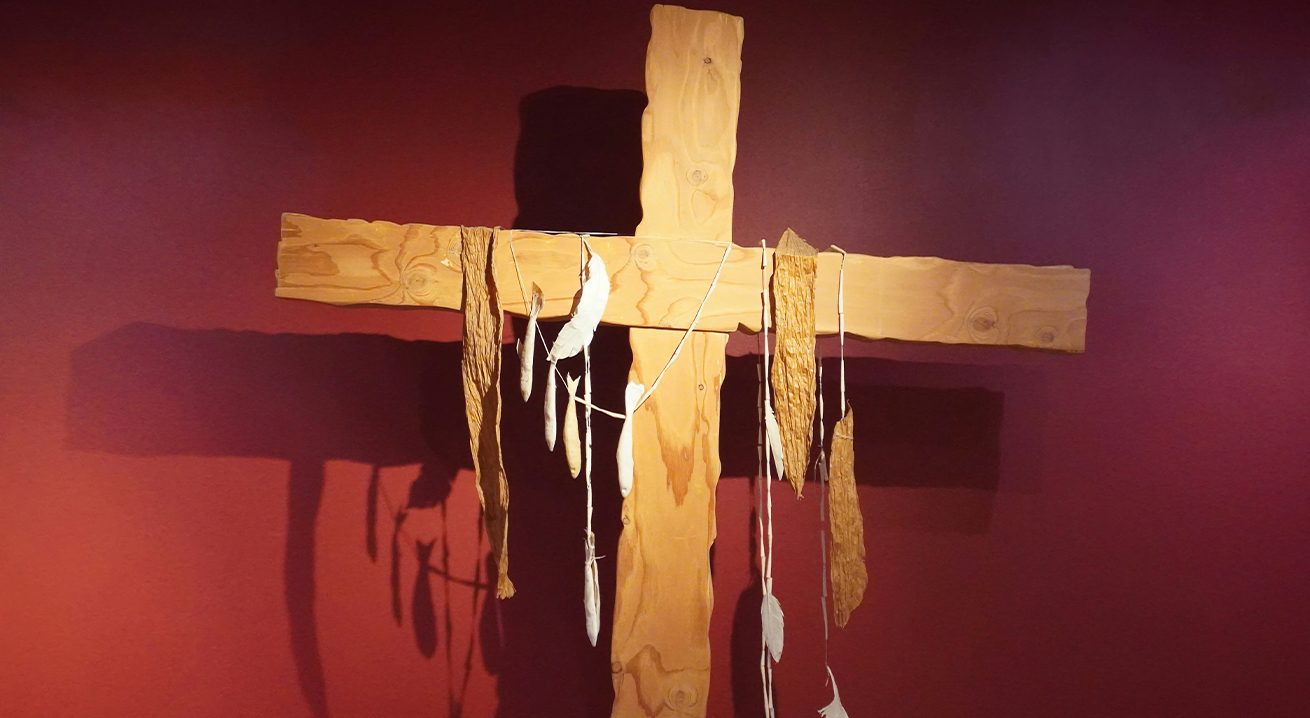
In the process of grappling with my family history, I’ve found the Lutheran theological tradition helpful. Martin Luther’s call for theologians of the cross to “call a thing what it actually is” opens a path for inheritors of white settler history to confess the truth. Such a confession implies seeking out and learning the truth, writing a truer story of oneself and engaging in acts of repair.
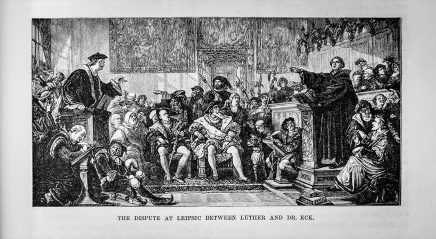
A good place to start is Luther’s famous articulation, in his Heidelberg Disputation (1518), of the difference between theologians of glory and theologians of the cross: “A theologian of glory calls evil good and good evil. The theologian of the cross calls the thing what it actually is.”
To understand how Luther’s claim relates to settler colonialism and postcolonial critique, I turn to Lutheran theologian Vítor Westhelle. He describes a Lutheran theology of the cross not as being about the cross but as being done from the cross.
In his book The Scandalous God: The Use and Abuse of the Cross (Fortress, 2006), Westhelle outlines three positions for theological reflection in relation to the cross: those on the cross, crucified; those nearby who mocked the crucified; and those who fled, only to meet Christ later, as two did on the road to Emmaus.
Vítor Westhelle describes a Lutheran theology of the cross not as being about the cross but as being done from the cross.
The first, Westhelle writes, is the point of view of those who cry from upon crosses even today, such as Native peoples who refuse to call evil good and who name directly the harm done to them. The second position denies this suffering, instead calling evil good. Too often, inheritors of white settler history are in this position, telling their family story without reference to the violent removal of Indigenous peoples from the land their family claimed as their own. But in the third, Westhelle writes, Christ himself can transfigure our sight and help us to see the truth, as happened on the road to Emmaus.
This is the position of transformation, of being converted to see from the cross in solidarity with all who suffer. Many privileged, white Christians like me do not inherently see from the cross—from the point of view of the “crucified people” of this age. Yet when those with privilege listen to and empathize with those who do suffer, they too can join in being theologians of the cross, calling a thing what it actually is and taking steps to repair the causes of the suffering.
I can’t change the story my ancestors told about our pioneer history. But in my life and actions, I can write a new story, one that centers repairing past harm and encourages just actions in new relationships. We are invited to open our hearts, eyes and minds to the conversion Christ offers us, seeing anew from the vantage point of the cross.
Get this column in your inbox: Visit livinglutheran.org/create-account and sign up for the free email digest LL Stories. Receive the digest weekly, biweekly or monthly, and select the categories that interest you. (“Deeper understandings” is a “Theology & Beliefs” column.)