Logout

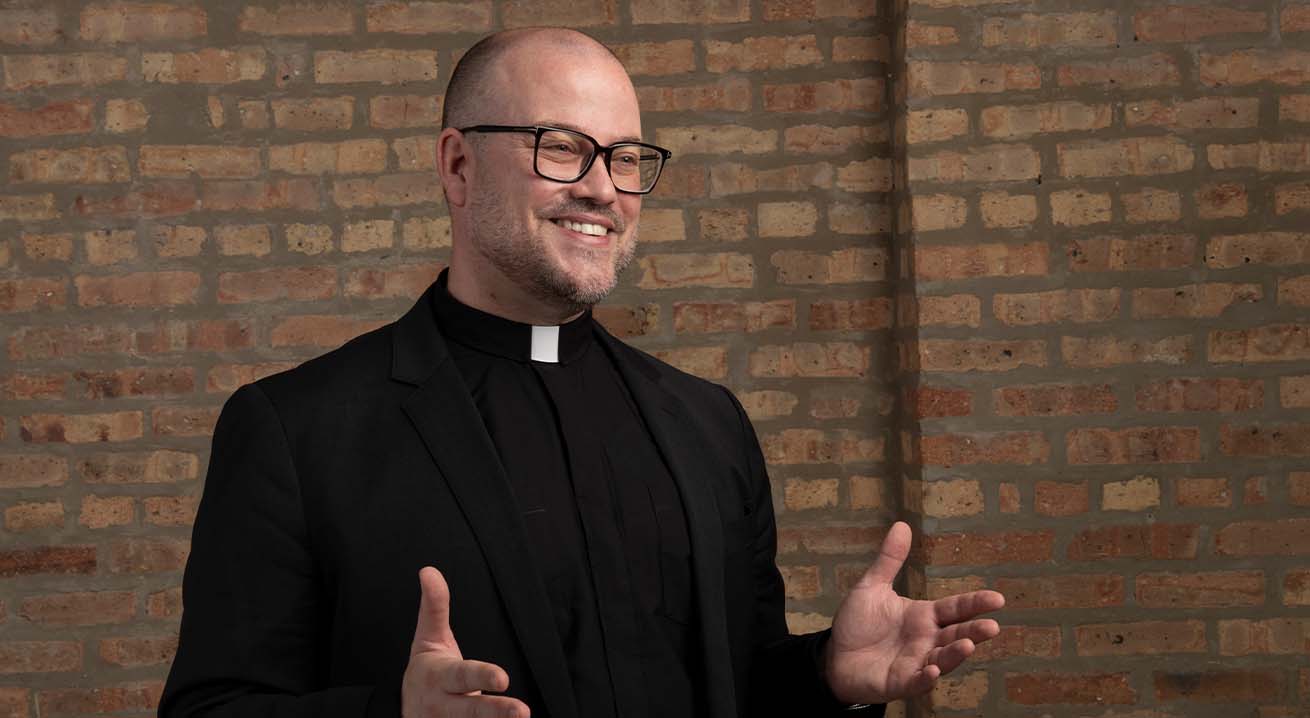
Installed Sept. 19 as bishop of the ELCA Metropolitan Chicago Synod, Erik Christensen believes that the church needs to equip its members to extend invitations to their communities in ways that are mutual, safe and authentic.
Christensen was ordained extra ordinem—outside official church policy–in 2006 and received onto the ELCA roster in 2010 after the 2009 Churchwide Assembly voted to allow partnered LGBTQIA+ ministers onto the roster. He served as pastor of Trinity Lutheran Church in Evanston, Ill., from 2024 until his election as bishop in June. Prior to that, he served as pastor to the community and director of strategic initiatives at the Lutheran School of Theology at Chicago, as pastor of St. Luke Lutheran Church of Logan Square in Chicago and as a community organizer.
He spoke with Living Lutheran about how his experiences—in both his personal life and his ministry—have prepared him to lead the synod.
Living Lutheran: Could you tell us about your vision for the future of synod?
Christensen: The ELCA and many of our full-communion partners are asking questions about what it means to be a connected, interdependent church. All of us are living under an unsustainable myth of self-sufficiency, and it’s not serving our families, our cities or our church. We need to come to a new vision and understanding of what it means to be in mutually dependent and mutually supportive relationships with one another—as family members, as citizens and as the body of Christ.
Within the church, and the synod more specifically, what this always means is working in partnership with congregations and with the churchwide organization to determine where various ministry areas can be most effectively supported.
What do you see as the top priorities for the synod?
We’ll be looking at how best to support and resource ministry with children, youth and young adults, both in those congregational settings where there are already children, youth and young adults who are being well supported by their congregations, and in areas of the synod where they are underrepresented or missing. In every expression of our church—from campus ministries to camp ministries, from congregations to synodical and churchwide ministries—we’re asking the question: How can we develop new relationships with people who we’re not already in a relationship with? How do we move beyond the doors of our various institutions to meet people where they’re at?
We’re living in a moment in which we’re somehow both hyperconnected and extremely isolated. People have devices in their pockets that put the whole world at their fingertips, and they feel lonely. So how do we use the gifts of this moment and its technologies to reach out to people who are experiencing anger, hopelessness and despair at the state of the world around them? How do we invite them into embodied relationship with people with whom they share a neighborhood, a workplace?
One of the great gifts of the church is inviting people into embodied experiences of community that have been challenged by our collective experience of COVID-19. A priority for the synod is, we want to continue to find ways to communicate with and connect with people in their congregations and beyond them. We want to offer an open invitation, both to people who have been lifelong Lutherans and people who are just considering Christianity, to be open to new relationships. We want to equip members of our communities to extend those invitations in ways that are mutual, safe and authentic.
How did you feel when you were elected?
Surprised. Honored. Joyful. I think again about interconnection. I moved to Chicago in 2006 from Atlanta, and I knew one human here. So part of me in that moment was just thinking, “How is it possible that an Iowa boy who went to seminary in Atlanta and moved to Chicago 20 years ago, knowing no one, has been elected bishop of this synod?”
But the church is a place for building community, and I feel grateful that a congregation in the Metro Chicago Synod invited me to become a pastor and to begin the work of pastoral ministry as a redevelopment pastor in a congregation that only had 12 members. From day one, I understood that my job was to meet people that the church didn’t already know. The only path to sustainability and new life was through new relationships with new people, and my conviction is that that’s actually true for all of us, all the time. The only path to sustainable life is through an expanding network of relationships with people we don’t already know, and that is, in fact, what the gospel calls us to.
The only path to sustainable life is through an expanding network of relationships with people we don’t already know, and that is, in fact, what the gospel calls us to.
It was also impossible for me not to remember at the moment of my election that, for the first years of my ministry in Chicago [prior to the 2009 vote], I wasn’t permitted to sit inside the [voter seating area] of synod assemblies. I would come to the assembly as a pastor of one of our congregations, and I had neither voice nor vote.
The truth is, synod assemblies were one of the last places [in the church] that did not feel immediately safe to me. So on the day of my election, part of me was both grappling with and grateful for all the distance we’ve covered. Somehow, in the course of 20 years, I went from being ineligible to attend synod assembly as a voting member to being called as its bishop. It was a lot to hold in tension.
What have you learned in your ministry that you might incorporate into your approach to leading the synod?
Both before I went to seminary and then after seminary—after I was removed from candidacy [prior to the 2009 vote]—I went back to community organizing with and among homeless youth. Part of what that taught me was how to approach strangers and invite conversation. It was my job to go out with two or three other people, walk up to total strangers and find a way to ask, “Are you safe and do you know where your next meal is coming from? Is there anything I can do to help you get what you need tonight?” Having awkward conversations with strangers was a professional skill set for a long time, and it equipped me to hear really hard stories.
It was an education in learning to listen to and receive the stories of hurt that are so common. If we want churches to be safe spaces for people, we need to not only hold out a vision that all are welcome and that we are a safe place, but also develop the capacity to let people tell the truth about the ways that the church has hurt them, so it’s not glossed over or moved too quickly past. I’ve been thinking a lot about not just what we owe to those who have been hurt in the church but the opportunity for reconciliation for those who have been hurt.
We have an unconditional commitment to the gospel, which is God’s promise of love and liberation, especially for those who have been hurt or abandoned. And we can have an unconditional commitment to the gospel and still have humility about our own history of proclaiming it, both in word and in deed. We have an opportunity to enter and remain in relationships, with people of all religious traditions and no tradition at all, that are clear about our grateful response to God’s constant love and liberation.