 Logout
We all know the story of the angel appearing to shepherds on the night Jesus was born. In church, we’ll hear Matthew’s version this year, but many will think of a young boy named Linus standing in an empty auditorium with his trusty blue security blanket, framed by a spotlight as he recites Luke’s version. As the TV special A Charlie Brown Christmas turns 60 this year—and the beloved Peanuts characters turn 75—it’s hard not to finish with “That’s what Christmas is all about, Charlie Brown.”
Whenever I watch this program, I think about two things. First, I wonder what those angels presented to the shepherds when they were “sore afraid.” Second, I wonder what our holiday would look like now if, back in 1965, Linus hadn’t read from the Bible to teach Charlie Brown about the true meaning of Christmas.
It’s an endearing passage from the first Peanuts animation. However, A Charlie Brown Christmas was deemed so bad by its producers and network that even the director, Bill Melendez, mused, “We’ve killed it” (in a bad way) before the special debuted in December 1965. Of course, they were wrong: nearly half of all U.S. households watched A Charlie Brown Christmas that night, and just as many watched it the next year, starting a new tradition for millions. The impact the special had on American culture and the Christmas season expands well beyond making it an annual watch—it’s a Christmas Eve must, right after church—it even changed how people decorated their homes.
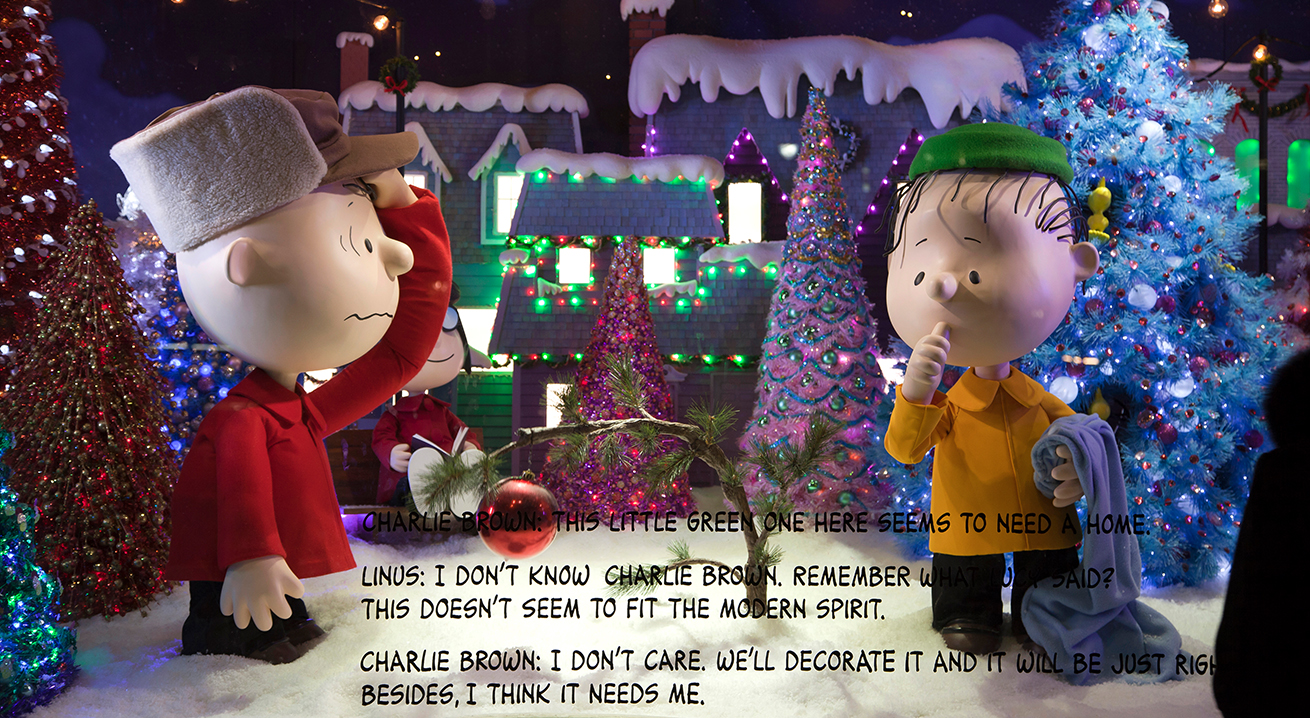
Midway through the special, Charlie Brown and Linus head out to find the perfect Christmas tree. Lucy asks for a pink aluminum one. For most children today, that’s an odd request. Even more peculiar is when Linus and Charlie Brown arrive at the Christmas tree lot and start knocking on options; a hollow sound indicates that they are as fake as the snow falling in El Paso, Texas. Charlie Brown finds a small tree—just a few branches and a handful of pine needles, a couple of which fall every time someone touches the tree. Linus remarks that he didn’t know they still made wooden Christmas trees, closing this strange scene from a time long passed.
What makes this segment so fascinating is that it reflects the United States in the Space Age. People were clamoring for “modern” conveniences—shiny, sleek and minimalist. Even the holiday decorations seemed out of this world. A part of this cultural shift was the aluminum Christmas tree, introduced in 1958.
The aluminum tree is exactly as it sounds: a tree consisting of a metal pole with holes, metal branches that fit into them and strips of aluminum that glisten as they are fluffed out to look like a tree. The metallic sheen is amplified not with lights adorning the silver “leaves” but a color wheel on the ground that spins around, projecting blue, green, yellow and red hues onto the branches to bounce onto the walls and ceiling. Companies such as the Aluminum Specialty Company in Manitowoc, Wis., churned these out, adorning homes across the country and beyond. But once A Charlie Brown Christmas aired, after Linus read Luke’s reading of Jesus’ birth, sales of aluminum trees fell. By the 1970s, people were opting for “wooden” Christmas trees and, later, plastic artificial trees that looked real.
Maybe it’s the enduring power of the Nativity Story or the Scripture being spoken so plainly that it disrupts the commercial cacophony of the holiday season. Whatever the reason, the resurgence in “real” Christmas trees reminds us that, as rapidly as the world evolves around us—amid the Space Age or the AI Revolution—God still chooses to enter the world as a baby, born in the most unremarkable way in the quiet hours of night, when all the world seems still.
Hearing these words, we stand in awe alongside the shepherds as they receive these “good tidings of great joy.” This passage gives us the same hope felt by so many people in ancient Judea: a savior for all people has arrived. When we hear those words, we can join the chorus of angels in singing “glory to God in the highest.”
Because that’s what Christmas is all about, isn’t it?