 Logout
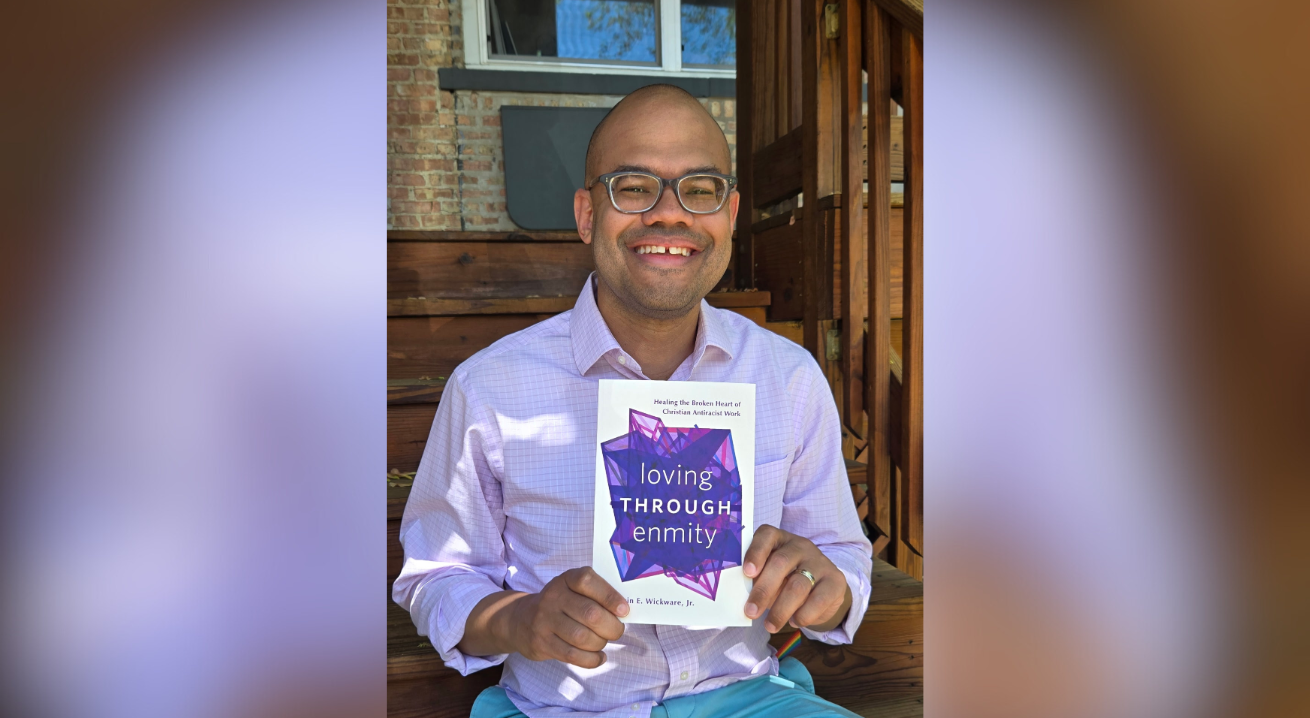
Theologian Marvin E. Wickware Jr.’s research addresses the intersections of identity, emotions, politics and theology. But he came to write Loving Through Enmity: Healing the Broken Heart of Christian Antiracist Work (Fortress Press, 2025) through personal experience.
Wickware is assistant professor of church and society and ethics at the Lutheran School of Theology at Chicago, where he has taught since earning his doctorate in 2018. He was a graduate student when the wheels began turning on the project that became Loving Through Enmity.
“I was in grad school and going to church, both spaces that claimed a commitment to racial reconciliation,” he said. “And I kept finding myself running into white people, specifically, who really couldn’t handle any critique from Black people.”
When Wickware or others attempted to engage in genuine conversations around antiracism with white peers or fellow parishioners, he would often hear back, “Why are you mad at us?” But “that critique really was being offered out of love, out of desire for a better relationship,” he said. “It was frustrating. There was misunderstanding, and I didn’t want there to be.”
That misunderstanding fueled Wickware’s desire to create a resource for guiding meaningful transformation. In Loving Through Enmity, he seeks to clarify the distinction between private and structural enmity. He also observes that Christian antiracist work too often centers on individual slights, struggles and forgiveness.
The book explores embracing our need for those whose interests are structurally opposed to ours under the conditions of white supremacy and how to engage in mutual aid and care.
The other experiences that led Wickware to writing Loving Through Enmity are more deeply rooted. When his mother, who is white, began a relationship with his father, who is Black, her family initially disowned her—especially his grandfather.
“My mom’s father was an amazingly loving grandparent to me—that’s who he was to me the whole time that I knew him,” he said. Wickware only found out about this period later in life. “I was trying to make sense of, how could someone I know who’s capable of love act like this when race gets involved?” he asked. “What’s going on with love that it doesn’t translate once race gets involved?”
In his book, Wickware considers love in terms of God’s power to sustain connection, holy need for relationship with creation and a desire for creaturely thriving.
Such connection is necessary for a deeper, more cooperative love to exist in communities of white and BIPOC (Black, Indigenous, people of color) Christians, he said.
“If we try to love each other but ignore all the ways that we’re working against one another’s interests, we run into those problems and can’t make sense of them in [the] context of a loving relationship, so they can only feel like the breakdown of the relationship,” he said. “The concept of loving through enmity means [acknowledging that] there are these things in our world that drive us to work against one another. … If we can accept that that doesn’t mean we don’t love each other, that our relationship isn’t broken because we’ve been formed differently, we can actually figure out what is a way to love one another.”
Wickware finds that such a reframing can be difficult in congregations where confrontation can be uncomfortable. Understanding what love is isn’t about getting along nicely, making sure we don’t have arguments or ensuring nobody’s complaining, he noted. “It’s to embrace the idea that we need each other,” he said.
“What we each need is to find a way to live together where our interests come together. That’s a completely different thing than I generally encounter in churches, where we just try to downplay the disagreements. When it comes to those structural issues, that’s the kind of enmity that I’m talking about: Taking love seriously means ‘I need you and I need us to be living in the context of a system that doesn’t pit us against each other.’”
He hopes his readers, in ELCA congregations or elsewhere, are “moved to try to love in a new way,” he said. “Do what you need to do sustain one another.”