 Logout
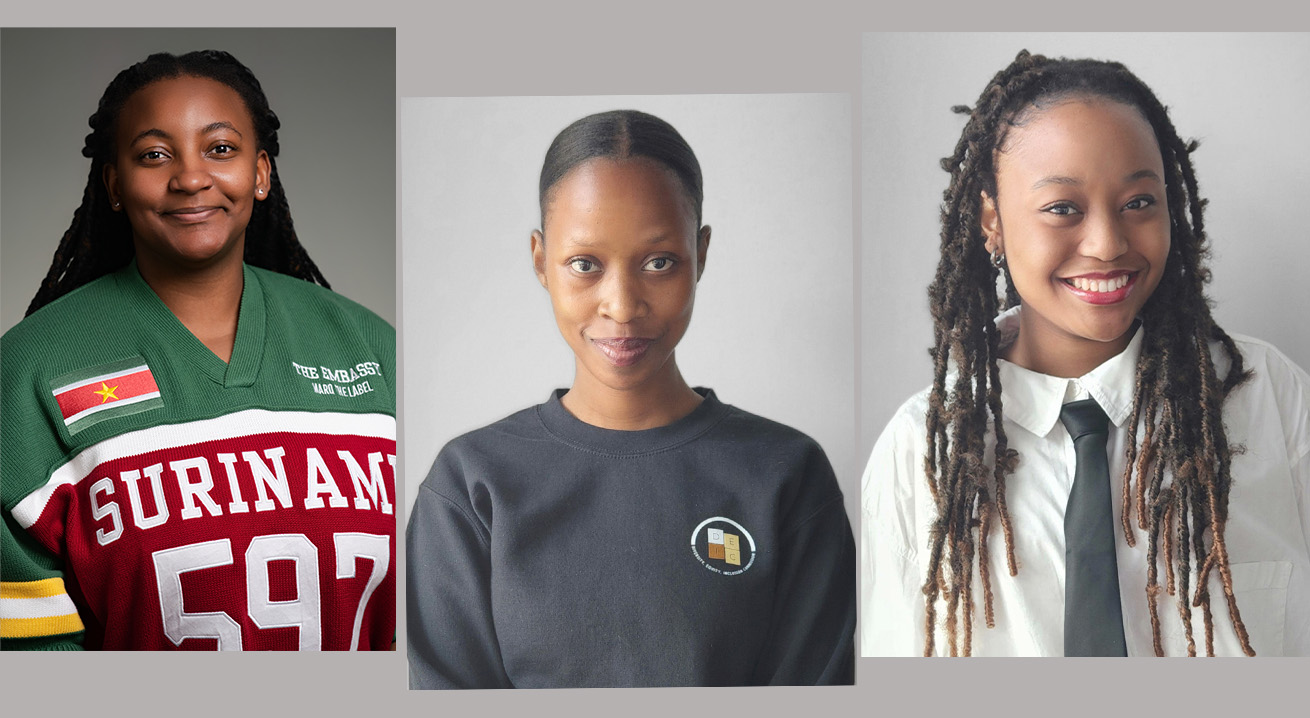
Editor’s note: In this article, three scholars reflect on their experiences with International Women Leaders (IWL). Through this program, students from global companion churches receive scholarships and leadership opportunities at ELCA colleges, seminaries and partner institutions so they can return home and strengthen their churches and communities. The IWL is part of the International Leaders Program.
Allanah Carron, St. Olaf College in Northfield, Minn.
“I’m the first—and the only—Surinamese person to attend St. Olaf,” Carron said. “I’ve been able to teach the community there so much about Suriname and even neighboring countries. It has been impactful for more than just me. I’m beyond grateful.”
In May, over 3,500 miles from home, Carron was also the first person from Suriname to walk across the stage and receive an undergraduate diploma from St. Olaf. She graduated with a double major in quantitative economics and sociology and anthropology, with a minor in international relations.
Carron sees not only the impact her experience had on herself but also on others in Suriname. “I wouldn’t have been able to get this education, let alone all the opportunities that come with it,” she said. “And that’s huge, because this has literally changed the trajectory of not only my life but also the life of my loved ones and the community.”
Carron’s faith has also evolved during her time in the program. “One very important fact that has changed during my journey, my four years, is that I’m viewing God very differently now,” she said. “Now I more look at God as a friend that I can talk to. Things have really shifted for me and have really brought me closer to God instead of looking at God like something that is some entity that’s far away and unreachable.”
Looking toward the future, Carron is weighing a graduate program. Inspired by her studies at St. Olaf, she aims to work at the intersection of nonprofit marketing and sustainability. “I would love to do something along the lines of public policy, something like leadership in the digital era that we live in,” she said.
She is now working with her home congregation on ways to engage youth in the work of the church through social media outreach.
Limakatso “Kat” Ramokoena, Augsburg University in Minneapolis
Growing up, Ramokoena observed firsthand how being a faith leader can strain one’s mental health. Her parents, priests in the Evangelical Lutheran Church in Southern Africa, are anchors in their community, providing support and care for those struggling. Yet they don’t have the same resources for their well-being.
“A lot of people come to pastors for support and hope, but pastors themselves don’t necessarily have those spaces to confide in people,” she said. “It’s not necessarily well spoken of. In fact … a lot of people get ostracized for having mental health issues and not having a good support structure.”
Ramokoena wants to change this. In May she graduated from Augsburg with a Bachelor of Science in biopsychology—“similar to neuroscience,” she said.
She also sees a gap in support for those living in poverty. “Where I’m from in South Africa, we have a lot of impoverished communities that don’t have access to proper healthcare, and there’s even less [support] for mental health,” she said. “I want to make sure that we have those spaces.”
Ramokoena is already speaking with her church’s bishop about a project to address this issue in her community.
“A lot of people come to pastors for support and hope, but pastors themselves don’t necessarily have those spaces to confide in people.”
In addition to her academic growth, Ramokoena has grown spiritually since arriving at Augsburg. “I’ve learned to nourish myself spiritually, even in spaces I’m not familiar with,” she said.
“Finding a church that I could call home was really difficult. Coming from a church where our services can take up to four to six hours and heavily imposed with worship—we’re big on praise and singing—then coming to the U.S., we only sing three or four songs and are here for an hour, then you’re done. I don’t know if that’s nourishing my soul.
“But then I have been able to go to different churches and show how my church does it, and a lot of them recognize they are missing that too.”
Being on her own, she had space to examine her connection with God and her faith, seeing if there are things she wants to change. For example, she found it enlightening to see how others interpret feminism in the Bible.
“Feminism within religion is not [widely] spoken in my community, but I found it’s so empowering here,” she said. “Seeing a bishop that is a woman, I’ve never seen that in my community. But I’ve met one—Bishop Dee [Pederson of the Southwestern Minnesota Synod]. I could see myself within the church and the clergy too. My mom is a priest, but I’ve never seen women in larger leadership.”
To those who made her journey possible, she said, “This opportunity has really impacted my life in the best way possible. It’s made dreams possible that I never thought would come true.
“How empowering that I can tell stories of what the scholarship has done for me to other young women in my community—that upper-level education is possible, regardless of what your background is, regardless of whether you have small dreams or big dreams. You can achieve it. That wouldn’t be possible without these sponsors.”
Sthandiwe Mhlongo, Concordia College in Moorhead, Minn.
Mhlongo sees herself as completely transformed. “It’s not just a degree,” she said. “It’s growth—I’m growth,” she said. “The way I speak, the way I handle myself, everything. It changed most aspects of my life. It’s not just one thing. It’s not just me going to school. It’s my mindset now.”
In May, Mhlongo graduated with a Bachelor of Science degree in psychology. While at Concordia, she participated in a practicum during which she applied what she was learning in the classroom in a hospital setting. There she witnessed many people struggling with mental illnesses, including children as young as 6 years old, as well as the positive impact she can have on them.
The experience changed her perspective and path—she is now determined to continue educating others on the importance of mental health. Returning home to her community in South Africa, she plans to “bring that awareness of taking care of your mental health, taking care of yourself, taking care of your family,” she said. “Ask people how they’re doing—ask people who are always ‘fine.’ Build a community with them.”
How did I get this? It’s something that seems unbelievable still, but it’s been four years. I’ve been here. I’ve navigated through the culture. I’ve learned so many things. It changed so many things about me.”
Throughout this experience her faith has been tested, but she believes it only made it stronger. “Sometimes I’m like, I’ve been praying about this, but I’m not getting any answers,” Mhlongo said. “But then one day you’re in a better place mentally, physically and emotionally. You know that eventually things work out. Whatever happens after this, if I have a problem, I just know it’s going to work out. That’s the amount of faith I have now.”
Mhlongo is already thinking about what’s next for her, including the possibility of pursuing an advanced degree in psychiatry.
Whatever the future holds, she said she is grateful for the opportunity, “because out of everyone … it’s me. How did I get this? It’s something that seems unbelievable still, but it’s been four years. I’ve been here. I’ve navigated through the culture. I’ve learned so many things. It changed so many things about me.”