 Logout
Series editor’s note: The 2026 theme for “Deeper understandings” is faithful witness in challenging times. This year various authors will explore what it means for the ELCA, and each of us as Lutherans, to face the headwinds of societal fracture, loneliness and political contention, and to bear witness to the good news of Jesus Christ that forgives, frees and transforms not only us individually but the whole world. We hope you will be encouraged and empowered to plant your feet firmly on the rock of our faith and speak joyfully and hopefully about the power of the gospel to foster peace and justice in a world desperately in need of both.
—Kristin Johnston Largen, president of Wartburg Theological Seminary, Dubuque, Iowa, on behalf of the ELCA’s seminaries
One can easily get discouraged in these challenging times. In fact, with all that’s going on in the world today, we might feel as if the end times are at hand. However, Christians have expressed some sense of impending collapse for 2,000 years. Is the only difference that now we live in an uberconnected world, overloaded with information and misinformation? There have always been war and violence, power-hungry empires, unbridled greed and corruption, and prejudice and oppression, based on countless factors.
As I write this, there is no apparent end to the Russia-Ukraine war, and the United States has launched a war against Iran. I can take part in peaceful protests, write letters to my elected officials and donate to worthwhile causes, but I still feel helpless to make significant change. It can all seem hopeless.
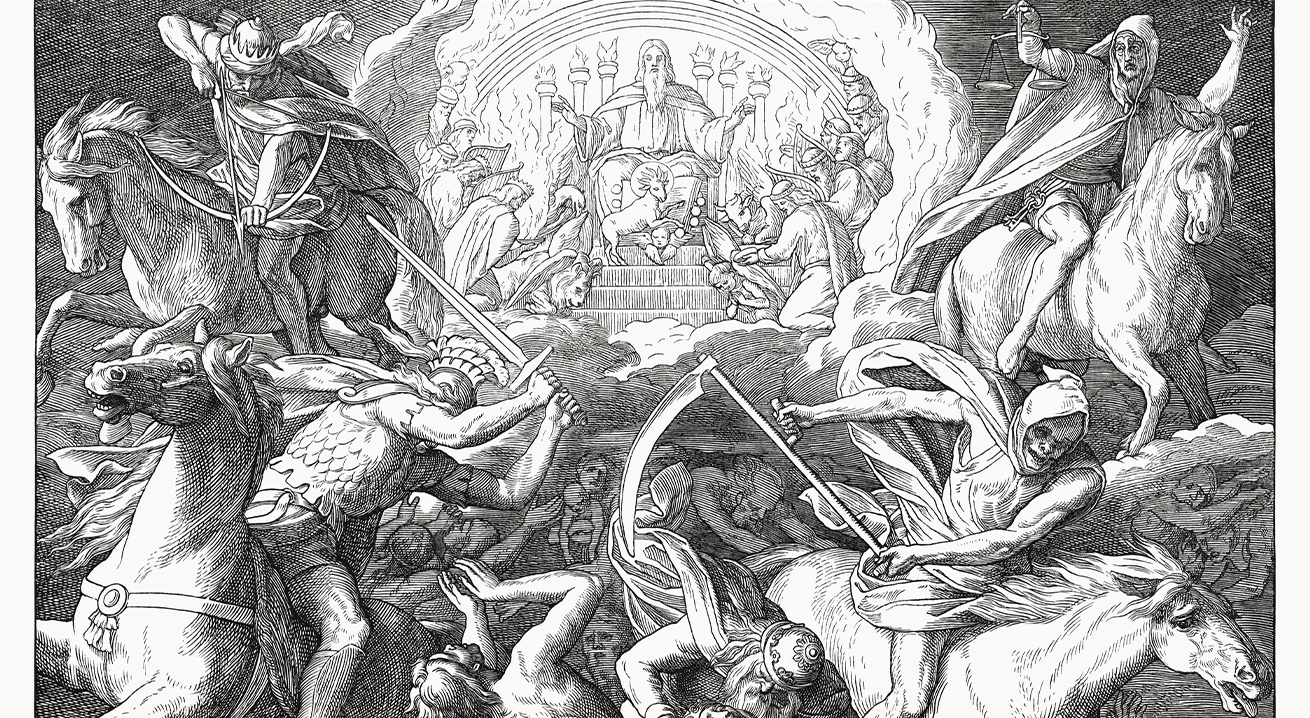
All the chaos swirling around seems a bit like scenarios in the book of Revelation. Martin Luther was somewhat suspicious of Revelation, and even today, Lutherans resist speculating on apocalyptic timelines. Still, Revelation does offer a word of hope that is consistent with a theology of the cross.
Keep in mind that the worldly way of thinking is a theology of glory. It is based on power, wealth and status. It revolves around a zero-sum game where if you’re not winning, you’re losing. A theology of the cross, however, sees things from God’s eternal perspective, and we see most clearly what God is doing in the death and resurrection of Jesus.
Jesus did not come with imposing power or promises of retribution against his foes. Rather, as he says in Mark 10:45, “The Son of Man came not to be served but to serve and to give his life [as] a ransom for many.”
For disciples of Jesus, a willingness to suffer and serve calls for endurance. The book of Revelation gives assurance that those who faithfully endure will experience God’s ultimate victory over all the messed-up, deathly ways of the world. In much the same way, Paul writes in Romans 5:3-5, “We also boast in our afflictions, knowing that affliction produces endurance.” But let’s be clear about the nature of Christian endurance. In the context of Christian faith, endurance is not a passive, helpless waiting but a matter of putting faith into practice.
Even in Revelation, where the battle between good and evil is waged on a cosmic scale, the cries and laments of God’s people are interspersed with their hymns of praise for the revelation and vindication of the Lamb who was slain. So it is for us today. In some ways, we can imagine our own life as a challenging choir practice, preparing us to sing in eternal glory. Yet in addition to our hymn-singing, there are also other tangible ways in which we sing God’s praises. Consider the letter to the church in Thyatira in Revelation 2:19. What does its “hymn” look like? The Son of God declares to them, “I know your works: your love, faith, service, and endurance.”
In the context of Christian faith, endurance is not a passive, helpless waiting but a matter of putting faith into practice.
How can we practice such things when, so often, evil seems to have the upper hand? Only because, as Jesus indicates above, he has served and given his life as a ransom but ultimately has triumphed over the powers of evil. What does this mean?
Before making this statement, Jesus acknowledges that there are rulers and tyrants and “great ones” lording it over the faithful and inflicting suffering. “But,” Jesus says, “it is not so among you; instead, whoever wishes to become great among you must be your servant, and whoever wishes to be first among you must be slave of all” (43-44). Once again, we hear a theology of the cross that shapes our being and actions.
One more thing: some readers may have noticed that, earlier, I didn’t give the full quotation of Romans 5:3-5. After claiming that affliction produces endurance, Paul goes on to say, “Endurance produces character, and character produces hope, and hope does not put us to shame, because God’s love has been poured into our hearts through the Holy Spirit that has been given to us.” In challenging times such as these, we do need hope.
The good news is that our hope is grounded in God’s love for us, demonstrated in the life, death and resurrection of Jesus. What other hope do we have? What other hope do we need? Be encouraged, fellow Christians.
Get this column in your inbox: Visit livinglutheran.org/create-account and sign up for the free email digest LL Stories. Receive the digest weekly, biweekly or monthly, and select the categories that interest you. (“Deeper understandings” is a “Theology & Beliefs” column.)