 Logout
Series editor’s note: The 2026 theme for “Deeper understandings” is faithful witness in challenging times. This year, various authors will explore what it means for the ELCA, and each of us as Lutherans, to face the headwinds of societal fracture, loneliness and political contention, and to bear witness to the good news of Jesus Christ that forgives, frees and transforms not only us individually but the whole world. We hope you will be encouraged and empowered to plant your feet firmly on the rock of our faith and speak joyfully and hopefully about the power of the gospel to foster peace and justice in a world desperately in need of both.
—Kristin Johnston Largen, president of Wartburg Theological Seminary, Dubuque, Iowa, on behalf of the ELCA’s seminaries
The power of the Spirit bears the word to the world amid upheaval by making Christ known. We see this in Scripture and we see it today—in your life, in my life and in the life of the world. This article connects the experience of Judith and Mary with our experience today and invites you to see and experience the places in your life where the power of the Spirit is at work.
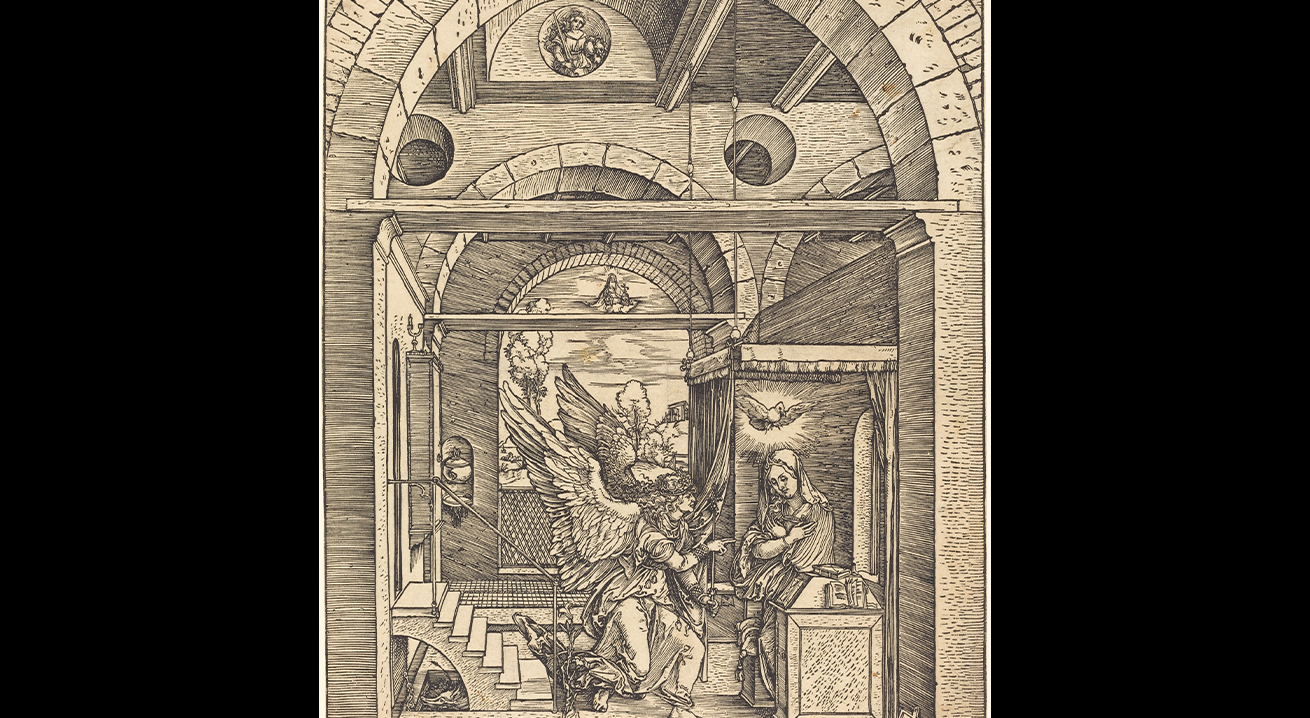
In Albrecht Dürer’s woodcut The Annunciation, a dove above Mary’s head signifies the Spirit, power radiating in all directions. Announcing transformation, the Spirit makes Christ known as the living Word takes flesh in Mary. Jesus becomes incarnate in human history, revealed in time as God with us, Emmanuel.
Dürer showed the Spirit’s power in many ways. Here I focus not only on Mary but also on the unexpected presence of Judith, who is depicted holding the head of the invading Assyrian general Holofernes. At first, her image seems to be a non sequitur. Why is Judith even in this picture? What does her presence signify? Dürer highlighted Judith: she is placed in a rondel in the highest tympanum.
Judith plays a decisive role in the redemption of the people of Bethulia, defeating the invading Assyrian army by infiltrating it, gaining access to Holofernes’ inner circle and slaying him. According to the Cleveland Museum of Art, in Dürer’s day, the detail of Judith would have “held significance for European Christians. … The Old Testament heroine Judith … symbolizes Mary’s victory over the devil.” By including Judith, Dürer invites attention to the parallels between her story and the annunciation, which show God’s powerful action in tumultuous times.
The connection between Judith and Mary
Often that power is manifested through God’s faithful ones. We see them blessed by God and honored by others. We see God attending to those brought low, lives being endangered by God-inspired actions and heavy-handed rulers being challenged.
First, others tell both Judith and Mary that God has blessed them. When Judith returns to Bethulia, Uzziah says, “O daughter, you are blessed by the Most High God above all other women on earth” (Judith 13:18). In Mary’s story, Elizabeth, “filled with the Holy Spirit … exclaimed with a loud cry, ‘Blessed are you among women’” (Luke 1:41-42).
Second, this blessedness is combined with ongoing honor. Uzziah tells Judith, “May God grant this to be a perpetual honor to you” (Judith 13:20). Mary sings, “Surely from now on all generations will call me blessed” (Luke 1:48). In both cases, this honor flows from their God-given roles.
Third, Scripture confirms that God sees and attends to those brought low. Judith recognizes “when our people [were] brought low” as the time of God’s blessing (Judith 13:20). Mary says God “lifted up the lowly” and “filled the hungry” (Luke 1:52-53). Both stories declare God’s care for the vulnerable.
Fourth, both Mary and Judith were endangered by actions aligned with God’s work of lifting the downtrodden and unsettling the lofty. Uzziah tells Judith, “You risked your own life when our people were brought low” (Judith 13:20), and Mary’s life is threatened when her pregnancy throws her engagement with Joseph into uncertainty, risking much in a patriarchal purity culture.
We see God attending to those brought low, lives being endangered by God-inspired actions and heavy-handed rulers being challenged.
Fifth, the reigns of unjust rulers totter when God’s Spirit moves through the people. Judith recounts, “My oppressed people shouted … and the enemy trembled” (Judith 16:11). Mary sings that God “brought down the powerful from their thrones” (Luke 1:52). God’s action in the Spirit can disquiet and even depose those using their positions to harm the vulnerable. In “An Advent Sermon,” Dietrich Bonhoeffer writes:
The song of Mary is the oldest … the most revolutionary Advent hymn that has ever been sung. … [A] hard, strong, relentless hymn about the toppling of the thrones and the humiliation of the lords of this world. … This is the sound of the prophetic women of the Old Testament—Deborah, Judith, Miriam—coming to life in the mouth of Mary. … [She] speaks, by the power of this Spirit, about God’s coming into the world, about the Advent of Jesus Christ.
Bonhoeffer names layers of power at the annunciation: the power of Mary in this “hard, strong, relentless hymn,” the power of evil in the “thrones” and “lords of this world” and, above all, the power of the Spirit, for Mary is “seized by the power of the Holy Spirit,” who speaks through her of the realities Jesus brings—lifting the lowly, unseating the enthroned.
By including Judith, Dürer emphasizes the Spirit’s power (through us and beyond us) to witness in turbulent times. Wherever our Bethulia may be, we live in a time of upheaval, as did Judith—our homes and loved ones threatened by invading dominions.
In such tenuous situations, God historically bodied forth the Word through the power of the Spirit in the lives of Mary and Judith and more. God will do so again. So, we notice signals that God has repeated in every generation: Where is God attending to those brought low? And what dominions opposed to God’s action are threatened even now by the transformative power of the Holy Spirit?
Get this column in your inbox: Visit livinglutheran.org/subscribe and sign up for the free email digest “LL Stories.” Receive the digest weekly, biweekly or monthly, and select the categories that interest you. (“Deeper understandings” is a “Theology & Beliefs” column.)