 Logout

Series editor’s note: The 2026 theme for “Deeper understandings” is faithful witness in challenging times. This year various authors will explore what it means for the ELCA, and each of us as Lutherans, to face the headwinds of societal fracture, loneliness and political contention, and to bear witness to the good news of Jesus Christ that forgives, frees and transforms not only us individually but the whole world. We hope you will be encouraged and empowered to plant your feet firmly on the rock of our faith and speak joyfully and hopefully about the power of the gospel to foster peace and justice in a world desperately in need of both.
—Kristin Johnston Largen, president of Wartburg Theological Seminary, Dubuque, Iowa, on behalf of the ELCA’s seminaries
To bear a child and to bear witness to their life are related but distinct endeavors. I may know something about the weight of water and the pains of birth whereas my sister comes to motherhood through burdens of loss or the sacrifice of another. In all these circumstances, we bear children—we carry, sustain and bring forth another. But to bear witness to a child’s life, to testify to the blazing work of the Spirit in and through them, requires a different kind of will. It necessitates release and an acknowledgment of God’s sustaining presence. It also invites a mother to purposefully sanction—if not, in wisdom, to welcome—the adversity her child will face.
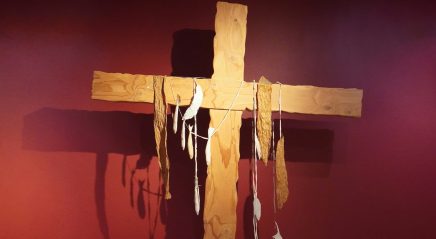
We mothers might be tempted to see our identity and worth as tangled up in the achievements of our children. Likewise, Martin Luther warned how prone all children of God are to cast divine glory as their own. In our sinfulness, we are skilled at claiming the work of God’s hands as fruit of our labor, easily making evil what was intended for good. Perhaps this is why Luther insisted on a theology of the cross, which reminded the 16th-century church—and reminds ours today—that we discern God’s presence most acutely through failure, isolation, despair and uncertainty.
Rather than avoid these harsh realities, our Lutheran faith calls us to testify to the quickening of the Spirit from within them. In community, we lift our chins and look the challenges straight on because hope in Christ has never been a static attribute. Hope is something we do. We bear witness to the good news by resisting the lethargy and resignation that can accompany the latest media cycle and by soberly recognizing what is but should not be. We insist on the truth, and we honor the way its proclamation “re-members” things.
These moments of reckoning birth reconfigure and evoke change on personal and corporate levels alike. The metanoia takes on different forms. For some of us, it looks like lamenting our ancestral participation in unjust systems and finding avenues for repair. For others, it may be courageously testifying to loss and nonetheless remaining in relationship with those who have inflicted harm. No matter one’s position in the pain, we bear witness to the gospel when we call a thing what it is.
Growth from hardship
Some years ago, while researching Christian perspectives on parenthood, I learned about the concept of “antifragility” and the work of mathematician and philosopher Nassim Nicholas Taleb. To be antifragile is to embrace unpredictability and accustom oneself to risk and volatility. Fragile entities—be they people, organisms, systems or organizations—frequently fracture under stress, yet the antifragile thrive under pressure.
Antifragility differs from resilience. A resilient child may remain stalwart in the storming face of affliction but go unchanged by the event; antifragile children adapt and strengthen in adversity. Taleb cites other examples such as the human immune system, political movements and biological evolution. Our bodies more effectively produce antibodies when exposed to foreign antigens. New political ideologies surface to address the failures of old ones. When confronted with food insecurity and an unstable environment during the Pleistocene Epoch, our species mobilized, becoming bipeds with large neocortices and cerebrums. In all, danger is a given and risk inevitable. Growth and innovation emerge from hardship.
I bear witness to God’s action in and through my children. And I marvel.
Amid our daily trials, how can we raise antifragile children? How can our church prepare young people to resist complacency and the lure of compassion fatigue when they’re coming of age during catastrophes? How do we mothers, or anyone providing care and guidance, signal the centrality of lament and the importance of repair?
Social science supports Taleb’s antifragility theory in relation to childhood development and particularly spiritual growth. To inhabit what he calls “discovery” rather than “defense modes,” children need opportunities to think for themselves, make mistakes and experience a spectrum of feelings, including boredom, sadness, loneliness and doubt. Children also benefit from witnessing others’ difficulties and find value in accompanying those who suffer. Because they depend on others, they’re often better equipped than adults to demonstrate compassion.
We live in challenging times. I know well the temptation to shield my young daughters from harm. But by the grace of God, in these very moments, I bear witness to God’s action in and through my children. And I marvel. Often it is they who bear my burden, who remind me of God’s unflinching presence, who sit more comfortably with uncertainty, failure and tears. So, as Jesus pleaded, let the children come. And let us not hinder them with false comfort but instead trust in their inborn capacity to bear witness to the light of Christ.
Get this column in your inbox: Visit livinglutheran.org/create-account and sign up for the free email digest LL Stories. Receive the digest weekly, biweekly or monthly, and select the categories that interest you. (“Deeper understandings” is a “Theology & Beliefs” column.)