 Logout

Editor’s note: Throughout the summer, Living Lutheran is commemorating the 250th anniversary of the adoption of the Declaration of Independence with articles reflecting on the church’s role in civic life and Lutheran contributions to the history of the United States. All articles will carry our America 250 logo.
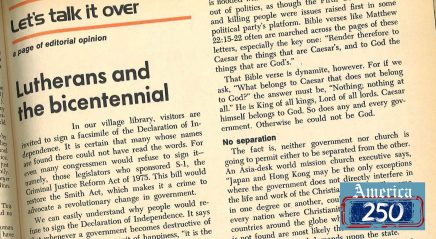
In this reprint from March 17, 1976, we hear from Frederick K. Wentz (1921-2014), an ELCA pastor and seminary professor and president. In 1975, he served as vice chairman of the Lutheran Church in America’s Consulting Committee on the Bicentenary of the United States. In this article, he explores the relationship between two important identities for many Lutheran Americans: being baptized and being American.
I am baptized.” “I am an American.” For the Lutheran citizen of the United States these are two powerful identifications. The one suggests Christian commitment; the other national patriotism. Are they related?
For most of us, both identifications refer to a crucial event at the beginning of our lives. Something happened to us before we knew anything! In “An Order for Affirming Our Life Together in Baptism” adopted by the Lutheran Church in America in 1974, the basic affirmation is this: “We have been baptized ….” Even before that, by virtue of our birth, many of us can affirm: “We have been born American.”
These basic facts of existence for the typical American Lutheran are free gifts and God provided both. First God gave life, then baptism and the proffer of salvation. Birth and rebirth—foundations of our human sense of identity.
Furthermore, both events were fundamentally social acts—gifts of community, ready-made belongingness. Birth provided initiation into God’s human race (as well as into citizenship and a family). Baptism provided initiation into the people of God (the Christian church, the Lutheran Church in America).
These acts were also social because other human beings entered decisively into them. Parents acted to create a baby. Parents, the pastor and perhaps others acted to bring the baby through baptism into the church.
Each act represented the inclusion of the infant into a long-standing covenant that emerged out of God’s action—the civil covenant which grows out of creation (since God made human beings as social creatures) and the baptismal covenant which grows out of God’s promises.
Each of these covenants includes a long and inspired history of human participation, with people responding to God and covenanting with each other under God. And, after their birth and baptism, these new participants learn that only as they, themselves, make appropriate responses can the covenants become fruitful for them. Both God’s giving and the person’s active receiving and responding are ongoing processes. It is this dynamic that leads one to say meaningfully: “I am baptized; I am an American.”
The Lutheran Church in America … is as “old as the American nation and much older than the American republic.”
Are these two affirmations equal? Certainly not. Though persons experience birth first and much of their life is lived together with others in the world, those who are baptized learn to make Jesus Christ the central affirmation. The civil claim becomes secondary. Yet this subordination enhances the meaning of “I am an American.” Properly understood, to say, “I am an American Christian” is the best kind of Americanism.
Clearly, though, both affirmations are enhanced when a healthy tension and a respectful interplay exist between them.
Many clergy are concerned that the two get mixed up. Because these trained leaders teach theology, they tell people about the centrality of baptism and commitment to Christ and warn against excessive or reactionary patriotism. They may imply that patriotism itself is unhealthy.
Actually, many Lutherans do mix the two commitments. In fact, since we all spend six days a week doing things where our national life seems important and religion unimportant, quite a few of us put national loyalty ahead of religion in many daily decisions.
(Here I mean, for example, people who easily shrug off decades of starvation in Bangladesh and near-slavery in Brazil because the military/economic interests of the United States appear to require such starvation and slavery. Or people who assume the moral superiority of Americans in every international clash of interests.)
Most of us feel some tension between our commitment to Christ and our American loyalty. Sometimes it becomes sharp conflict—do we support a stronger American economy at the expense of other national economies? We don’t expect that greater commitment to Christ will resolve these tensions and we don’t want to give patriotism top priority. But we do love our country too.
Research recently discovered that the typical LCAer lives in two worlds—a Sunday world and a Monday world—and doesn’t know how to relate them. The tension won’t go away.
Granted, our weekday world involves a lot more than patriotism—family, jobs, recreation, hobbies. But the most potent symbols of this world appeal to national loyalty—our national anthem, the flag, the pledge of allegiance, the Fourth of July and Memorial Day. The American flag even hangs in many church chancels, and while I think that is not an appropriate practice (because it implies equal loyalty to Christ and to the nation), it does show the strongest social bond we have as a people living in one geographic territory.
One could say that nation-states are becoming obsolete and we should all become citizens of the world. I believe it is better to recognize patriotism as honest and natural. If we subordinate it to our loyalty to Christ it will be a useful sentiment to carry into America’s third century.
“Tribal loyalties” (whether we speak of motherhood or kinship or nationhood) are natural and exclusive (one mother per person, usually one nation per person). They are good, God-given sentiments. But they can also be limiting and dangerous. They are at tension with our loyalty to all of humanity. Furthermore, sin, which twists every loyalty we have, often uses our strong and exclusive loyalties at the expense of our commitment to humanity.
Living the Christian life means loving service to one’s neighbors, both those nearest people who are bound together in patriotic loyalty and those other neighbors who make up the world community.
How do Americans meet people of other nations? As Christians we can be sensitive and open. I once heard a group of German historians decry the absence of anyone like Abraham Lincoln to provide inspiration within their tradition as a nation (not as a German people, of course). It made me grateful for some of the best in my American heritage.
Recently I visited Panama City and heard Panamanians deplore the calloused way in which the American presence in that country—both within the Canal Zone and beyond it—ignored and crushed their national sentiments. That made me ashamed to be an American. The Christian’s national loyalty carries a tension and a desire for improvement. And his patriotism cannot be at the expense of commitment to world fellowship.
But for the Christian, the deeper tension is between tribal sentiments and Christian faithfulness. Jesus did not turn from his mother or his·ethnic group. He did have some sharp things to say about family loyalties, not to deny such sentiments but to assert the priority of the Gospel: “He who loves father or mother more than me is not worthy of me.” How can we handle this tension so that it may become a fruitful interplay, so that tribal loyalties do not threaten our commitment to humanity or our commitment to Jesus Christ?
Our Christian tradition, sharpened by [Martin] Luther, carries a useful distinction. A Christian has a twofold relationship to God, a direct one and an indirect one. In the direct relationship the activity and authority are wholly on the side of God, and the person is wholly dependent upon God and wholly responsible to him. The indirect relation to God is with and through other human beings. Here we initiate action, accept responsibility and exercise authority. The person acts as an instrument of God in conferring good upon one’s fellows and is acted upon for good by others also, as instruments of God.
Patriotism, a limited but powerful loyalty, belongs to the realm of indirect responsibility. We can and should provide God’s blessings to other people through our Americanism. Jesus’ famous saying, “Render unto Caesar the things that are Caesar’s” implies that a person should also serve God in the way one carries out political and ethnic obligations.
Living the Christian life means loving service to one’s neighbors, both those nearest people who are bound together in patriotic loyalty and those other neighbors who make up the world community. Because of Christ and because of our indirect relation to God as Americans we use our patriotism as one aspect of Christian service.
We are free to initiate and take responsible authority. We thank God for his good gift of political life and a rich democratic tradition. We are loyal. But we are free to criticize and to reshape and to work toward more just and humane political agreements.
We are even free under God to pursue civil disobedience—and eventually revolution, if need be—in order to reach political and social goals which seem to us, in conscience and good sense, to be in accord with God’s will. Christians join Carl Schurz [American revolutionary and U.S. senator] in his wise revision of the toast made by [Navy officer] Stephen Decatur: “Our country, right or wrong!” Schurz declared: “Our country, right or wrong! When right, to be kept right; when wrong, to be put right!”
“It is the only nation I have and God put me in it. Thank God (while I roll up my sleeves). I am baptized! I am an American!
Sometimes patriotic sentiments badly need purging. We must try to do that as one aspect of Christian service. But we may find it wiser simply to appeal to a better patriotism.
Suppose you are in the high school auditorium and have just joined in an enthusiastic singing of “God Bless America.” The public has gathered to discuss a hot political issue (like school busing or an increase of utility rates). Then a speaker appeals to “our common hatred of uppity niggers” or “communist-inspired utility management” or utters some other obscenity. You rise to object; it is your Christian duty.
You could object explicitly in the name of Jesus Christ. You would be wiser to object in the name of a better patriotism, calling upon an American tradition such as: fair play, a reasonable consideration of facts, democratic equality before the law, or a commitment to tolerance and justice for all. It even would not hurt to remind that audience that “this nation under God” includes a judgment upon people who hate. That would be a good (and rather powerful) use of patriotism in your Christian service.
For the LCA the time is ripe for a new emphasis upon the meaning of our civic loyalties. Two years ago at the Baltimore convention we put a focus upon our baptismal covenant. Upcoming is the 1976 climax of the U.S. Bicentennial celebrations, which for the LCA as a body will peak at the Boston convention next July. To turn now to bicentennial themes and the civil covenant provides opportunity for a useful relating of the two covenants as a segment of the people of God (the LCA) joins in the national celebration and the nationwide soul-searching.
How do we put our Sunday world and our Monday world together?
Among American Lutherans, LCAers are unique because they represent the Muhlenberg tradition stemming from the colonial era and present at the birth of the nation. Only an LCA historian (Abdel Ross Wentz) could so confidently affirm in the preface of his A Basic History of Lutheranism in America:
The position of the Lutheran Church in America rests upon a birthright. It is not an immigrant church that needed to be naturalized after it was transplanted from some European land. It is as old as the American nation and much older than the American republic … The people in the Lutheran churches of the land are a constituent and typical element of the American nation.
We have a rich, particular heritage and we should have a unique perspective to add to the discussions about patriotism in our day.
“Proclaim liberty,” the theme of the Boston convention, means two things. It means: Let us proclaim God’s direct grace through Jesus Christ which sets us free to be completely dependent upon him. It also means: Let us proclaim liberty as a traditional American ideal toward which we Christian patriots will increasingly strive to draw our national life.
There’s a tension between these two. There should also be an enriching interplay. They’re held together within me. After all, I am baptized, and, I am an American!
“Proclaim liberty” is inadequate, even for a slogan. It should be: Proclaim and strive for liberty and justice for all. Standing alone, “liberty” has been too much abused as an ideal in both the American and the Christian tradition. The ideal of “justice for all” is a strong component in both traditions. It is to this that we need a new commitment. And let’s not forget that ”for all” in both traditions includes the whole of humanity.
Furthermore, Americans desperately need some unifying commitment today. We live in a sharply pluralistic situation, and without an underlying unity, we could easily tear ourselves apart, shattering our nationhood. As a tradition, as an ideal, as a goal, the concepts in “liberty and justice for all” could rally Americans to redefinition and radical recommitment, beginning with bicentennial celebrations.
Yet there’s danger in such a rallying cry. The idea of “liberty and justice for all” may be hopelessly without meaning in our country. The words may even once again be used simply to strengthen the hold of the people in power at the expense of everyone else.
And, Christians can’t expect to gain their point just because what they mean by liberty and justice is related to their faith in God. But since they do think of liberty and justice in terms of God’s will, they could provide that meaning as a part of the broader debate, in the hope that God will (indirectly) bring good out of their efforts.
I don’t agree with Lincoln that America is “the last, best hope of earth.” But it is the only nation I have and God put me in it. Thank God (while I roll up my sleeves). I am baptized! I am an American!