Logout



Editor’s note: One way the ELCA is a connected church is through Lutherans’ shared love of music. As Reformation Day approaches, we’re sharing a series of articles exploring Gen Z’s ties to our historic liturgy and theology; and readers’ reflections on their favorite hymns. Today we are looking at how Martin Luther’s musical influence connected congregations in the past and continues to do so today.
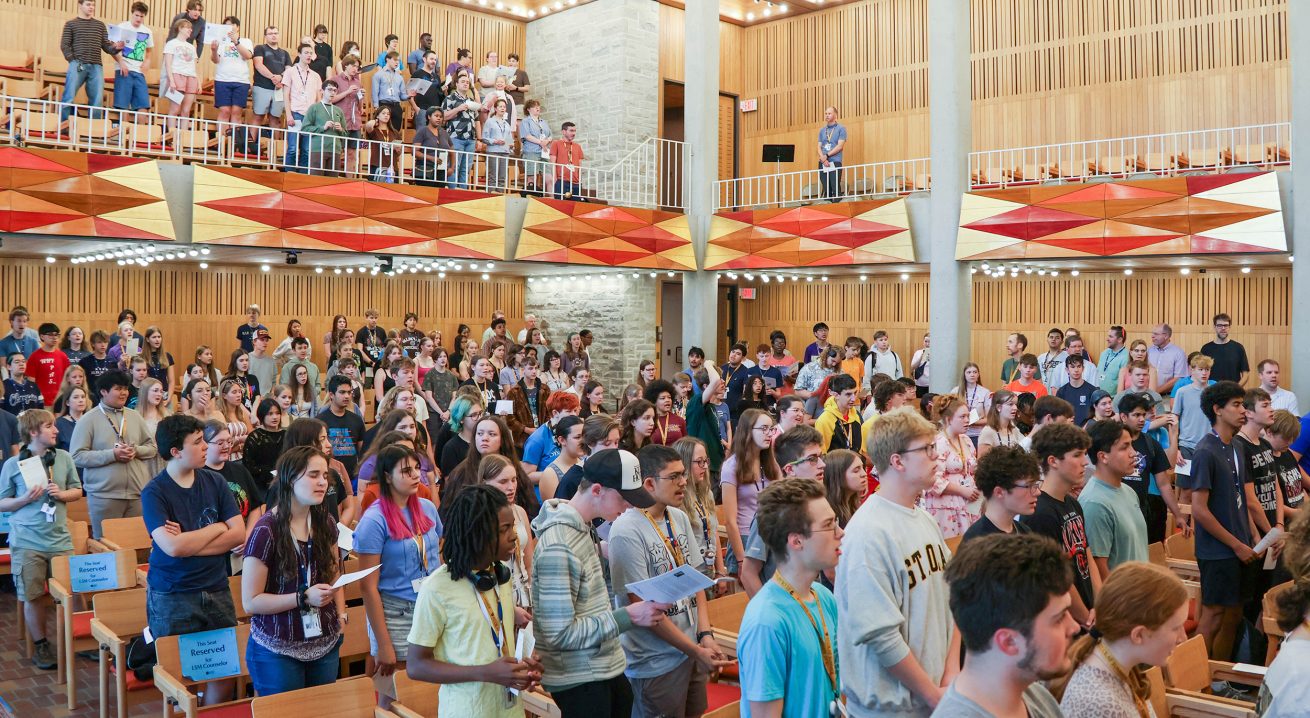
For four weeks each summer, every morning at 8:30 a.m., a chaplain steps before an assembly of high school music students, teachers and teaching assistants, residence counselors and staff during Lutheran Summer Music. As the chaplain gestures an invitation for all to stand, a keyboardist intones a brief introduction. Then the assembly begins singing in four-part harmony, unaccompanied:
I thank you, heavenly Father, through Jesus Christ, your Son, our Lord. You kept me safely through the night, and brought me to the morning light ….
Included in the Small Catechism of 1529, “Luther’s Morning Prayer” probably wasn’t intended to be sung. Yet Carl Schalk’s setting of the text, composed for Lutheran Summer Music in 2009, has become a cherished part of each season’s community and of the thousands of alums who have participated in the program. Through daily repetition, the words and melody become embedded in memory—just as Martin Luther envisioned for many of the chorales that accompanied the teaching of the catechism. The repetition did more than teach; it formed a community through a shared repertoire.
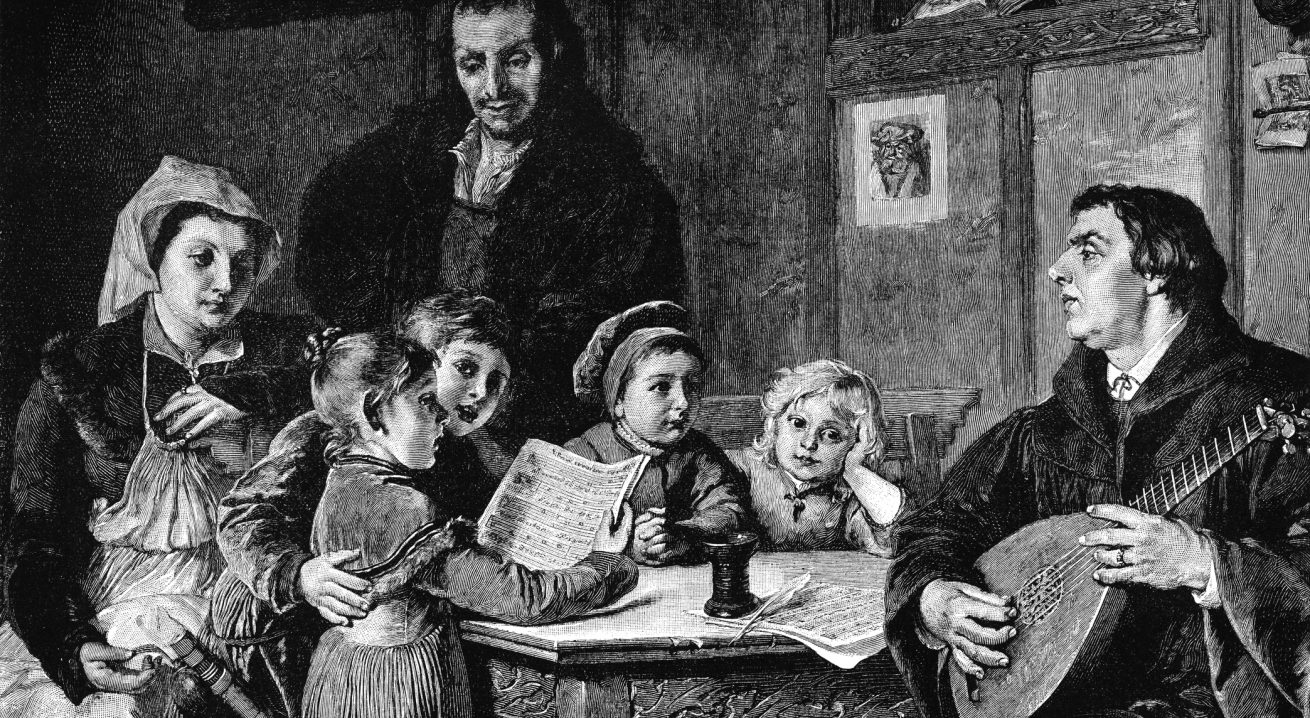
A skilled lutenist with a strong singing voice, Luther instinctively understood music’s power to forge bonds among congregations that embraced the Reformation. Not unlike the protest songs of more recent generations, his hymns created a shared identity by placing the language of faith into the mouths of ordinary people in words they could understand—and ultimately into their hearts and minds.
Though a few of Luther’s hymns, such as “From Heaven Above” (Evangelical Lutheran Worship 268), were perhaps written especially with children in mind, his music was intergenerational. Children sang chorales in school, families sang them at home and congregations sang them in worship. These songs accompanied the rhythms of daily life: morning and evening prayer, meals, festivals, weddings, funerals and countless ordinary moments in between.
Luther’s hymns connected not only Lutheran congregations during the Reformation but also worshipers within the broader tradition of the church. His Advent hymn “Savior of the Nations, Come” (ELW 263) adapts a text written more than a millennium earlier, whereas the melodies of several hymns associated with his works, such as “In the Midst of Earthly Life” (All Creation Sings 1026), derive from ancient Latin hymn and chant traditions.
Even as Luther gave the church new songs in the vernacular, he carefully preserved musical threads that connected 16th-century Christians with generations of believers who had sung before them. He understood that community isn’t sustained by a steady diet of only new musical expressions. Rather it is nourished by a rich feast in which old and new are woven together in service of proclaiming the gospel.
A growing connection
The webs of connection around Luther’s music have continued to grow across the centuries, extending far beyond the walls of the church. Wordless quotations of chorales in the instrumental music of Johann Sebastian Bach and his contemporaries carried with them the texts, theology and memories associated with those melodies, even when no words were sung.
In the 19th century, composers such as Felix Mendelssohn and Giacomo Meyerbeer quoted “A Mighty Fortress Is Our God” (ELW 503-505) to evoke Protestant identity and the legacy of the Reformation.
More recently, composers who don’t necessarily identify with any faith tradition have continued to draw on chorales to suggest communal belief or a sense of the sacred. During the 2017 Reformation anniversary, the National Youth Jazz Orchestra of Germany released an album that reimagined Luther’s chorales in jazz and big-band styles. Artists, including pianist Dave Brubeck, keyboardist Dan Trudell and Swedish organist Gunnar Idenstam, have likewise quoted or evoked chorales in creative ways, extending their reach into new musical communities while preserving their connections to the past.
Those connections have also become increasingly global. Even during Luther’s lifetime, his hymns were translated into Danish, Swedish, Finnish, Dutch, Czech and Polish. In the centuries since, Lutheran hymns—both those by Luther and those from the broader Lutheran tradition—have been translated into languages as diverse as Inuktitut, Quechua, Hmong, Swahili and Malagasy. It’s estimated that “A Mighty Fortress Is Our God” alone can now be sung in more than 200 languages.
In turn, Lutheran congregations from around the world have enriched the church’s song with their own expressions. Hymns and liturgical songs from Africa, Asia, Latin America, the Middle East and Indigenous communities are now voiced alongside Reformation chorales in worship.
While Luther might not recognize every language or musical style, he would surely recognize the purpose: assembly song, carefully crafted and faithfully led, places the gospel on the lips of God’s people. The “heart songs” of many worshipers today transcend many languages, cultures and generations, forming lives of faith in Jesus. These songs echo in the closing lines of “Luther’s Morning Prayer,” which the Lutheran Summer Music community sings every day:
Into your hands I now commend my body and soul until life’s end. Your angel keep me safe from harm until I rest in Jesus’ arm. Amen.
Then, as the Small Catechism instructs us, “Go joyfully to your work, singing a hymn.”
Listen to a recording of Lutheran Summer Music participants singing “Luther’s Morning Prayer” as a group here.