Logout

Series editor’s note: The 2026 theme for “Deeper understandings” is faithful witness in challenging times. This year, various authors will explore what it means for the ELCA, and each of us as Lutherans, to face the headwinds of societal fracture, loneliness and political contention, and to bear witness to the good news of Jesus Christ that forgives, frees and transforms not only us individually but the whole world. We hope you will be encouraged and empowered to plant your feet firmly on the rock of our faith and speak joyfully and hopefully about the power of the gospel to foster peace and justice in a world desperately in need of both.
—Kristin Johnston Largen, president of Wartburg Theological Seminary, Dubuque, Iowa, on behalf of the ELCA’s seminaries
I grew up in the Global South, in the town of Rajahmundry, South India. My Christian faith took shape at home and in church, in the holy Scriptures, Reformation history and Lutheran identity in faith and praxis.
As a young Lutheran, I had to explain why I was a Lutheran and not a Hindu or Muslim—both to my siblings from other Christian traditions and also to friends at school, which gave me a great opportunity to grow deeper in my understandings of God, Christ, Spirit, faith, grace and neighbor from a Lutheran perspective.
As I reflect on the theme of Lutherans bearing witness in challenging times, I look to three important reformers, all of whom give me courage, grace and inspiration to witness my faith in Jesus Christ and to practice my love for my neighbors and all creation.
Along with many other historical leaders who made a difference by standing in solidarity for justice and truth, I lift up Katharina von Bora, one of the mothers of the Reformation—the “runaway nun” and “the Morning Star of Wittenberg,” as her spouse, Martin Luther, called her (as she was an early riser); Philip Melanchthon, a colleague and friend of Luther at the University of Wittenberg and a systematic theologian who prepared the Augsburg Confession and defended the Protestant faith with courage and grace before the Holy Roman Emperor Charles V; and Luther himself, Augustinian monk, university professor, biblical scholar and a reformer of history, culture, tradition and Christian faith.
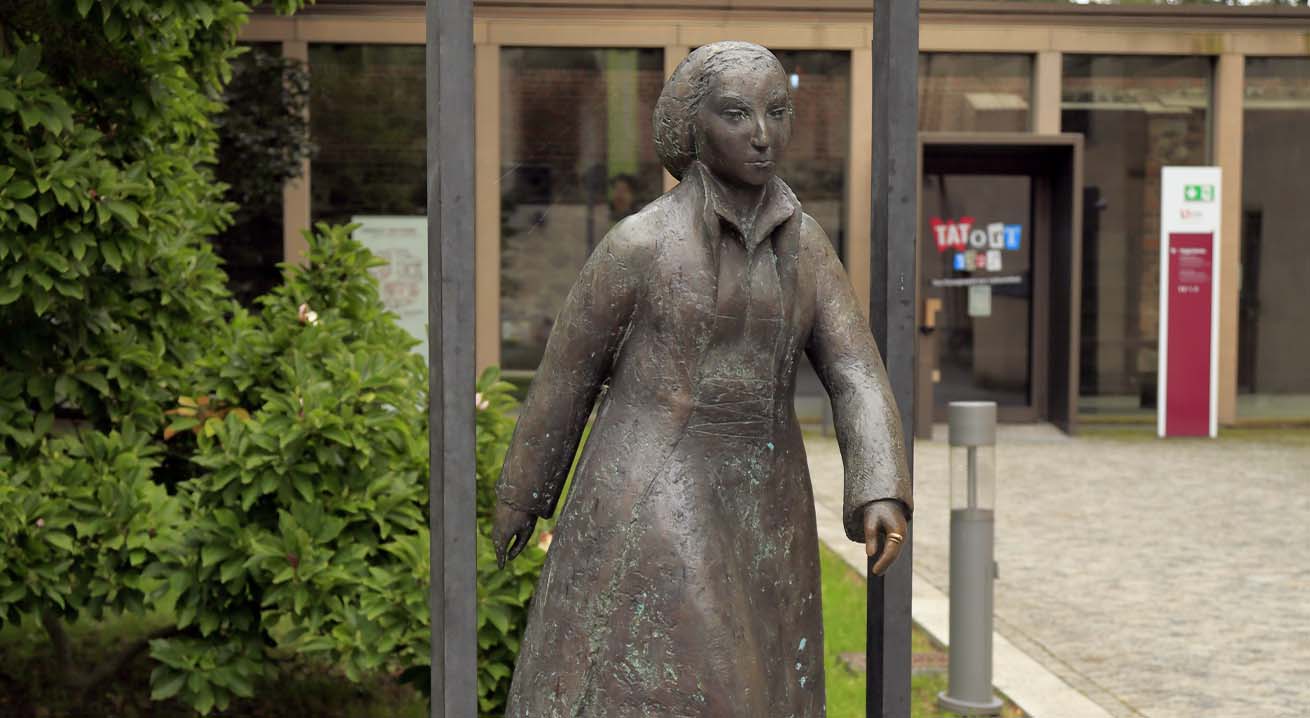
Von Bora was sent by her parents to a nunnery to be educated. Her faithful reflection of Christ, deep dedication to Christian marriage and family, and support of Luther, at home and at work, are an inspiration to me. In November 2024, I had the privilege of participating in the 25th anniversary of the establishment of the ELCA Wittenberg Center in Wittenberg, Germany. When I visited von Bora and Luther’s home, I was drawn to a magnificent bronze statue of von Bora striding out of a doorframe, created by sculptor Nina Koch. It is a powerful display of von Bora’s grace, enthusiasm, courage and determination. She is a great motivation for me in challenging times.
Melanchthon was the architect of the “Lutheran Magna Carta,” the Augsburg Confession, which was presented to Charles V at the Diet of Augsburg on June 25, 1530. In his preface to the Augsburg Confession, Melanchthon, the defender of Protestant faith, reiterated, “To these we declare our continuing adherence, and we shall not be turned aside from our position by these or any following negotiations (unless the matters in dissension are finally heard, amicably weighed, charitably settled, and brought to Christian concord in accordance with Your Imperial Majesty’s summons) as we herewith publicly witness and assert.”
For Lutherans in the Global South, October is a festive month. In Rajahmundry, my faith community had sports, games and celebrations, and presented plays about Reformation history. My father would play Luther, always a major figure in my life.
It is a powerful display of von Bora’s grace, enthusiasm, courage and determination.
Luther’s contribution to biblical commentary became the inspiration for many, including many liberation theologians. However, he was humble in expressing his total dedication to Christ and claiming no credit for his rich contributions. In the preface to his Commentary on Saint Paul’s Epistle to the Galatians (1535), he wrote: “For in my heart there rules this one doctrine, namely, faith in Christ. From it, through it, and to it; all my theological thought flows and returns day and night; yet I am aware that I have grasped of this wisdom in its height, width, and depth as few poor and insignificant first fruits and fragments.”
His theology continues to motivate people all over the world, in part because of his emphasis on the denial of self and total trust in “the steadfast love of God that endures forever”—as he wrote in his Commentary on Psalm 1:18 (1530)—revealed to us through cross and resurrection.
Our faith in God (an “inexhaustible fountain” of love and forgiveness, as Luther wrote in the Large Catechism), our hope in the crucified Christ, and the deeper understanding that comes with the guidance of the Holy Spirit give us the courage, confidence and commitment to bear witness to our faith in challenging times. In his commentary on Psalm 118:17, Luther writes, “The psalmist says of the help: ‘I shall live.’ Isn’t this amazing help? The dying live; the suffering rejoice; the fallen rise, the disgraced are honored. … These are all words that no human heart can comprehend” (Luther’s Works, Vol. 14, p. 86).
Today we have new challenges, including economic inequality, gender inequality, racism, environmental crisis, religious nationalism, rapidly accelerating technology, profit-driven markets, dehumanization and war. The future can seem hopeless. In such times, God the creator, Jesus the redeemer and the Holy Spirit the sustainer continue to give us hope through insignificant people and unexpected events, and we shall march on with the saints toward a future in which God’s justice prevails and hope becomes a reality.