 Logout
Editor’s note: Throughout the summer, Living Lutheran is commemorating the 250th anniversary of the adoption of the Declaration of Independence with articles reflecting on the church’s role in civic life and Lutheran contributions to the history of the United States. All articles carry our America 250 logo.
World War II stands as one of, if not the most, formative 20th-century events. It not only cemented the United States’ place as a global superpower, it also shaped the way Americans continue to see themselves and how they operate in the world.
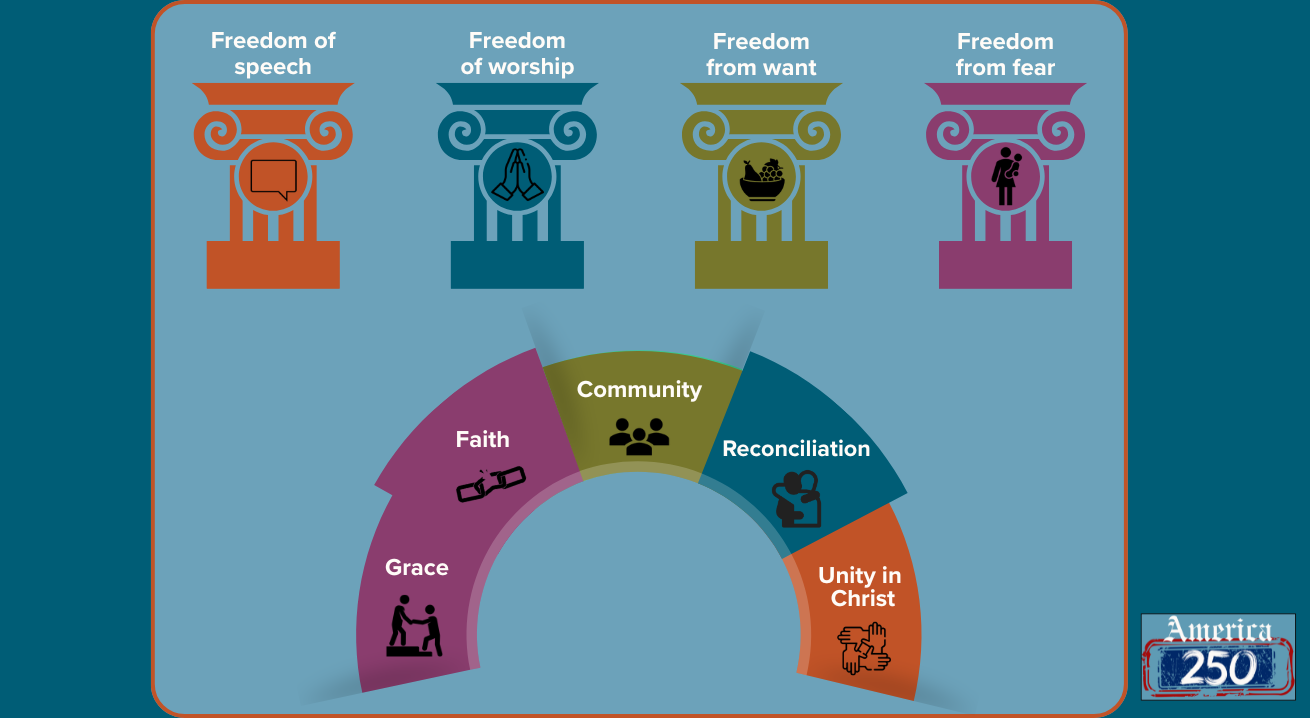
In his Annual Message to Congress on Jan. 6, 1941, President Franklin Delano Roosevelt articulated his vision for the role the United States would play in the seething conflict. According to Roosevelt, the country would strive to uphold “essential human freedoms” that belonged to all people:
- Freedom of speech and expression
- Freedom of worship
- Freedom from want
- Freedom from fear
Pearl Harbor was still almost a year away. Debate raged across the country regarding potential U.S. involvement in the conflict. Isolationist groups such as the America First Committee clamored for the nation to stay out of the war overseas, calling on leaders to “Make AMERICA safe for democracy” in flyers. Moderate interventionist groups such as the Committee to Defend America by Aiding the Allies advocated for financial support of Great Britain’s struggle against Germany without direct involvement. Committee chairman William Allen White drove home the point, declaring, “If I were making a motto for [this] committee, it would be ‘The Yanks Are Not Coming.’” Others fell somewhere along the vast spectrum between isolationism and full military intervention.
However, Roosevelt’s words laid a foundation of self-understanding and American ideals that would persist and grow, brought to life by artist Norman Rockwell in his famous “Four Freedoms” paintings.
Though there may not be a one-to-one correlation between the Four Freedoms and the Lutheran tradition, central pillars of the church echo the sentiments Roosevelt identified as fundamental to being human. When followers of Jesus live out their faith in the communities to which God has called them through their everyday actions for the betterment of those around them, that is the essence of the Christian life.
Freedom of speech and expression: Unity in Christ
“In the future days, which we seek to make secure, we look forward to a world founded upon four essential human freedoms. The first is freedom of speech and expression—everywhere in the world.” —Franklin Roosevelt
Lutherans understand that unity in Christ embraces diversity, reflecting God’s desire for inclusivity. In communion with one another, we become one body, taking on each other’s needs and wounds, trusting God for redemption. Unity doesn’t equal uniformity, but leaves room for safe, fruitful and, at times, conflict-filled conversations that open our ears to the Spirit and ultimately strengthen the community.
- “United with Christ and all believers in baptism, Christians welcome and celebrate their diversity. Because they share common convictions of faith, they are free, indeed obligated, to deliberate together on the challenges they face in the world …. This church is open to learn from the experience, knowledge, and imagination of all people, in order to have the best possible information and understanding of today’s world.
“This church shall seek to be a community where open, passionate, and respectful deliberation on challenging and controversial issues of contemporary society is expected and encouraged.” —“The Church in Society: A Lutheran Perspective” (1991), pages 5, 7-8 - “Because we recognize that every person is one for whom Christ died, this church has a special responsibility to seek to provide safe spaces for challenging conversations. A safe space does not mean a space where all agree. The responsibility for safe space means providing space where all are honored and valued regardless of what they believe. This is true even as worshiping communities disagree or struggle together to discern the common good.” —“Faith and Civic Life: Seeking the Well-being of All” (2025), pages 25.
Freedom of worship: Reconciliation
“The second is freedom of every person to worship God in [their] own way—everywhere in the world.” —Franklin Roosevelt
Reconciliation brings people back into right relationship with God and with each other, repairing the ties once broken by sin. While the world seeks to divide people into categories based on belief, class, culture, race and gender, Lutherans believe that God works—and entrusts his followers to work—to rebuild radically inclusive community, where all belong as God’s children.
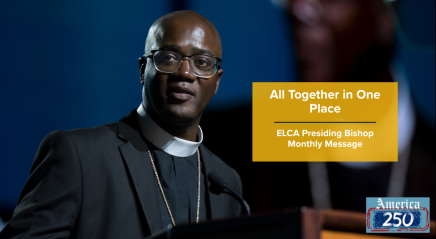
- “Reconciliation involves living in God’s future—including through renewed interreligious relationships. Religious diversity is the reality of the world we live in …. Through encountering neighbors and working side by side in shared commitments to love and compassion and community, our own Christian faith is strengthened …. Like personal friendships we hold, these relationships do not require us to set aside Christian faith. Rather they reaffirm that in a nation as diverse as ours, being a good neighbor across religious differences is not optional. It’s a part of the shared American experience. It is an experience we can support as everyday Lutherans in God’s call to reconciliation.” —Yehiel Curry, presiding bishop of the ELCA, “All Together in one Place: Choosing reconciliation over division in a multifaith America,” July 28, 2026
- “The ELCA will explore and encourage inter-religious friendship, accompaniment, and partnership with all who seek justice, peace, human wholeness, and the well-being of creation” (ELCA Constitution, Chapter 4.03.f). —“A Declaration of Inter-Religious Commitment: A policy statement of the Evangelical Lutheran Church in America” (2019)
Freedom from want: Community
“The third is freedom from want … which will secure to every nation a healthy peacetime life for its inhabitants—everywhere in the world.” —Franklin Roosevelt
Lutherans are called to live as a connected community of word and service, caring for fellow Christians and those in the wider sphere of faithfulness. The faith community participates in civic life to serve the neighbor and work for the common good. The church is woven together for the sake of the world.
- “The Evangelical Lutheran Church in America is called to be a part of the ecumenical Church of Jesus Christ in the context in which God has placed it—a diverse, divided, and threatened global society on a beautiful, fragile planet. In faithfulness to its calling, this church is committed to defend human dignity, to stand with poor and powerless people, to advocate justice, to work for peace, and to care for the earth in the processes and structures of contemporary society.” —”The Church in Society: A Lutheran Perspective” (1991), page 1.
- “God’s people live in the ‘now but not yet’ of God’s reign. … Christians are called to both engage in bringing about a better world and be vigilant in regard to any earthly arrangement. … Christians are simultaneously people of hope and courage, realism and restlessness.” —“Faith and Civic Life: Seeking the Well-being of All” (2025), pages 1-2, 16-17.
Freedom from fear: Grace and faith
“The fourth is freedom from fear … that no nation will be in a position to commit an act of physical aggression against any neighbor—anywhere in the world.” —Franklin Roosevelt
Martin Luther leaned into Ephesians’ teaching that all are saved by grace alone (sola gratia) through faith alone (sola fide) for the sake of Christ alone (solus Christus). Through Christ’s saving death and resurrection, everyone who believes is set free to serve others.
Faith frees Christ-followers from fear, assuring them that they don’t have to carry the weight of the world but can trust in God’s presence and redeeming love. In this freedom, they can boldly advocate for and walk alongside those Jesus calls his disciples to love: the widow, the orphan, the prisoner and the stranger. As Luther put it, “Faith is a living, daring confidence in God’s grace” (Preface to the Epistle of St. Paul to the Romans, 1522).
- “Faith is active in love; love calls for justice in the relationships and structures of society. It is in grateful response to God’s grace in Jesus Christ that this church carries out its responsibility for the well-being of society and the environment.
“Jesus frees Christians to serve others and to walk with people who are hungry, forgotten, oppressed, and despised.
“As a prophetic presence, this church has the obligation to name and denounce the idols before which people bow, to identify the power of sin present in social structures, and to advocate in hope with poor and powerless people. When religious or secular structures, ideologies, or authorities claim to be absolute, this church says, ‘We must obey God rather than any human authority.’ (Acts 5:29).” —”The Church in Society: A Lutheran Perspective” (1991), pages 1-2, 4.
So what?
“Since the beginning of our American history, we have been engaged in change—in a perpetual peaceful revolution—a revolution which goes on steadily, quietly adjusting itself to changing conditions. …. This nation has placed its destiny in the hands and hearts of its millions of free men and women. … Freedom means the supremacy of human rights everywhere. Our support goes to those who struggle to gain those rights or keep them. Our strength is our unity of purpose.” —Franklin Roosevelt
What if American Lutherans oriented their lives as people of faith around these pillars: Grace, faith, community, reconciliation and unity in Christ? How would churches, neighborhoods, towns, the country and the world be different?
“Here I stand; I cannot do otherwise. God help me. Amen.” —Luther, Diet of Worms, April 18, 1521