
 Logout
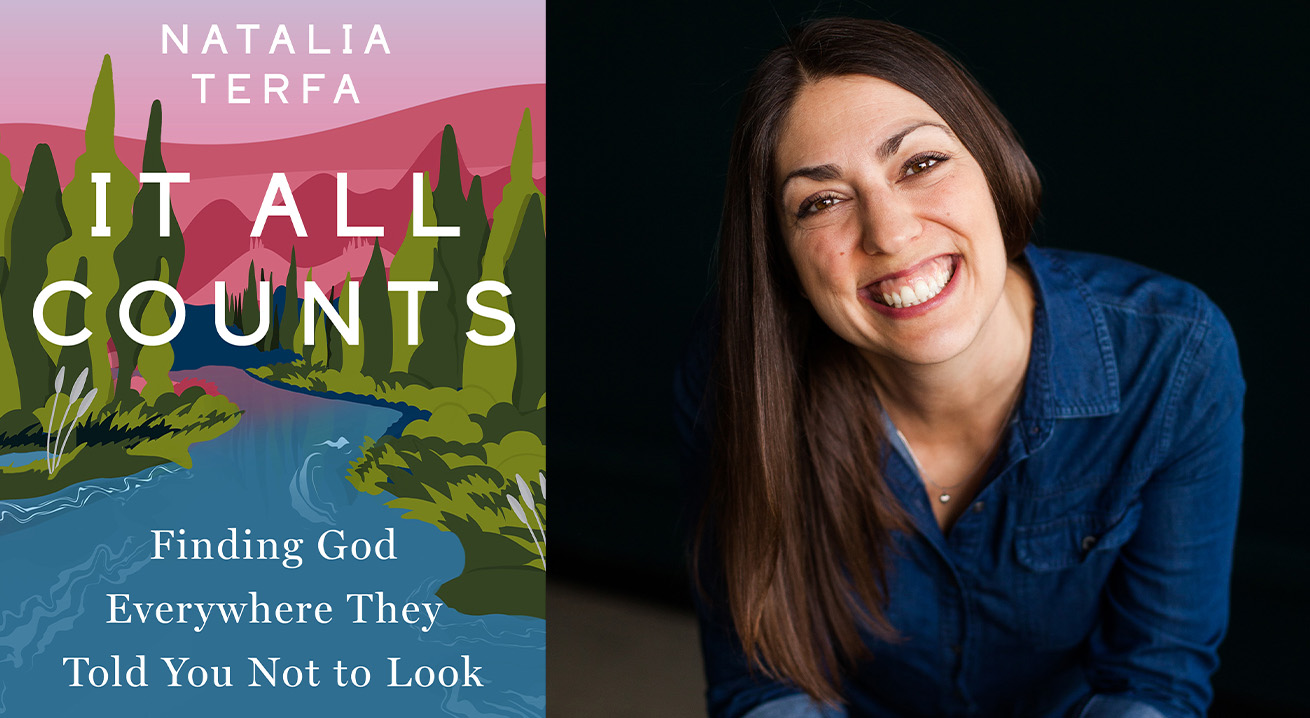
Author and ELCA pastor Natalia Terfa knows what it’s like to find oneself on the outside looking in. Growing up, she had a healthy curiosity that she found wasn’t always welcome at church. The answers she received—or didn’t—to her questions frequently made her feel as if she wasn’t “doing it right” when it came to a life of faith.
Her new book, It All Counts: Finding God Everywhere They Told You Not to Look (Broadleaf, releasing July 21), was written for people who’ve had similar experiences in their faith journeys. For a time, such discouragement eroded Terfa’s connection to the church. “It wasn’t one loss or question, but a series of losses and struggles,” she writes. “Not believing that my questions and doubts were holy, or a part of the process, or even welcome.”
Living Lutheran spoke to Terfa about creating intentional spaces for asking questions and nurturing an expansive view of God.
Living Lutheran: It All Counts addresses how engaging with questions thoughtfully can strengthen faith, as opposed to allowing doubt to grow. Could you tell readers more about that?
Terfa: I grew up Catholic, and questions were really not encouraged in my church, in a way that felt like everybody knew something that I didn’t know. I was supposed to know these things that I didn’t, and as a young person, that ended up being very frustrating, to feel like I was on the outside of some big secret. I was a curious kid and I wanted to ask questions.
My parents were always open to conversation, but it never felt like the church was the place where that happened. Even the way the church was structured—you came, and the priest read the Bible, and they told you what it said, and they sent you off. You didn’t really get a chance to say, “Well, can you answer this question?” So I started feeling like I wasn’t supposed to. But it didn’t stop the questions. The more I talked about that, the more other people [said,] “Yes, I also have that question.” I don’t think I’ve ever asked a question when somebody [said,] “I’ve never thought about that before.” So many people have the same questions, and the more times I’ve opened up spaces or been the person to ask, it’s confirmed to me that questions create a space that is holy, and I want to just sit in that space all the time.
When something doesn’t make sense to someone so they ask a question, and they’re told, “This is how it is” or they’re not given the space to ask the question or to sit with the confusion or the disconnect, that creates distance instead of space—that beautiful space for people to say, “Let’s talk about this and wonder together and talk about how we’ve experienced God or this moment” versus “Don’t ask,” which feels like a stiff arm. You stay far away then, and faith feels unattainable.
What advice do you have for people who want to more thoughtfully discuss questions together in their faith communities?
Faith is supposed to be a place where questions and doubt and curiosity are welcome. It’s all over Scripture. In the stories of Jesus and the disciples, the disciples never knew what was going on.
So make a request—ask. Maybe nobody’s ever asked, “Can we do a faith Q&A one night, Pastor? Can we do a coffee hour where we just sit and ask our theological questions and talk together about it?”
And if your pastor says no, that’s maybe a different conversation. But most of the pastors I know would welcome that kind of theological conversation that they can facilitate and make sure [people are] not going to the internet [instead] or ChatGPT, which is scraping the worst kind of theology off the internet. To have a safe place with people you trust to go to talk through [questions], that feels really holy to me.
In my previous call, we would do a “Questions Sunday” four times a year. Usually we would throw out the sermon and build questions from the room instead, and those were awesome—people always had questions. We never ran out.
How do you hope readers engage with the book?
I think it would be a very interesting study to take a chapter, every week or however long, and have a conversation built around that chapter. … It would be pretty easy to build conversation around each chapter and have spaces where people can share their own stories of when they asked one too many questions. “What was the question that pushed you out? What were the 11 too many questions?” That is a fascinating conversation.
And if there were spaces for people to do that together, it could be really beautiful. I would love to hear stories about that.
What do you hope Lutheran readers, in particular, take away from It All Counts?
There are just too many people out there who are hungry and curious and longing and will never walk into a church building. I want us to be more curious about how we connect with people who may never step into our church. What does that look like? Because it really matters.
How did you decide to write a book on this topic?
A lot of the work I do with Cafeteria Christian connects with people who have been harmed by, or pushed outside of, the church, or haven’t felt like … the church has a space for them in it, or that they’ve asked too many questions and been sent away. All these people who connect with Cafeteria Christian, that’s who I was thinking of when I was sitting down with a friend to talk through this book.
We talked about all of these things that have caused people to feel like they weren’t allowed to be there. So often, somebody has an experience with God or a spiritual moment that they are told isn’t real—and it is very real to them. And that becomes the start of the distance, right? There were so many of those things that I named.
Faith is supposed to be a place where questions and doubt and curiosity are welcome.
That’s kind of how we landed on “What if we just took out all those pieces that felt like walls and barriers and instead said, ‘I want to hear more about this experience of God that you had’? That sounds like nothing I’ve ever heard before. But that doesn’t minimize my experience of God. It just expands more and more.’” I think the more I’ve done that, the more honest my experience has become. It’s been really helpful for me, personally.
You mentioned Cafeteria Christian, the podcast you host with your fellow ELCA pastor Emmy Kegler. Could you tell readers more about the show?
The two pieces that we built the podcast around are openness and curiosity. We just try our hardest to be a place where we’re going to bring up a bunch of stuff and talk about it, and every episode, we encourage people to “take what you like and leave the rest.” We call it Cafeteria Christian because of trying to reclaim the pejorative of that idea a little bit, where people say, “Oh, you’re the cafeteria Christian, you’re just taking the parts you like and leaving the parts you don’t.” I’m like, “Yeah. That’s exactly what I’m doing.” Because not every part of Christianity meets me where I need it to meet me.
There are times where confession and absolution are exactly what I need, and there are times when it is absolutely the wrong thing. There are times when I believe every word of what I say, and there are times when I need other people to say it for me because I just don’t have it.
From the very beginning, that’s what the podcast has been about. We answer listener questions, we talk about current events, we talk about faith, we do Bible study, all sorts of different things, on a rotation. And we’ve been doing it since 2018—a really long time. I’m grateful for the community and the listenership and the people who’ve stuck with us and have encouraged us to keep doing it, because they feel like those spaces are not very common. Though I do feel like there are more than there used to be.
Earlier, you mentioned people turning to ChatGPT for their theological questions. What are your thoughts about how artificial intelligence (AI) is being used for such queries?
The thing that’s dangerous about AI is that when someone goes to AI, they don’t realize that it’s using all of the internet. Every type of religion or spirituality is included in the answer, and some of it might be really theologically harmful.
What I would say to someone is, if you have a pastor that you know and trust, whether they’re your pastor in your neighborhood, in your community, where you attend regularly, or if it’s a pastor online that you know and follow, ask that person. If somebody asks me a theological question, I’ll answer it.
I think it matters to try to find a real person with a theology that connects to you to ask a question, versus an algorithm scraping all the theology conversations from everywhere online, [which can be] really harmful. That makes me scared for people who have taken the risk to ask a question, and they get an answer that is harmful. And it creates more distance, and instead of the generative space that of asking questions in a group of people being, saying “I always wondered that.” That is so life-giving and holy.