 Logout


Series editor’s note: The 2026 theme for “Deeper understandings” is faithful witness in challenging times. This year, various authors will explore what it means for the ELCA, and each of us as Lutherans, to face the headwinds of societal fracture, loneliness and political contention, and to bear witness to the good news of Jesus Christ that forgives, frees and transforms not only us individually but the whole world. We hope you will be encouraged and empowered to plant your feet firmly on the rock of our faith and speak joyfully and hopefully about the power of the gospel to foster peace and justice in a world desperately in need of both.
—Kristin Johnston Largen, president of Wartburg Theological Seminary, Dubuque, Iowa, on behalf of the ELCA’s seminaries
“Look!” a woman near me said. “I see a monarch butterfly!” She sounded delighted and also a bit surprised. I smiled. At that time, I had been noticing signs of fall in my northeast Iowa home: crisp mornings, yellowing soybean fields and numerous monarch sightings, enough to suggest that the fall migration was on. That morning, I was in a hallway at the Mayo Clinic in Rochester, Minn. Large windows gave view to other clinic buildings as well as the plaza, shops and restaurants at street level. The view from the top floors reveals the countryside beyond.
It’s a busy hallway, full of movement and emotion, where patients and their loved ones may be coming or going from appointments at which they learn that their lives will never be the same. Others may be at different points in their health journeys; they could be feeling relief or joy.
Before making the trip to Rochester, I had been thinking about seeing—how our bodies perceive our surroundings—in light of the concept of witness that is part of the theme for this year’s series.
When does seeing become witness?
While I don’t know for certain, the surprise in the woman’s voice suggested that her monarch sighting felt random to her; perhaps she was simply seeing a butterfly. But shared out loud, it became a kind of conversation, however fleeting; her sighting took on a greater meaning and became a moment of witness to challenging journeys.
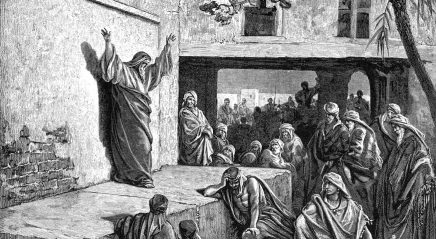
Musings on seeing and witness can’t help but bring us to the prophets of the Hebrew Bible. Seeing takes different forms in the prophetic books. Some prophets, such as Ezekiel, have visions. Others, such as Amos, practice careful observation, bringing their immediate and wider contexts into the same frame. Engaging with these fascinating figures can be difficult; imagery in the prophetic books is often very violent, and their eccentric, symbolic actions—including walking around naked (Isaiah 20:1-4) and hiding underclothes in a crack in a rock (Jeremiah 13:1-7)—make these men tempting to dismiss. However, their insistent and embodied witness to what God wants for God’s people, within their specific challenging times, makes them compelling faith conversation partners for us.
Take Amos for example. He prophesied in the mid-eighth century B.C., when the Assyrians were looming to the north. He seemed cognizant of the brutal war tactics the Assyrians used against populations they conquered; themes of deportation and destruction scratch around the edges of his proclamations to Samaria in the northern kingdom of Israel (Amos 4:2-3, 6:7, 7:17). Yet the Assyrians are not the central theme of the book of Amos. Instead he repeatedly indicts the elites of Samaria for their mistreatment of the poor through corruption, complacency and callousness (4:1-3, 5:10-12, 6:4-7, 8:4-6).
Amos seems to recognize that the injustices he witnessed in Samaria threaten the soul of God’s people and the security of Samaria, and he eloquently makes clear that what God wants for God’s people is justice and righteousness (5:24).
When does seeing become witness?
Other prophets seem to be more directly in conversation with each other. Like Amos, the prophets Isaiah and Micah call for justice and righteousness; it’s in Micah 6:8 that we find the famous verse “He has told you, O mortal, what is good, and what does the Lord require of you but to do justice and to love kindness and to walk humbly with your God?”
Contemporaries each grappled with the existential threat of an Assyrian invasion of Judah. Isaiah, a priest in the Jerusalem temple, urged nonparticipation in military coalitions, based on his confidence that God would protect the city. For him, faith in military alliances was misplaced (Isaiah 28:14-19, 30:1-5, 31). Micah, in a more rural setting about 25 miles away from Jerusalem, excoriated the city’s elites. For him, faith in God’s protection of the city was misplaced as long as injustice prevailed (Micah 3:9-12). Even with similar moral convictions, these prophets remind us that we humans are contextual beings. The biblical editors, by including both texts within the same collection, created a conversation and a moment of witness to multiple perspectives.
Sprinkled throughout the prophetic books are moments when God asks a prophet, “What do you see?” Amos sees a basket of summer fruit (8:2), whereas Jeremiah sees an almond tree branch (1:11). In both instances, God replies with wordplay, connecting with but pointing beyond the object in question, thus relating the object to the challenges of their times.
Reading these passages today, we are reminded that even when we see well, we don’t see fully, and that all times are challenging—perhaps more so if we fail to see the challenge at hand. When we gather in our communities and ask, “What do you see?”—and then listen with the kind of attention and care God shows us—we have the opportunity to bear witness in our own challenging times.
Get this column in your inbox: Visit livinglutheran.org/subscribe and sign up for the free email digest “LL Stories.” Receive the digest weekly, biweekly or monthly, and select the categories that interest you. (“Deeper understandings” is a “Theology & Beliefs” column.)