 Logout

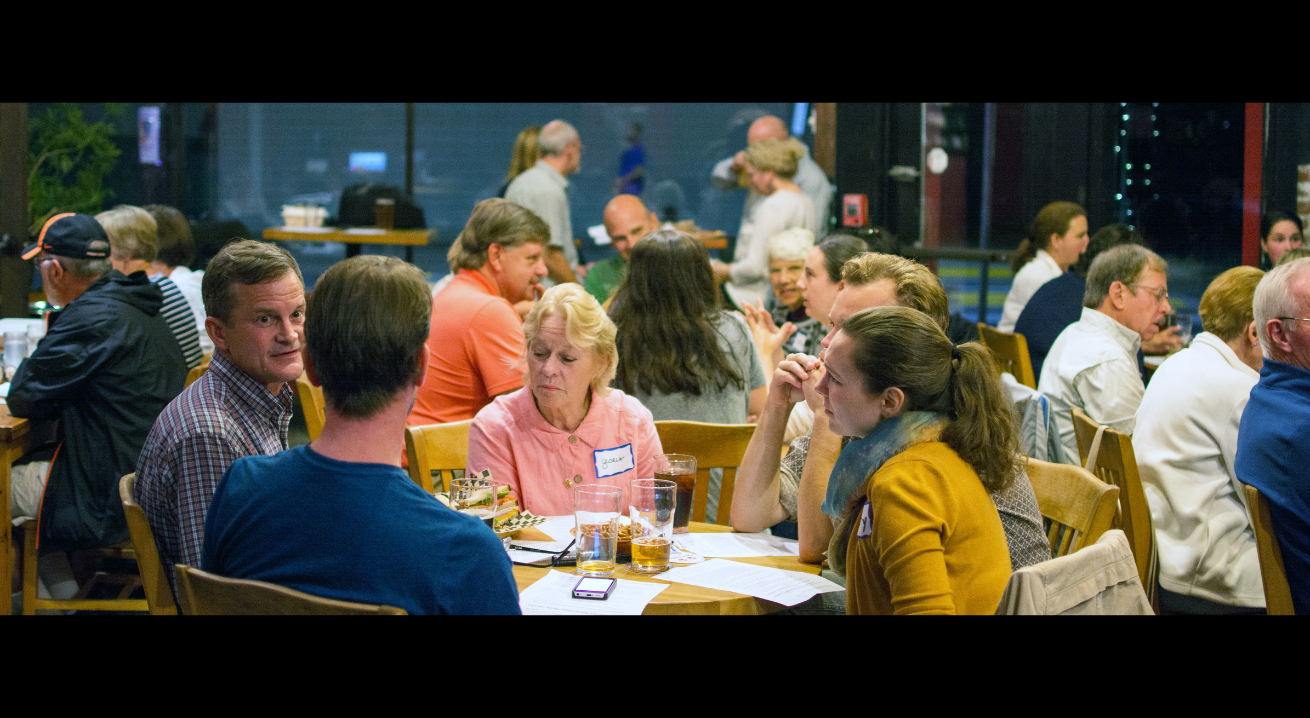


Ben Eisele, a pastor and co-founder of the discussion group Brewed Theology (BT), was leading one of its monthly sessions at a local brewery. His group included several faithful attendees “who would never set foot in a church,” Eisele said. “They probably would have filed themselves as Christian, curious, spiritual [but] not religious.” The evening’s theme was how to die well. “Not a light topic,” Eisele said. BT hosted a panel of hospital ethicists and other experts for the session, sparking conversations on death and dying.
Eisele and the other leaders later discovered that one of the so-called “church-adjacent” attendees, a BT regular, had shared with her table that she had Stage 4 cancer. For Eisele, it was a moment of clarity: the group “had become its own little church. They probably would just call it community, but it was a place [where] they felt safe enough to talk about that and bring that up in a vulnerable way.”
That’s the goal of BT: to create safe spaces for deep, meaningful conversations worth having.
As BT co-founder and retired pastor Peter Braafladt put it, “It’s one more ministry for building Christ’s community.”
Braafladt traces BT’s origins to 2012, when he was serving as pastor of Messiah Lutheran Church in Vancouver, Wash., with his wife, Kathy. That year he visited Gonzaga University in Spokane, Wash., where he saw posters advertising Thursday night “theology on tap” sessions with a campus ministry leader. “It took me right back to my years as a college student at Pacific Lutheran University [in Tacoma, Wash.],” he said. “That’s something I never thought about as actually being doable.” He tried out the concept at a local pub the next year.
“We didn’t know what we were doing, and we hoped that we would get 10 people,” he said. Thirty-six people showed up for that first gathering.
Over the years, the program format has changed, but that first session showed Braafladt “that people would come out on a weeknight to a pub and talk as people who had an association with Jesus.”
Managing the sessions became a regular part of the portfolio for Messiah’s pastoral interns, a role held by Eisele and his wife, Kristen, who now co-pastor Farmington (Minn.) Lutheran Church, as well as Joe Natwick, now pastor of Bethel Lutheran Church in Windsor, Colo.
“There were a lot of parts of the internship that were excellent, but this was the best part,” Natwick said. “This was the most fun and imaginative way of doing ministry … to see that this was possible in the church.” Both Natwick and Ben Eisele wrote session topics during their internships, and the experience followed them as they entered ordained ministry.
The three pastors kept coming back to the idea, asking themselves, “What if this is something valuable that people can use?” What if they could take the process of facilitating meaningful conversation on sometimes-difficult topics and build it out as a public resource available to any interested congregation or community?
Joined by Kathy Braafladt and Kristen Eisele—both of whom brought valuable research, writing and editing skills to the team—they formally launched BT on the content platform Patreon in 2023. The venture expanded quickly and now offers downloadable resource packs on 50 topics, ranging from evergreen subjects (such as how to define church) to issues in the news (such as immigration) and everything in between.
How does Brewed Theology work?
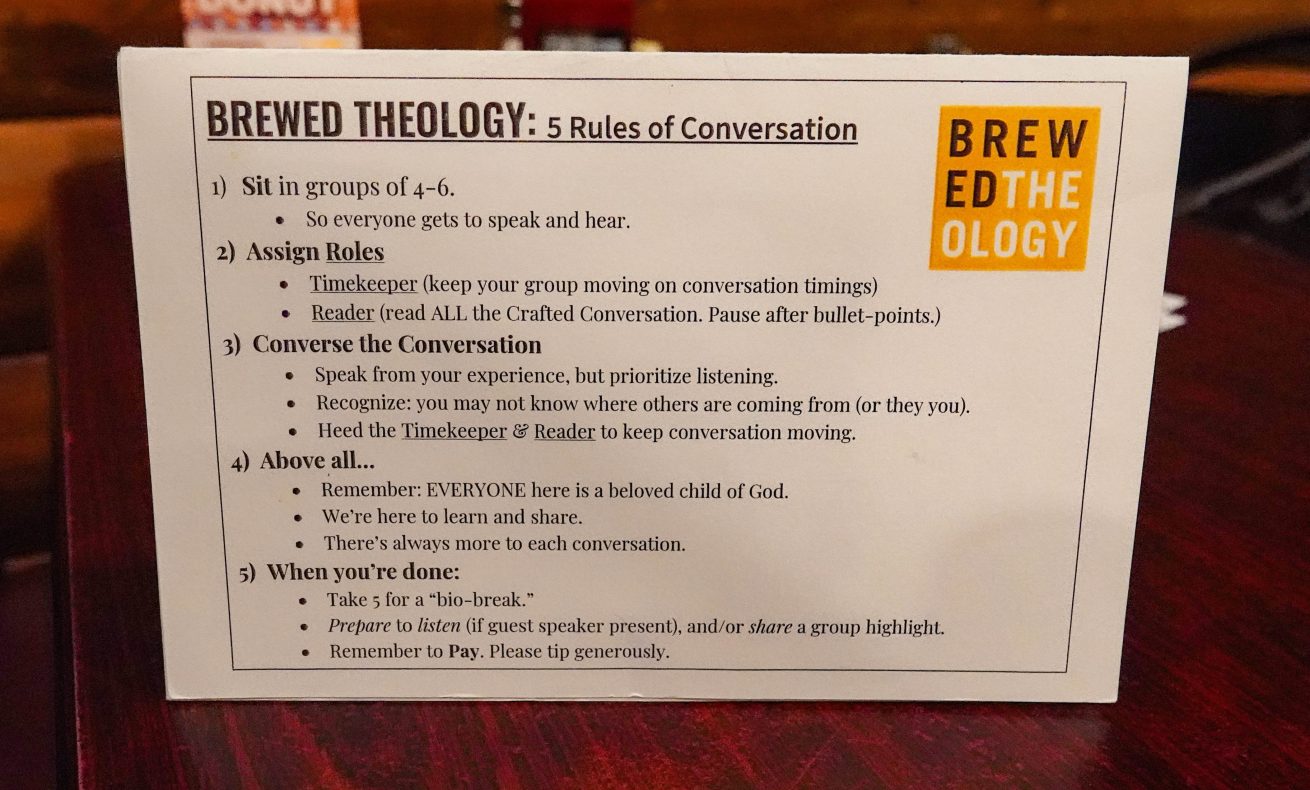
Each 60-minute crafted session, road-tested in the founding pastors’ local contexts, includes a timed and guided conversation with table prompts for three to six people. This format keeps the conversation going and prevents any one person from monopolizing it. Curriculum packs contain leader guides, participant homework and a list of publicly available resources on the topic.
Developing the BT curriculum combines passion, long-term planning, attention to current events and “the gift of the Holy Spirit,” Ben Eisele said. “Sometimes it’s a matter of what the world gives, because it keeps on giving topics of interest that people need a place [for talking] about in a format that facilitates conversation and not argument.”
Eisele and Natwick keep an ear to the ground in their congregations and communities to discern important issues that are emerging, which topics might resonate and what conversations are likely to gain traction. Materials are designed to be accessible to a wide swath of traditions.
“We’ve always come at Brewed Theology topics from a place of trying to meet people where they are,” Natwick said.
That outlook includes approaching a topic from multiple angles to engage as many people as possible. “We try to ask questions that don’t just hit a point we’re trying to make but move around a topic,” Natwick said, “so that people feel like they’re intentionally and faithfully engaging [it] from more than one point of view.”
“There’s certainly not a political agenda,” Eisele explained.
“The agenda is Jesus. The on-ramp is love of neighbor. … How do we build an on-ramp so that we can talk about this across the table with someone who disagrees?
Hungry for discourse
Over the course of BT’s existence, Braafladt, Eisele and Natwick have gleaned valuable insights and witnessed delightful surprises.
From the start, the concept has attracted a multigenerational crowd. “When you start something like this, you think, ‘This is going to be a young-adult thing,’” Natwick said. “We have a guy in his late 80s who comes every single time. He loves it. And we have young people in their 20s who come.”
The co-founders also appreciate how much participants value the sense of safety, civility and community BT creates. People are “hungry … for this kind of discourse in their life,” Natwick said, and they can’t find it anywhere else.
BT has expanded beyond its beer-oriented roots to coffee shops, Sunday school classrooms, adult study groups, Older Wiser Lutherans (or “OWLs”) meetings, home churches, youth groups, confirmation classes, camp staff orientations and synod assemblies.
“That’s the gift of the format—the accessibility,” Eisele said.
That accessibility extends beyond simple ease of use. It encompasses the ability to be emotionally and spiritually vulnerable within a trusted built community. “We learned a while ago that if you put church people into a different context—a coffee shop, a brewery, a restaurant—they’ll talk about things that they won’t often talk about,” he said.
Such accessibility allows the co-founders to fulfill their mission of meeting people where they are—in the “third spaces” where they already gather. Natwick wants to take BT anywhere its mission of building a Christ-centered community can take root.
“How do we welcome people into the church?” Braafladt asked. “Well, the church shows up where they are. The people of Christ show up where they are.”
Eisele sees BT’s mission as facilitating discussion and connection in an age of rising isolation and polarization. “Not talking to each other is really killing us,” he said. “But when you can craft something where people who are on different pages can sit down and have a conversation across the table … that is a ministry.”
Learn more at patreon.com/brewedtheology.